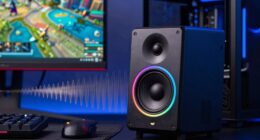
Upfiring speakers boost your Atmos setup by bouncing sound off your ceiling, creating the illusion of overhead effects without actual ceiling speakers. They use angled drivers to reflect high-frequency sound waves upward, simulating height and space in your audio environment. Their effectiveness depends on ceiling height and material, but they offer a simple and flexible way to add immersive dimension to your sound. Explore how this technology works and how to optimize it for your room.
Key Takeaways
- Upfiring speakers bounce sound off the ceiling to create overhead sound effects without installing in-ceiling speakers.
- They emit high-frequency sounds designed to reflect accurately and simulate height in a Dolby Atmos setup.
- Placement and angle are crucial to align reflected sound with the listener’s position for optimal overhead effects.
- Upfiring speakers are easier to install and more flexible than in-ceiling options, fitting on furniture or existing speakers.
- Their effectiveness depends on ceiling height and material, with reflective ceilings providing better overhead sound experience.
Understanding the Concept of Upfiring Technology
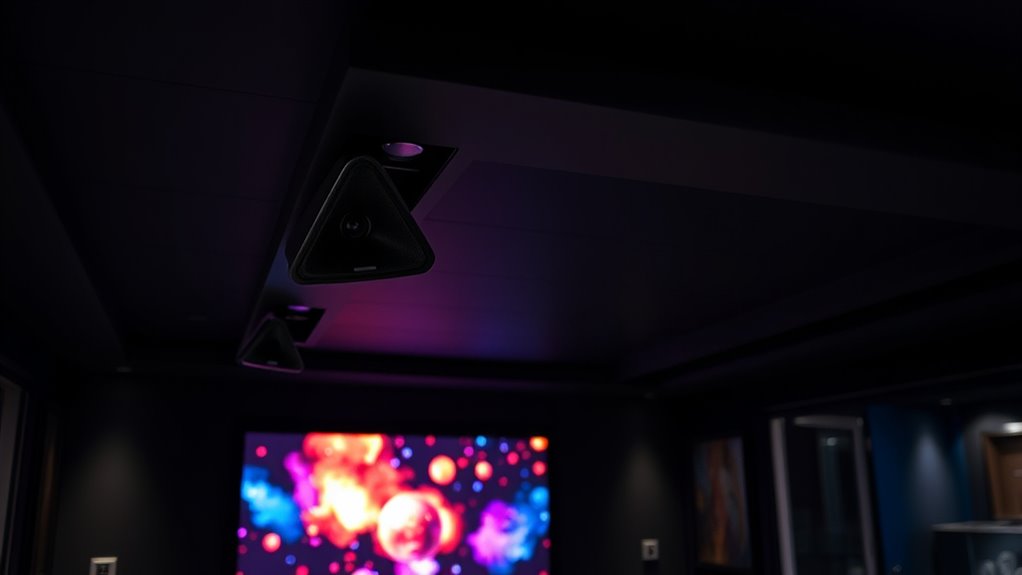
Upfiring technology plays a crucial role in creating immersive audio experiences with Dolby Atmos. It works by bouncing sound off the ceiling, which then reflects toward your ears, simulating sounds coming from above. These speakers are specially designed to project sound upward, even though they are positioned on the floor or mounted on your TV or wall. The technology relies on precise angles and frequencies to guarantee the reflected sound accurately mimics overhead effects. Unlike traditional speakers that focus on front, rear, or side sound, upfiring speakers add a new dimension, delivering a sense of height and space. This enhances your listening experience, making movies, games, and music feel more dynamic and enveloping without needing dedicated ceiling speakers. Moreover, this innovative approach aligns with the European cloud innovation in creating advanced and sustainable audio solutions. Additionally, the effectiveness of upfiring speakers depends heavily on the room’s ceiling height and material, which can influence how well sound reflections occur. Proper room design and placement can significantly improve the performance of upfiring speakers, ensuring a more accurate and immersive soundstage. Understanding how room acoustics and furnishings affect sound reflection can help you fine-tune your setup, especially considering technological advancements that continue to enhance audio clarity and immersion.
How Dolby Atmos Creates Overhead Sound Effects
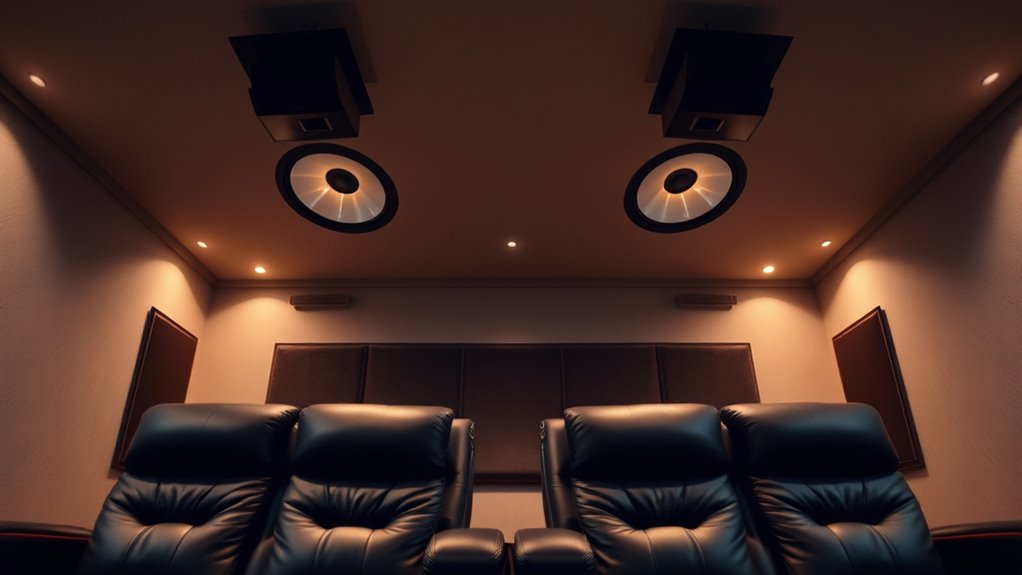
Dolby Atmos creates realistic overhead sound effects by precisely directing audio signals to speakers equipped with specialized technology. This process involves spatially positioning sounds so they appear to come from above, enhancing immersion. The technology uses object-based audio, allowing sound designers to assign specific sounds to defined locations in a three-dimensional space. Your system processes these objects and renders them in real-time, creating a convincing overhead effect. The result is a dynamic soundscape where voices, effects, and music seem to move naturally through the room. This technique works seamlessly with both dedicated overhead speakers and upfiring speakers that bounce sound off the ceiling. As a result, you experience a more enveloping, three-dimensional audio experience that heightens realism and engagement. object-based audio enables this precise placement of sounds, making the experience more immersive.
The Mechanics Behind Upfiring Speakers

Since dedicated overhead speakers aren’t always practical, upfiring speakers offer a clever solution by bouncing sound off your ceiling to create overhead effects. These speakers are designed with angled drivers that emit sound in a specific direction. When you play Dolby Atmos content, the sound waves hit your ceiling and reflect downward, mimicking the sensation of overhead sound. The key is the precise frequency range these speakers produce—usually high frequencies—so the reflected sound remains clear and distinct. The speaker’s angle and placement are essential; they need to be positioned correctly to guarantee the reflected sound aligns with your listening position. Proper speaker placement and calibration are crucial to optimizing the reflected sound experience. This mechanism allows you to experience immersive overhead effects without installing additional in-ceiling or overhead speakers, making Atmos setups more practical and accessible. Additionally, upfiring speakers are often more affordable and easier to install than traditional overhead speakers, broadening their appeal. Advances in speaker technology continue to improve the accuracy and realism of reflected sound, enhancing the overall listening experience. Improved sound reflection techniques also contribute to a more seamless and natural overhead audio sensation. Moreover, ongoing innovations in audio engineering help refine how reflected sound interacts with room acoustics, further elevating the immersive experience.
Comparing Upfiring and In-Ceiling Height Speakers

While both upfiring and in-ceiling height speakers aim to deliver immersive overhead sound, they differ considerably in setup, performance, and flexibility. Upfiring speakers sit on your existing speakers or furniture and bounce sound off the ceiling, making installation straightforward. In contrast, in-ceiling speakers are recessed into your ceiling, requiring more complex installation but offering a cleaner look. Performance-wise, in-ceiling speakers often produce more accurate, consistent overhead effects due to their direct sound projection. Upfiring speakers can sometimes struggle with reflected sound accuracy, especially in rooms with high ceilings. Additionally, installation complexity plays a significant role in choosing between the two options, as it impacts both setup time and long-term maintenance. Considering room acoustics can also influence which type performs better in your space. When planning for immersive audio experiences, understanding how each speaker type interacts with your room’s environment is crucial for optimal sound quality. Moreover, evaluating sound reflection qualities can help determine the best fit for your specific setup.
Evaluating the Benefits and Limitations of Upfiring Speakers
Upfiring speakers offer a convenient way to add height effects to your home theater without extensive installation. They bounce sound off the ceiling, creating a sense of overhead audio. The main benefit is simplicity—you don’t need to install in-ceiling speakers or run extra wiring. Additionally, their performance depends on ceiling height and material, which can limit sound accuracy. Upfiring speakers work best in rooms with reflective ceilings, but may struggle in rooms with textured or low ceilings. Properly managing user privacy and understanding cookie preferences can enhance your browsing experience when researching these products. Understanding the sound reflection properties of your space can help optimize their placement and performance. Being aware of room acoustics can also guide you in achieving the best sound quality from these speakers. To maximize their effectiveness, consider the room’s reflective surfaces and how they influence sound dispersion.
Frequently Asked Questions
How Do Room Acoustics Affect Upfiring Speaker Performance?
Room acoustics markedly influence upfiring speaker performance. If your room has high ceilings, hard surfaces, or lots of reflective materials, sound waves bounce unpredictably, reducing clarity and directionality. Conversely, soft furnishings, carpets, and curtains absorb sound, helping the upward-firing speakers project sound more accurately. To optimize, consider adding rugs or acoustic panels. These adjustments ensure you experience the full immersive effect that upfiring speakers are designed to deliver.
Can Upfiring Speakers Be Customized for Different Room Sizes?
Yes, upfiring speakers can be customized for different room sizes. In fact, larger rooms may require more powerful or multiple speakers to maintain immersive sound quality. You should adjust speaker placement and calibration settings to suit your space, ensuring sound is evenly distributed. Proper tuning can markedly enhance your listening experience, regardless of room dimensions, making your Dolby Atmos setup feel natural and engaging.
Are There Specific Brands Known for the Best Upfiring Technology?
Yes, some brands are known for their premium upfiring technology. Brands like Sony, Denon, and Yamaha consistently deliver high-quality Atmos speakers that produce clear, immersive sound. You’ll want to look for models with advanced drivers and precise calibration features. These brands often incorporate innovative design and technology, ensuring you get the best height effects possible. Investing in reputable brands guarantees a more accurate and enjoyable Dolby Atmos experience in your space.
How Does Speaker Placement Influence the Effectiveness of Height Effects?
You’re on the right track—placement really makes all the difference. To get the best height effects, position your speakers near the ceiling or just above ear level, ensuring they face downward or reflect sound off the ceiling. Keep them spaced evenly for a balanced soundstage. If you don’t, you risk letting the sound fall flat. When set up properly, your system will truly bring movies and music to life.
What Maintenance Is Required for Optimal Upfiring Speaker Performance?
You should regularly dust and clean your upfiring speakers to keep dust and debris from affecting sound quality. Make sure they’re positioned correctly and free from obstructions that might block sound reflection. Check for loose connections or corrosion and replace any damaged parts promptly. Keep the surrounding area dry and at a stable temperature, and periodically test the speakers to confirm they’re producing clear, balanced sound for the best Atmos experience.
Conclusion
Now that you understand how upfiring speakers create that immersive overhead sound, you might wonder if they can truly replace in-ceiling speakers. While they deliver impressive height effects without complex installation, they may not offer the same precision. So, are you ready to enhance your home theater with this innovative technology, or do you prefer a more permanent, integrated solution? Either way, Dolby Atmos height speakers bring a new dimension to your listening experience.