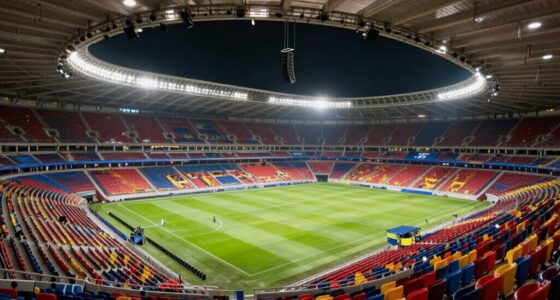
Crowd noise can overpower commentary because it often dominates lower and mid frequencies, drowning out announcers. To fix this quickly, use a narrow-band EQ to reduce these frequencies where crowd sounds are strongest, typically around 200 Hz to 1 kHz. While preserving the lively atmosphere, this adjustment clears up speech and makes commentary more audible. If you want to learn more about balancing audio for a natural, clear broadcast, keep exploring this topic further.
Key Takeaways
- Crowd noise often dominates lower and mid frequencies, masking the announcers’ voices.
- Applying narrow-band EQ cuts in these frequency ranges reduces crowd sound interference.
- Boosting higher frequencies (around 4-8 kHz) helps enhance speech clarity of commentary.
- Selective EQ adjustments maintain a natural, energetic atmosphere without overwhelming speech.
- Combining EQ with compression stabilizes volume levels for clearer, more balanced commentary.

When live sports broadcasts suffer from overwhelming crowd noise or unbalanced commentary, viewers often struggle to follow the game or stay engaged. This issue isn’t just about loud fans; it’s about how the audio mix can drown out commentary, making it hard to catch important play-by-play details. Luckily, a quick EQ fix can dramatically improve the listening experience. By focusing on audio masking and frequency balancing, you can clear up the sound and bring the commentary back into focus. Proper audio mixing techniques are essential to achieving a natural and balanced sound environment.
Audio masking occurs when loud crowd noises cover or obscure the commentary, creating a barrier to understanding. When the crowd gets rowdy, their noise can easily overpower the spoken words, especially if the audio mix isn’t carefully adjusted. To combat this, you need to identify the frequency range where the crowd’s noise is most prominent and reduce it. This process, known as frequency balancing, involves cutting or attenuating certain frequencies to minimize interference without affecting the overall clarity of the commentary. Usually, crowd noise dominates the lower and mid frequencies, so applying a narrow-band EQ cut in these ranges can help suppress the crowd sounds while preserving the intelligibility of the announcers.
However, you don’t want to eliminate the crowd entirely; that would strip away the excitement of the live atmosphere. Instead, aim for a balanced mix where the crowd adds energy without overpowering the commentary. To do this, boost the higher frequencies slightly—around 4 to 8 kHz—where the announcers’ voices reside, which helps make their speech clearer and more prominent. Simultaneously, cut some of the midrange frequencies that carry the bulk of crowd noise. This selective frequency adjustment ensures that the commentary cuts through the din, making it easier for viewers to follow the game in real-time.
It’s also important to consider dynamic processing, like compression, to keep the commentary consistent in volume, preventing sudden jumps that could be startling or distracting. This, combined with precise EQ adjustments, offers a quick yet effective solution to the overpowering crowd noise problem. When done correctly, these tweaks create a more balanced audio environment where the excitement of the crowd complements, rather than competes with, the commentary. As a viewer, you’ll notice a significant improvement—clearer narration, less frustration, and a more immersive viewing experience. With a few simple steps focusing on audio masking and frequency balancing, you can enjoy the game without missing out on essential commentary insights.

MIZISNR Stereo Graphic Equalizer 15-Band EQ for Home Audio System, Rack Mount Dual Channel Pro DJ Equalizer with Subwoofer Output, Noise Reduction (EQX-215S)
- Dual-Channel Stereo Equalizer: High-performance for audiophiles and professionals
- 15-Band Adjustable Control: Customize sound with ±12dB range per band
- Precise Gain and Decay Adjustment: Fine-tune audio with ±6dB to ±12dB flexibility
As an affiliate, we earn on qualifying purchases.
As an affiliate, we earn on qualifying purchases.
Frequently Asked Questions
Can EQ Adjustment Fully Eliminate Crowd Noise?
EQ adjustments can considerably reduce crowd noise, but they can’t fully eliminate it. Spectral masking occurs when crowd noise overlaps with the commentator’s voice, making complete removal difficult. Plus, preserving dynamic range is essential to maintain natural sound quality. You might minimize crowd noise with EQ, but some residual background will likely remain. For a cleaner result, consider combining EQ with other noise reduction techniques.
What EQuipment Is Best for Quick EQ Fixes?
You should use a high-quality digital processor with live sound capabilities for quick EQ fixes. Look for units that offer real-time frequency adjustments and preset options designed for crowd noise suppression. These processors allow you to swiftly target problematic frequencies, making it easier to balance commentary and crowd sounds effectively. Investing in reliable equipment guarantees you can make fast, precise adjustments during live events without sacrificing sound quality.
How Do Different Crowd Environments Affect Audio Clarity?
Imagine each crowd environment as a different landscape shaping your audio journey. In lively venues, the roar of the crowd acts like a thick fog, drowning out clarity and challenging audience engagement. Conversely, in quieter settings, sound flows smoothly like a clear stream. You need to adjust your EQ settings to navigate these acoustic environments, ensuring your commentary remains sharp and engaging regardless of the crowd’s noise level.
Is There a Way to Automate Crowd Noise Suppression?
Yes, you can automate crowd noise suppression using advanced audio software. Automation techniques like dynamic noise gates or sidechain compression help reduce crowd noise during quieter moments, allowing commentary to stand out. You set parameters once, and the software adjusts automatically, providing consistent clarity. This approach saves you time and effort, ensuring your audio remains clear even in unpredictable crowd environments.
How Does Crowd Noise Impact Listener Experience?
Crowd noise can drown out commentary like a thunderstorm, making it hard for you to focus. It impacts your audience engagement by causing frustration and reducing their enjoyment. When crowd noise overwhelms, sound clarity drops sharply, making the broadcast less professional and harder to follow. To keep your listeners tuned in, you need to manage noise levels effectively, ensuring commentary remains clear and engaging despite the lively atmosphere.

MIZISNR 12 Channel Audio Mixer Professional Sound Mixing Board with 99 DSP Effects, 7-band EQ Digital DJ Mixer Console w/USB Bluetooth MP3 for Recording, Independent 48V Power & Mute Button
- 12-Channel Professional Mixer: Versatile audio connections with independent controls
- 99 DSP Effects: Built-in effects for various scenarios
- 7-Band Main Output EQ: Precise sound tuning for main output
As an affiliate, we earn on qualifying purchases.
As an affiliate, we earn on qualifying purchases.
Conclusion
So next time the crowd noise drowns out the commentary, remember there’s a quick EQ fix that can balance things out. It’s like giving your ears a little secret weapon to cut through the chaos. Some say the crowd’s roar is just part of the game, but with a simple adjustment, you get to enjoy the best of both worlds — the excitement and the commentary. Give it a try and hear the game like never before!

Microphone Wind Shield Pop Filter Microphone Isolation Ball, Acoustic Filter for Record Studios Mic, Sound-Absorbing Foam Five-sided Seal Design to Effectively Reduces Noise and Reflections
- Universal Microphone Compatibility: Fits XLR and USB microphones
- Noise Reduction: Reduces plosives and wind interference
- Five-Sided Seal Design: Provides comprehensive noise isolation
As an affiliate, we earn on qualifying purchases.
As an affiliate, we earn on qualifying purchases.

Warm Audio WA-1B Optical Compressor
- Channel: Single-channel tube optical compressor
As an affiliate, we earn on qualifying purchases.
As an affiliate, we earn on qualifying purchases.