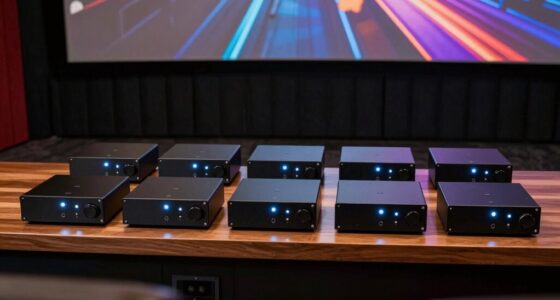
Choosing the best home audio systems depends entirely on your room size and willingness to manage cables. My top overall pick is the Klipsch Reference Dolby Atmos Home Theater System, which delivers dynamic, room-filling sound that soundbars simply cannot match. For those prioritizing convenience, the JBL Bar 800 stands out with its detachable rear speakers, offering a 5.1.2 setup without permanent wiring. The main tradeoff in this category is between acoustic performance and setup simplicity; dedicated receivers and separate speakers require calibration and placement effort but provide superior clarity. Continue reading to see how these fifteen options compare across price, immersion, and ease of installation.

Get audio and creator gear delivered free with Prime
- Fast, free delivery on millions of items
- Prime Video, Amazon Music and more included
- Member-only deals all year
Complete the kit


Key Takeaways
- Dedicated receiver systems like the Klipsch Reference series offer significantly better dynamic range and clarity than any soundbar in this list, but require more complex setup.
- Detachable rear speakers on soundbars like the JBL Bar 800 provide a middle ground, offering true surround sound when needed and simplicity when not.
- Budget options like the Saiyin and ULTIMEA models sacrifice surround immersion for stereo clarity, making them suitable only for smaller rooms or casual viewing.
- Wireless subwoofers are now standard across all price points, eliminating the biggest hurdle to adding bass to living room layouts.
- Receiver-based systems from Onkyo and Yamaha offer superior future-proofing through HDMI 2.1 support and upgradability, unlike integrated soundbars.
| Klipsch Reference Dolby Atmos Home Theater System with Onkyo TX-NR7100 Receiver |  | Best for a Traditional Dolby Atmos Setup | Speaker configuration: 5.1-channel system | Floorstanding speakers: 2 × Klipsch R-625FA with built-in up-firing Dolby Atmos channels | Center speaker: Klipsch R-52C | VIEW LATEST PRICE | See Our Full Breakdown |
| JBL Bar 800 5.1.2-Channel Soundbar with Detachable Surround Speakers and Wireless Subwoofer |  | Best for Wire-Free Surround Placement | Audio channels: 5.1.2 | Total output power: 720 W | Surround sound: Dolby Atmos | VIEW LATEST PRICE | See Our Full Breakdown |
| ULTIMEA 5.1.2-Channel Dolby Atmos Soundbar System |  | Best for Hands-On Sound Customization | Channels: 5.1.2 | Audio technology: Dolby Atmos and SurroundX | Included speakers: Soundbar, 2 rear surround speakers, 5.25-inch wired subwoofer | VIEW LATEST PRICE | See Our Full Breakdown |
| Klipsch Reference 5.2 Home Theater System with Onkyo TX-NR7100 |  | Best for Bass-Forward Home Theater | System configuration: 5.2-channel speaker bundle | Included speakers: 2 R-625FA floorstanding, 1 R-52C center, 2 R-41M bookshelf | Subwoofers: 2 Klipsch R-12SW powered subwoofers | VIEW LATEST PRICE | See Our Full Breakdown |
| Saiyin Soundbar with Subwoofer for TV and PC |  | Best for Simple Stereo TV Audio | Audio output mode: Stereo | Soundbar size: 16.9 inches | Subwoofer diameter: 5 inches | VIEW LATEST PRICE | See Our Full Breakdown |
| Sony HT-S40R 5.1-Channel Home Theater Soundbar System |  | Best for Straightforward 5.1 Surround | Channels: 5.1 | Maximum output power: 600 watts | Connections: HDMI, optical, analog, Bluetooth, USB | VIEW LATEST PRICE | See Our Full Breakdown |
| Sony BRAVIA Theater System 6 5.1-Channel Soundbar with Subwoofer and Rear Speakers |  | Best for BRAVIA TV Owners | Channels: 5.1 | Supported formats: Dolby Atmos, DTS:X | Speaker configuration: Soundbar, two rear speakers, wired subwoofer | VIEW LATEST PRICE | See Our Full Breakdown |
| Klipsch Reference Theater Pack 5.1 Speaker System with Onkyo TX-NR7100 Receiver |  | Best for Receiver-Based Home Theater | Included speaker configuration: 5.1 channels: four satellites, one center speaker, one powered subwoofer | Receiver: Onkyo TX-NR7100, 9.2 channels | Receiver power: 100W per channel at 8 ohms | VIEW LATEST PRICE | See Our Full Breakdown |
| ULTIMEA Aura A40 Pro 7.1-Channel Surround Soundbar System with Subwoofer |  | Best for App-Based Sound Customization | Audio output mode: 7.1-channel surround | Speaker configuration: Soundbar, subwoofer, four surround speakers | Bass response: Down to 45 Hz | VIEW LATEST PRICE | See Our Full Breakdown |
| ULTIMEA Skywave X50 5.1.4-Channel Wireless Surround Sound System with Soundbar and 8-Inch Subwoofer |  | Best for Immersive Dolby Atmos | Channels: 5.1.4 | Peak power: 760W | Wireless transmission: Dual 5GHz | VIEW LATEST PRICE | See Our Full Breakdown |
| Bose SoundTouch 520 Home Theater System |  | Best Legacy Surround System | Audio Output: Surround Sound | Speakers: Five Direct/Reflecting Series II | Subwoofer: Wireless Acoustic Mass Module | VIEW LATEST PRICE | See Our Full Breakdown |
| JBL Bar 700MK2 7.1-Channel Soundbar with Wireless Subwoofer, Dolby Atmos, and Detachable Surround Speakers |  | Best Modular Convenience | Channels: 7.1 | Power: 780 Watts | Subwoofer: 10-inch Wireless | VIEW LATEST PRICE | See Our Full Breakdown |
| ULTIMEA Aura A60 Pro 7.1-Channel Dolby Atmos Soundbar System |  | Best Value for Customization | Channels: 7.1 | Speakers: 4 Surrounds + Soundbar | Subwoofer: 5.25-inch Wired | VIEW LATEST PRICE | See Our Full Breakdown |
| Yamaha YHT-4970U 5.1-Channel Home Theater System with Dolby Atmos and 4K/120, 8K/60 Support |  | Best for Future-Proof Gaming | Receiver: RX300A AV Receiver | Video Support: 4K/120, 8K/60 | HDMI: 2.1, eARC, VRR, ALLM | VIEW LATEST PRICE | See Our Full Breakdown |
| Yamaha YHT-4950U 4K Ultra HD 5.1-Channel Home Theater System with Bluetooth |  | Best Entry-Level Traditional Setup | Channels: 5.1 | Video: 4K/60, Dolby Vision | HDMI Ports: 4 Inputs / 1 Output | VIEW LATEST PRICE | See Our Full Breakdown |
| home audio system | Connectivity |
|---|---|
| Klipsch Reference Dolby Atmos | — |
| JBL Bar 800 5.1.2-Channel Soun | Bluetooth, Ethernet, HDMI, USB, Wi-Fi |
| ULTIMEA 5.1.2-Channel Dolby At | HDMI eARC and Bluetooth 5.4 |
| Klipsch Reference 5.2 Home The | — |
| Saiyin Soundbar with Subwoofer | Bluetooth, optical, auxiliary |
| Sony HT-S40R 5.1-Channel Home | — |
| Sony BRAVIA Theater System 6 5 | Bluetooth |
| Klipsch Reference Theater Pack | HDMI, optical, coaxial, RCA, Wi-Fi, Bluetooth, AirPlay 2, Chromecast built-in |
| ULTIMEA Aura A40 Pro 7.1-Chann | — |
| ULTIMEA Skywave X50 5.1.4-Chan | — |
| Bose SoundTouch 520 Home Theat | Wi-Fi, Bluetooth, 4x HDMI |
| JBL Bar 700MK2 7.1-Channel Sou | HDMI eARC, Wi-Fi, BT |
| ULTIMEA Aura A60 Pro 7.1-Chann | — |
| Yamaha YHT-4970U 5.1-Channel H | — |
| Yamaha YHT-4950U 4K Ultra HD 5 | HDMI, Optical, USB, BT |
More Details on Our Top Picks
Klipsch Reference Dolby Atmos Home Theater System with Onkyo TX-NR7100 Receiver
This bundle suits buyers who want separate speakers, a full-featured receiver, and built-in height channels in one home theater package. The R-625FA floorstanders fire sound upward for Dolby Atmos effects, while dedicated center and surround speakers give dialogue and directional effects their own channels. Compared with the JBL Bar 800, this Klipsch system needs more floor and shelf space, but offers a conventional receiver-and-speaker layout rather than detachable soundbar surrounds. Its 12-inch subwoofer is built for weightier bass than the compact bass unit in the Saiyin system. The tradeoff is setup complexity: overhead effects rely on sound reflecting from the ceiling, so room shape and placement can affect the result. Choose it for a permanent, spacious listening area; skip it if you want a simple, wire-light installation.
Pros:- Built-in up-firing channels add Dolby Atmos height effects without separate ceiling speakers.
- Dedicated center and surround speakers support dialogue clarity and directional sound.
- A powered 12-inch subwoofer is designed to deliver deep, substantial bass.
- Onkyo receiver supports 8K and 4K video and offers room to expand beyond the included speaker layout.
Cons:- Overhead effects depend on ceiling reflections and suitable speaker placement.
- The full system takes considerably more space and setup effort than the JBL Bar 800.
- A receiver, several speakers, and a subwoofer mean multiple cables and power connections.
Best for: Home theater buyers with room for floorstanding speakers who want a receiver-based system with Dolby Atmos height channels and a dedicated center speaker.
Not ideal for: Apartment dwellers or buyers seeking a compact, quick-install system, since this bundle needs multiple speaker positions and ceiling reflections for its height effects.
- Speaker configuration:5.1-channel system
- Floorstanding speakers:2 × Klipsch R-625FA with built-in up-firing Dolby Atmos channels
- Center speaker:Klipsch R-52C
- Surround speakers:2 × Klipsch R-41M bookshelf speakers
- Subwoofer:Klipsch R-12SW powered subwoofer with 12-inch driver
- Receiver:Onkyo TX-NR7100, 9.2-channel
- Receiver power:220 W per channel at 6 ohms
- Video support:8K and 4K
- Streaming:Built-in HEOS
Our verdict“Choose this Klipsch bundle for a spacious, receiver-based Dolby Atmos theater, but pick a soundbar if you value a simpler installation.”
JBL Bar 800 5.1.2-Channel Soundbar with Detachable Surround Speakers and Wireless Subwoofer
The JBL Bar 800 stands out for delivering rear surround channels without running speaker wire across the room. Its detachable, battery-powered surrounds can sit behind the listener during a movie and return to the bar to recharge afterward, a more flexible arrangement than the wired rear speakers in the ULTIMEA 5.1.2 system. The included 10-inch wireless subwoofer adds a dedicated bass source without tying it to the soundbar by cable, and PureVoice targets clearer dialogue. Wi-Fi streaming, app controls, and HDMI eARC make it a capable all-in-one alternative to the larger Klipsch receiver bundles. The compromise is that the main bar still needs corded power, and removable surrounds require charging and repositioning. Atmos and Dolby Vision pass-through also depend on compatible source devices and connections.
Pros:- Detachable battery-powered surround speakers avoid long rear-speaker power and signal cables.
- A 10-inch wireless subwoofer provides a separate bass channel.
- Wi-Fi streaming includes AirPlay, Alexa Multi-Room Music, and Chromecast built-in.
- PureVoice dialogue enhancement and room calibration offer useful setup and listening controls.
Cons:- The main soundbar still requires corded power, and detachable surrounds need charging.
- Dolby Atmos and 4K Dolby Vision pass-through require compatible devices and connections.
- Compared with the Klipsch receiver bundles, it offers less flexibility for building a traditional component-based system.
Best for: TV owners who want Dolby Atmos and rear surround effects but cannot run speaker cables to the back of the room.
Not ideal for: Buyers who want a fully separate receiver-and-speaker system or do not want to recharge and reposition detachable surround speakers.
- Audio channels:5.1.2
- Total output power:720 W
- Surround sound:Dolby Atmos
- Surround speakers:Two detachable, battery-powered speakers
- Subwoofer:10-inch wireless
- Streaming support:AirPlay, Alexa Multi-Room Music, Chromecast built-in
- Connectivity:Bluetooth, Ethernet, HDMI, USB, Wi-Fi
- HDMI:eARC with 4K Dolby Vision pass-through
- Audio features:PureVoice dialogue enhancement and room calibration
Our verdict“Pick the JBL Bar 800 if you want adaptable rear surround sound without speaker wiring, and choose a Klipsch bundle for a more expandable component setup.”
ULTIMEA 5.1.2-Channel Dolby Atmos Soundbar System
For buyers who like tuning sound to their room and preferences, this ULTIMEA system offers unusually detailed app controls for a soundbar package. Its 10-band EQ, 121 presets, and adjustable speaker levels provide more ways to shape playback than the JBL Bar 800’s simpler control approach. Two rear speakers and up-firing drivers create a 5.1.2 layout, while HDMI eARC supports lossless audio transmission from compatible sources. Compared with the receiver-based Klipsch Dolby Atmos bundle, this system takes up less space and is easier to fit around a TV, though its 5.25-inch subwoofer is wired and smaller than the Klipsch’s 12-inch unit. One firm limitation is no DTS support; buyers with DTS sources should choose a system that handles that format or confirm they can output a compatible signal.
Pros:- App provides a 10-band EQ, 121 presets, and adjustable speaker levels for detailed sound tuning.
- Rear speakers and up-firing drivers create a 5.1.2 surround and height-channel layout.
- HDMI eARC supports lossless audio transmission from compatible sources.
- CEC synchronization can coordinate TV and soundbar power, volume, and input.
Cons:- DTS audio is not supported, which limits format compatibility for some media and devices.
- The 5.25-inch subwoofer is wired, unlike the wireless subwoofer in the JBL Bar 800.
- A wired rear-speaker setup still requires planning for cable placement.
Best for: TV owners who want a compact Atmos soundbar package and enjoy adjusting EQ, sound presets, and individual speaker levels through an app.
Not ideal for: Listeners with DTS-based media or anyone who needs a wireless subwoofer, since DTS is unsupported and the included subwoofer is wired.
- Channels:5.1.2
- Audio technology:Dolby Atmos and SurroundX
- Included speakers:Soundbar, 2 rear surround speakers, 5.25-inch wired subwoofer
- Connectivity:HDMI eARC and Bluetooth 5.4
- App controls:10-band EQ, 121 sound presets, 13-step level adjustment
- Mounting:Tabletop or wall mount
- Dimensions:31.5 × 1.81 × 3.54 inches (D × W × H)
- DTS support:Not compatible
Our verdict“Choose ULTIMEA for extensive app-based sound tuning in a soundbar format, but avoid it if DTS support or a wireless subwoofer is a priority.”
Klipsch Reference 5.2 Home Theater System with Onkyo TX-NR7100
This 5.2-channel Klipsch bundle is the pick for listeners who want two dedicated subwoofers rather than built-in Dolby Atmos elevation channels. Its pair of 12-inch R-12SW subwoofers gives bass-heavy films and music two powered bass sources, while the included floorstanding, center, and bookshelf speakers form a traditional surround layout. The Onkyo TX-NR7100 supports 9.2 channels and 8K/4K video, leaving room for a broader system than the soundbar options here. Compared with the other Klipsch bundle in this batch, the B09VBC7J6T, this version trades its built-in up-firing Atmos channels and single subwoofer for a second sub. That makes it a better fit for buyers focused on bass coverage, but a weaker match for those prioritizing overhead effects. Its size and wiring needs call for a dedicated listening space.
Pros:- Two 12-inch powered subwoofers provide a dedicated bass source on each side of the system.
- Separate floorstanding, center, and bookshelf speakers provide a conventional surround layout.
- The 9.2-channel receiver supports system expansion beyond the included 5.2 speaker bundle.
- Receiver supports 8K and 4K video.
Cons:- Unlike the other Klipsch bundle in this batch, it does not list built-in up-firing Dolby Atmos channels.
- Two subwoofers and multiple speakers need substantial room and careful placement.
- The system requires multiple wired connections and corded power.
Best for: Movie and music listeners with a dedicated room who want two powered subwoofers, separate speakers, and an AV receiver.
Not ideal for: Buyers seeking built-in Dolby Atmos height channels or a compact setup; this bundle has no listed up-firing channels and requires space for two subwoofers.
- System configuration:5.2-channel speaker bundle
- Included speakers:2 R-625FA floorstanding, 1 R-52C center, 2 R-41M bookshelf
- Subwoofers:2 Klipsch R-12SW powered subwoofers
- Subwoofer driver diameter:12 inches
- Subwoofer power configuration:400 W all-digital powered
- AV receiver:Onkyo TX-NR7100, 9.2-channel
- Receiver output:220 W per channel at 6 ohms
- Video support:8K and 4K
- Finish:Black wood-grain vinyl
Our verdict“Choose this Klipsch bundle for a large, bass-focused 5.2 theater, but select the other Klipsch package if built-in Atmos height effects matter more.”
Saiyin Soundbar with Subwoofer for TV and PC
The Saiyin is a straightforward step up from built-in TV speakers, not a substitute for the Atmos systems elsewhere in this roundup. Its soundbar and dedicated 5-inch subwoofer add a separate bass source, while Bluetooth, optical, and auxiliary inputs make it easy to connect a TV, computer, or phone. Three EQ modes offer a simple way to switch between movie, news, and music listening without the deeper app adjustments found on the ULTIMEA 5.1.2 system. The key compromise is format support: Saiyin is stereo only and does not support Dolby or DTS, so connected devices need to output PCM or stereo. It also asks users to connect the subwoofer to the labeled SUB OUT port. Choose it for basic, compact audio; skip it if you want rear speakers, surround effects, or broader movie-format compatibility.
Pros:- Dedicated 5-inch subwoofer adds bass beyond the soundbar alone.
- Bluetooth, optical, and auxiliary inputs suit TVs, computers, and portable devices.
- Three EQ modes provide quick choices for news, movies, and music.
- Package includes optical and auxiliary cables plus wall-mounting hardware.
Cons:- Stereo output and lack of Dolby or DTS support rule out surround-format playback.
- Connected devices need PCM or stereo output for compatibility with streaming apps.
- The subwoofer must connect to the labeled SUB OUT port to operate.
Best for: TV and PC owners who want a basic stereo soundbar with a separate subwoofer and simple wired or Bluetooth connections.
Not ideal for: Home theater shoppers who want Dolby Atmos, rear surround speakers, or native Dolby and DTS format support.
- Audio output mode:Stereo
- Soundbar size:16.9 inches
- Subwoofer diameter:5 inches
- Connectivity:Bluetooth, optical, auxiliary
- Bluetooth range:10 meters
- Equalizer modes:3
- Sound dispersion angle:28 degrees
- Control method:Remote
- Compatibility:TVs, computers, gaming consoles, smartphones, and tablets
Our verdict“Pick the Saiyin for simple stereo TV or PC sound with a separate subwoofer, not for a surround-sound home theater.”
Sony HT-S40R 5.1-Channel Home Theater Soundbar System
The Sony HT-S40R is a practical choice for buyers who want a soundbar-based setup with actual rear speakers, rather than relying on virtual surround effects. Its 5.1-channel layout and 600 watts of stated output suit movie nights and TV dialogue, while HDMI, optical, and analog inputs give it more connection options than the Bluetooth-only details listed for the BRAVIA Theater System 6. It also streams music over Bluetooth and offers selectable sound modes with dialogue enhancement.
The tradeoff is a less advanced format and control package than the BRAVIA Theater System 6, which adds Dolby Atmos, DTS:X, and app control. Choose the HT-S40R for a simpler TV-centered system; skip it if immersive object-based audio is a priority. Its rear speakers also mean more pieces to place than a single-bar setup.
Pros:- Includes rear speakers for physical 5.1-channel surround.
- HDMI, optical, and analog inputs accommodate different TV setups.
- Bluetooth supports wireless music streaming.
- Dialogue enhancement and selectable sound modes offer basic listening adjustments.
Cons:- Does not list Dolby Atmos or DTS:X support.
- Separate rear speakers require room and placement planning.
- Remote requires two AAA batteries.
Best for: TV owners who want physical rear speakers and several wired connection options without moving to a separate receiver and passive-speaker system.
Not ideal for: Buyers seeking Dolby Atmos or DTS:X support, app-based adjustments, or the more advanced format support of the Sony BRAVIA Theater System 6.
- Channels:5.1
- Maximum output power:600 watts
- Connections:HDMI, optical, analog, Bluetooth, USB
- Wireless technology:Bluetooth
- Sound features:Selectable sound modes; dialogue enhancement
- Enclosure material:Metal and plastic
- Dimensions:13.66 × 33.22 × 9.76 inches (D × W × H)
- Warranty:1 year
Our verdict“Choose the HT-S40R for accessible, connection-flexible 5.1 surround, but opt for the BRAVIA Theater System 6 if newer surround formats and app controls matter more.”
Sony BRAVIA Theater System 6 5.1-Channel Soundbar with Subwoofer and Rear Speakers
The Sony BRAVIA Theater System 6 pairs a familiar soundbar setup with Dolby Atmos and DTS:X, a dedicated center channel, two rear speakers, and a wired subwoofer. That center channel is useful for keeping speech distinct from effects, while the rear speakers provide a physical surround field that the more basic HT-S40R also targets. BRAVIA TV owners get extra convenience: compatible models support Voice Zoom 3 and TV menu controls, and the BRAVIA Connect app adds smartphone control.
Those TV-specific perks limit its appeal outside Sony’s ecosystem, and the wired subwoofer constrains placement compared with the Klipsch Reference Theater Pack’s wireless subwoofer link. The listed connectivity emphasizes Bluetooth, so buyers should verify that the included HDMI connection meets their setup needs. This is the better fit for BRAVIA households wanting newer audio formats, not for shoppers seeking a fully wireless installation.
Pros:- Supports Dolby Atmos and DTS:X.
- Dedicated center channel is designed to improve dialogue clarity.
- Includes two rear speakers and a subwoofer for a 5.1-channel layout.
- BRAVIA Connect app provides smartphone control.
Cons:- Wired subwoofer placement depends on access to a power connection and cable routing.
- Voice Zoom 3 and TV menu controls require a compatible BRAVIA TV.
- The listed connectivity is less extensive than the receiver-based Klipsch Reference Theater Pack.
Best for: Owners of compatible BRAVIA TVs who want physical rear speakers, clearer dialogue, and Dolby Atmos or DTS:X in a soundbar-based system.
Not ideal for: Buyers who need a wireless subwoofer, want the broad receiver connections of the Klipsch bundle, or own a non-BRAVIA TV and expect Sony-specific controls.
- Channels:5.1
- Supported formats:Dolby Atmos, DTS:X
- Speaker configuration:Soundbar, two rear speakers, wired subwoofer
- Maximum output power:1000 watts
- Connectivity:Bluetooth
- Controls:Remote, BRAVIA Connect app
- Mounting:Tabletop or wall mount
- Weight:5.8 pounds
Our verdict“Pick the BRAVIA Theater System 6 for a compatible Sony TV and format-rich surround, but choose a receiver bundle if flexible connections and speaker upgrades are priorities.”
Klipsch Reference Theater Pack 5.1 Speaker System with Onkyo TX-NR7100 Receiver
This Klipsch and Onkyo bundle is the most flexible, component-style option in this group: it combines four satellites, a center speaker, a powered subwoofer, and a 9.2-channel receiver. Compared with the Sony soundbar systems, the receiver offers a broader set of connections and more room to grow. Dirac Live room correction can tune the system to the listening space, while Dolby Atmos, DTS:X, and support for up to 8K/60Hz or 4K/120Hz make it a stronger match for a home theater that also handles current gaming and video sources.
That flexibility brings setup demands: the satellite and center speakers need wired connections, and the wireless subwoofer still needs AC power. The included speaker package is 5.1, so additional height speakers are needed to use expanded surround configurations. Compared with the simpler Skywave X50, this system asks more of the room and installer, but provides a receiver-based foundation for future changes.
Pros:- Pairs a 5.1 speaker package with a 9.2-channel receiver.
- Dirac Live room correction can adapt sound to the listening space.
- Supports Dolby Atmos, DTS:X, and 8K/60Hz or 4K/120Hz video with compatible equipment.
- Offers HDMI, optical, coaxial, RCA, Wi-Fi, Bluetooth, AirPlay 2, and Chromecast built-in.
Cons:- Satellite and center speakers require wired connections.
- The powered subwoofer needs AC power despite its wireless signal link.
- Height speakers for expanded surround formats are sold separately.
Best for: Home theater builders who want a full receiver and speaker package, broad source connectivity, room correction, and room to add speakers later.
Not ideal for: Buyers who want minimal setup, wireless connections for every speaker, or a compact soundbar that takes little floor and shelf space.
- Included speaker configuration:5.1 channels: four satellites, one center speaker, one powered subwoofer
- Receiver:Onkyo TX-NR7100, 9.2 channels
- Receiver power:100W per channel at 8 ohms
- Subwoofer:Down-firing, 8-inch powered driver; 2.4GHz wireless link
- Audio formats:Dolby Atmos, DTS:X
- Room correction:Dirac Live
- Video support:Up to 8K/60Hz or 4K/120Hz with compatible equipment
- Connectivity:HDMI, optical, coaxial, RCA, Wi-Fi, Bluetooth, AirPlay 2, Chromecast built-in
Our verdict“Choose this bundle for a configurable, receiver-led theater with wide connectivity, but skip it if you want the simpler installation of a soundbar system.”
ULTIMEA Aura A40 Pro 7.1-Channel Surround Soundbar System with Subwoofer
The ULTIMEA Aura A40 Pro puts customization ahead of receiver flexibility. Its 7.1-channel package combines a soundbar, subwoofer, and four surround speakers, while the app offers a 10-band EQ, 121 sound presets, and 13 surround-level adjustments. That gives listeners more ways to tune music, games, and dialogue than the Sony HT-S40R’s selectable sound modes. VoiceMX processing targets vocal clarity, and the stated bass response reaches down to 45 Hz.
Its hybrid rear-speaker connection is the key compromise: one rear speaker connects to the other, so this is not a cable-free room setup. The receiver-based Klipsch bundle offers more source connections and room correction, but requires more component wiring. Choose the A40 Pro if phone-based tuning and a soundbar layout matter most; skip it if you want Dolby Atmos support or the simpler physical arrangement of a bar with only a subwoofer.
Pros:- Four surround speakers create a 7.1-channel layout.
- 10-band EQ, 121 presets, and adjustable surround levels provide extensive app tuning.
- VoiceMX processing is designed to emphasize dialogue.
- Specified bass response reaches down to 45 Hz.
Cons:- One rear speaker connects to the other through a hybrid wired and wireless arrangement.
- No Dolby Atmos or DTS:X support is listed.
- Multiple surround speakers require more placement and cable planning than a basic soundbar.
Best for: Listeners who want multiple surround speakers and detailed app-based EQ controls for adjusting movies, music, and games.
Not ideal for: Buyers who want a fully wireless rear setup, Dolby Atmos support, or the broader source connections and receiver flexibility of the Klipsch bundle.
- Audio output mode:7.1-channel surround
- Speaker configuration:Soundbar, subwoofer, four surround speakers
- Bass response:Down to 45 Hz
- Equalizer:10-band graphic EQ
- Sound presets:121
- Adjustable surround levels:13
- Bluetooth:Version 6.0; listed range of 15 m
- Dimensions:15.75 × 2.76 × 3.54 inches
Our verdict“Pick the Aura A40 Pro for app-driven sound shaping and a 7.1 layout, but choose the Klipsch bundle for receiver flexibility or the Skywave X50 for Atmos and a deeper stated bass range.”
ULTIMEA Skywave X50 5.1.4-Channel Wireless Surround Sound System with Soundbar and 8-Inch Subwoofer
The ULTIMEA Skywave X50 is the most cinema-focused soundbar system in this batch, with a 5.1.4-channel layout designed for surround and overhead audio. Its dual 5GHz wireless transmission links the surround speakers, and the 8-inch subwoofer is specified to reach down to 28Hz—deeper than the Aura A40 Pro’s stated 45Hz bass response. Dolby Atmos, 4K HDR pass-through, and 24-bit/192kHz audio support add appeal for movie and gaming setups.
Compared with the receiver-based Klipsch bundle, the Skywave X50 avoids wiring each satellite back to a receiver, though it still needs corded electric power. The tradeoffs are its 43.31-inch-wide soundbar and the need to place the subwoofer and surround speakers around the room. This makes more sense for buyers prioritizing immersive formats and strong low-frequency specifications than for anyone with a narrow TV stand or a compact listening area.
Pros:- 5.1.4-channel configuration supports surround and overhead audio.
- Dual 5GHz wireless transmission connects the surround speakers.
- 8-inch subwoofer is specified for bass response down to 28Hz.
- Supports Dolby Atmos and 4K HDR pass-through.
Cons:- Soundbar measures over 43 inches wide and may not fit smaller TV furniture.
- Soundbar and subwoofer require corded electric power.
- The multiple speakers and subwoofer still need considered room placement.
Best for: Movie and gaming fans who want Dolby Atmos, overhead-channel support, wireless surround links, and a large subwoofer in a soundbar-based system.
Not ideal for: Owners of narrow TV stands, small rooms, or setups where a 43.31-inch soundbar and multiple surround speakers are difficult to place.
- Channels:5.1.4
- Peak power:760W
- Wireless transmission:Dual 5GHz
- Subwoofer:8 inches; bass response down to 28Hz
- Audio resolution:24-bit/192kHz
- Video pass-through:4K HDR
- Dimensions:43.31 × 2.76 × 3.94 inches
- Controls:App and remote
Our verdict“Choose the Skywave X50 for a wide, Atmos-focused soundbar system with wireless surround links, but favor the Aura A40 Pro if detailed app EQ and a smaller bar matter more.”
Bose SoundTouch 520 Home Theater System
This system stands out for its compact Direct/Reflecting speakers, which use walls to bounce sound around the room rather than requiring rear wall mounting. Compared to the Yamaha YHT-4970U, the Bose SoundTouch 520 sacrifices raw power and modern video support for a cleaner, less cluttered aesthetic. The wireless bass module eliminates the need for a subwoofer cable running across the floor, a significant convenience factor for living room setups. However, its reliance on the SoundTouch app and lack of HDMI 2.1 support make it feel dated against newer competitors. It delivers balanced, clear audio suitable for mixed media, but bass enthusiasts may find the wireless sub less impactful than dedicated wired options.
Pros:- Five compact speakers minimize visual clutter in the living space
- Wireless bass module simplifies placement without long cables
- Direct/Reflecting technology enhances surround effect without rear wall mounting
Cons:- Lacks modern HDMI 2.1 support for next-gen gaming
- Depends on the aging SoundTouch ecosystem for smart features
- Subwoofer output is less powerful than dedicated 10-inch units
Best for: Users who prioritize a tidy living room setup with minimal visible wiring and prefer Bose’s signature balanced sound profile.
Not ideal for: Gamers needing HDMI 2.1 features or audiophiles seeking deep, chest-thumping bass from a large subwoofer.
- Audio Output:Surround Sound
- Speakers:Five Direct/Reflecting Series II
- Subwoofer:Wireless Acoustic Mass Module
- Connectivity:Wi-Fi, Bluetooth, 4x HDMI
- Control:Universal Remote & App
- Weight:18 kg
Our verdict“A refined, low-profile surround system that trades cutting-edge connectivity for elegant design and simple setup.”
JBL Bar 700MK2 7.1-Channel Soundbar with Wireless Subwoofer, Dolby Atmos, and Detachable Surround Speakers
This unit redefines flexibility by allowing you to detach the rear speakers from the soundbar, use them wirelessly for movies, and snap them back to charge. Unlike the ULTIMEA Aura A60 Pro, which requires permanent placement of rear satellites, the JBL Bar 700MK2 adapts to your room layout dynamically. The 780W output and 10-inch wireless subwoofer deliver substantial impact, making it superior to smaller soundbars for action-heavy content. While the PureVoice 2.0 dialogue clarity is excellent for news and dramas, the system’s bulk may overwhelm smaller spaces. It is a powerhouse for those who want true surround sound without permanently drilling holes in their walls.
Pros:- Detachable surround speakers charge automatically when docked
- 780W total power and 10-inch sub provide cinematic bass depth
- MultiBeam 3.0 creates a wider soundstage than standard stereo bars
Cons:- Large footprint requires significant TV stand and floor space
- Detachable speakers must be manually returned to dock to charge
- Dolby Atmos is virtualized, lacking upward-firing drivers for true height
Best for: Renters or flexible living spaces where rear speaker placement changes frequently and charging convenience is a priority.
Not ideal for: Users with very small rooms who cannot spare floor space for a large 10-inch subwoofer and a long soundbar.
- Channels:7.1
- Power:780 Watts
- Subwoofer:10-inch Wireless
- Surrounds:Detachable Wireless
- Formats:Dolby Atmos, DTS Virtual:X
- Connectivity:HDMI eARC, Wi-Fi, BT
Our verdict“The ultimate choice for those who want modular, high-power surround sound without permanent installation hassles.”
ULTIMEA Aura A60 Pro 7.1-Channel Dolby Atmos Soundbar System
For buyers who want to tweak their audio signature, this system offers extensive EQ controls via its app, including 121 presets and a 10-band equalizer. This level of granular control far exceeds the fixed profiles found in the Bose SoundTouch 520. The four surround speakers create a enveloping soundstage, though the wired subwoofer limits placement options compared to wireless rivals like the JBL Bar 700MK2. Despite the cable constraint, the BassMX technology compensates by enhancing low-end punch relative to its 5.25-inch driver size. It is a compelling option for tech-savvy users who prioritize tunability over wireless convenience.
Pros:- Deep app-based customization with 10-band EQ and 121 presets
- Four surround speakers provide a wide, immersive soundstage
- BassMX technology boosts low frequencies from a compact sub
Cons:- Wired subwoofer requires running a cable across the living area
- Interface relies heavily on mobile app for major adjustments
- Subwoofer size limits maximum bass depth compared to 10-inch units
Best for: Audio enthusiasts who enjoy manually adjusting equalizer settings to match specific content or room acoustics.
Not ideal for: Simplicity seekers who dislike managing apps or dealing with wired subwoofer connections across the room.
- Channels:7.1
- Speakers:4 Surrounds + Soundbar
- Subwoofer:5.25-inch Wired
- Tuning:121 Presets, 10-Band EQ
- Room Size:108–270 sq ft
- Material:Metal Enclosure
Our verdict“A highly customizable surround system that rewards users willing to trade wireless convenience for precise audio control.”
Yamaha YHT-4970U 5.1-Channel Home Theater System with Dolby Atmos and 4K/120, 8K/60 Support
This package is engineered for the modern gamer, featuring HDMI 2.1 support with 4K/120Hz and 8K/60Hz pass-through. Unlike the Yamaha YHT-4950U, which lacks these high-bandwidth video standards, the YHT-4970U handles next-gen consoles and high-refresh-rate monitors seamlessly. The inclusion of automatic room correction with a setup microphone ensures optimal calibration, a feature absent in many budget soundbars. While the 5.1 configuration is traditional, the RX300A receiver provides robust amplification and Dolby Atmos decoding. The trade-off is a more complex setup involving multiple cables and speaker connections, demanding more effort than plug-and-play soundbar alternatives.
Pros:- Full HDMI 2.1 support for 4K/120Hz and 8K/60Hz video
- Automatic room correction optimizes sound for specific room acoustics
- Includes all necessary cables and a setup microphone for calibration
Cons:- Complex setup requires connecting five speakers and a subwoofer
- Included 80-foot speaker wire may be excessive for small rooms
- Lacks wireless rear speaker capability found in newer JBL models
Best for: Gamers and home theater enthusiasts who need HDMI 2.1 compatibility for PS5, Xbox Series X, or high-end PCs.
Not ideal for: Casual viewers who want a simple, wireless setup without managing multiple speaker wires and receiver menus.
- Receiver:RX300A AV Receiver
- Video Support:4K/120, 8K/60
- HDMI:2.1, eARC, VRR, ALLM
- Audio Formats:Dolby Atmos, DTS Virtual:X
- Room Correction:Automatic with Mic
- Weight:50.4 lbs
Our verdict“The definitive choice for gamers prioritizing video connectivity and calibrated surround sound over wireless simplicity.”
Yamaha YHT-4950U 4K Ultra HD 5.1-Channel Home Theater System with Bluetooth
This system offers a classic 5.1-channel experience at an accessible entry point, including a receiver, speakers, and subwoofer. It supports 4K/60Hz pass-through and Dolby Vision, making it suitable for standard 4K Blu-ray players and streaming sticks, though it misses out on the high-refresh-rate gaming features of the Yamaha YHT-4970U. The YPAO room optimization simplifies tuning, while the virtual CINEMA FRONT mode allows for surround effects without rear speakers if space is tight. However, it lacks wireless rear connectivity, requiring physical wiring for full immersion. It is a solid, no-nonsense package for those building their first traditional home theater.
Pros:- Complete kit includes receiver, five speakers, sub, and wire
- Supports 4K/60Hz and Dolby Vision for standard 4K content
- Virtual CINEMA FRONT mode offers flexibility for rear-less setups
Cons:- No wireless rear speakers; requires manual wiring for surround
- Lacks HDMI 2.1 features for high-refresh-rate gaming
- Bluetooth streaming is limited to audio, not video
Best for: First-time home theater builders who want a complete, wired 5.1 system with good video compatibility.
Not ideal for: Users needing HDMI 2.1 for next-gen gaming or those who refuse to run speaker wires across their floor.
- Channels:5.1
- Video:4K/60, Dolby Vision
- HDMI Ports:4 Inputs / 1 Output
- Power:150 Watts
- Optimization:YPAO Room Optimization
- Connectivity:HDMI, Optical, USB, BT
Our verdict“A reliable, all-in-one 5.1 system for standard 4K viewing that prioritizes value over advanced gaming features.”
How We Picked
I evaluated these systems based on audio fidelity, ease of installation, and versatility. Audio fidelity was judged by the system’s ability to handle dialogue clarity, bass depth, and surround immersion, with a preference for systems offering Dolby Atmos height channels. I prioritized ease of installation because many buyers abandon complex setups; systems with wireless rears or simple receiver pairing scored higher. Versatility included support for modern video formats like 4K/120Hz and Bluetooth streaming capabilities.
The ranking logic favors systems that offer the best return on effort. A high-end receiver system ranks lower than a mid-range soundbar if the receiver requires extensive calibration that a casual user will skip. I also weighed build quality and brand reputation for long-term reliability, ensuring that cheaper options do not compromise core components like amplifier stability or speaker durability.
Factors to Consider When Choosing Best Home Audio Systems
Selecting a home audio system is not just about wattage; it is about matching technology to your living space and listening habits. Here are five critical factors that will determine which system works for you.
Soundbar vs. Dedicated Receiver Systems
This is the fundamental choice that dictates your entire experience. Soundbars are integrated units that rely on digital signal processing to simulate surround sound, making them ideal for apartments or rooms where permanent installation is impossible. Dedicated receiver systems use separate amplifiers and passive speakers, providing physical separation that creates a wider soundstage and more accurate localization of effects. The tradeoff is complexity: receivers require running speaker wire, configuring inputs, and often purchasing separate components. If you value simplicity and have limited space, a high-end soundbar like the JBL Bar 800 is preferable. If you have a dedicated media room and crave acoustic accuracy, a receiver system like the Klipsch Reference is the only viable choice.
The Importance of Dolby Atmos and Height Channels
Not all surround sound is created equal. Traditional 5.1 systems provide horizontal immersion, but Dolby Atmos adds verticality, allowing sounds to move overhead. In this roundup, systems with .2 or .4 channel counts (like the ULTIMEA Skywave X50 or Klipsch Reference) utilize up-firing speakers or ceiling mounts to reflect sound. For movies with heavy sound design, such as sci-fi or action films, Atmos creates a tangible sense of space that stereo or 5.1 cannot replicate. However, Atmos requires a ceiling height of at least 8 feet and a flat, reflective surface to work correctly. If your room has vaulted ceilings or exposed beams, the height channel benefits diminish, making a high-quality 5.1 system a more practical investment.
Room Size and Acoustic Treatment
Audio performance is heavily dependent on your environment. A powerful system like the Sony BRAVIA Theater System 6 may overwhelm a small bedroom, causing boomy bass and muddled dialogue. Conversely, a compact soundbar will disappear in a large, open-plan living area. Measure your room’s square footage before buying. Small rooms (under 200 sq ft) benefit from compact 2.1 or 3.1 systems. Medium rooms (200-400 sq ft) are the sweet spot for 5.1 soundbars. Large rooms (400+ sq ft) demand the power and dispersion of dedicated tower speakers and a powerful subwoofer. Additionally, hard surfaces reflect sound, while soft furnishings absorb it. If your room has minimal soft furnishings, you may need to dampen the system’s treble or add acoustic panels to prevent harshness.
Connectivity and Future-Proofing
Modern TVs and consoles require specific HDMI capabilities. Look for systems with HDMI 2.1 support, which enables 4K resolution at 120Hz and Variable Refresh Rate (VRR) for gaming. The Yamaha YHT-4970U and Klipsch Onkyo bundles excel here, passing through high-bandwidth signals without lag. Older systems or budget soundbars may only support HDMI 2.0, capping your gaming performance at 60Hz. Additionally, consider eARC (Enhanced Audio Return Channel), which allows your TV to send high-quality audio from built-in apps back to the sound system. If you plan to keep this system for five years or more, prioritize HDMI 2.1 and eARC support to avoid bottlenecks with next-generation consoles and streaming devices.
Wireless vs. Wired Rear Speakers
True surround sound requires rear speakers, but running wire across a living room is a major deterrent for many buyers. Wireless rear speakers, such as those on the JBL Bar 800 or Sony HT-S40R, connect via a proprietary wireless protocol. This simplifies placement but can occasionally suffer from interference or latency issues in crowded Wi-Fi environments. Wired rears offer zero latency and unlimited placement flexibility but require visible cabling. Detachable wireless rears, like those on the JBL Bar 700MK2, offer a hybrid solution: they charge in the soundbar and can be moved for wireless surround. Choose wireless if you rent or cannot hide cables; choose wired if you are building a permanent home theater and demand absolute reliability.
Frequently Asked Questions
Is a soundbar really better than a dedicated receiver system for movies?
Generally, no. A dedicated receiver system with separate passive speakers provides superior dynamic range, clarity, and soundstage width compared to a soundbar. Soundbars use digital processing to create a virtual surround effect, which can sound impressive but lacks the physical separation and power headroom of discrete speakers. However, high-end soundbars with wireless rears and subwoofers, like the JBL Bar 800, can come close for casual viewing. If your primary goal is cinematic immersion and you have the space, a receiver system is the objectively better audio choice.
Do I need a subwoofer if I already have a soundbar?
Yes, for most users. Small drivers in soundbars struggle to reproduce low-frequency effects (LFE) like explosions and deep bass notes. A dedicated subwoofer offloads this work, allowing the soundbar to focus on dialogue and mid-range frequencies, resulting in clearer voices and more impactful action scenes. Even compact 2.1 systems significantly outperform standalone soundbars in bass response. If your system does not include a subwoofer, you will likely feel a lack of physical impact during movie-watching. Adding a wireless subwoofer is often the single most effective upgrade for home audio.
Can I use a Bluetooth speaker system for gaming?
It is not recommended. Bluetooth introduces audio latency, or lag, between the video on your screen and the sound you hear. While newer codecs like aptX Low Latency reduce this delay, it is still noticeable in fast-paced games where audio cues are critical for reaction time. Wired connections, HDMI, or optical cables provide zero-latency audio. If you must use wireless, look for systems that support proprietary 2.4GHz wireless protocols for their rear speakers, as these are faster than Bluetooth. Always use a direct wired connection for your primary audio source when gaming.
Why do some systems have ‘Atmos’ and others don’t?
Dolby Atmos is a specific audio format that requires object-based sound mixing and hardware capable of reproducing height channels. Systems without Atmos, like the Saiyin or basic 2.1 setups, are stereo or basic surround systems that cannot decode or reproduce overhead audio. Atmos-capable systems use up-firing drivers or ceiling-mounted speakers to reflect sound off the ceiling. If you watch movies on streaming services that support Atmos (like Netflix or Disney+), you need an Atmos-capable system to hear the intended mix. Without it, you are listening to a downmixed stereo or 5.1 track, which is still good but lacks the vertical immersion.
How important is the receiver in a home theater system?
The receiver is the brain and muscle of a dedicated system. It decodes audio formats, amplifies the signal to drive your speakers, and switches video sources. A poor-quality receiver will introduce noise, limit power output, and fail to support modern video standards like 4K/120Hz. In this roundup, systems bundled with Onkyo or Yamaha receivers benefit from established audio engineering and reliable video passthrough. When buying a separate system, the receiver often costs as much as the speakers. Investing in a mid-tier receiver ensures you have enough channels for future upgrades and sufficient power to drive speakers without distortion at high volumes.
Conclusion
Selecting the right home audio system comes down to balancing immersion with convenience. For the Best Overall experience, the Klipsch Reference Dolby Atmos Home Theater System offers unmatched clarity and power, provided you are willing to handle the setup. If you want Best Value without sacrificing too much performance, the ULTIMEA 5.1.2-Channel Dolby Atmos Soundbar System delivers impressive Atmos effects at a fraction of the cost of premium brands. For Beginners or renters who cannot run wires, the JBL Bar 800 is the standout choice due to its detachable rear speakers and easy wireless connectivity. If you are a Gamer prioritizing low latency and high frame rates, the Yamaha YHT-4970U with its HDMI 2.1 support is the most future-proof option. Finally, for those seeking Best Premium convenience, the Sony BRAVIA Theater System 6 offers a polished, integrated experience with strong brand ecosystem integration.