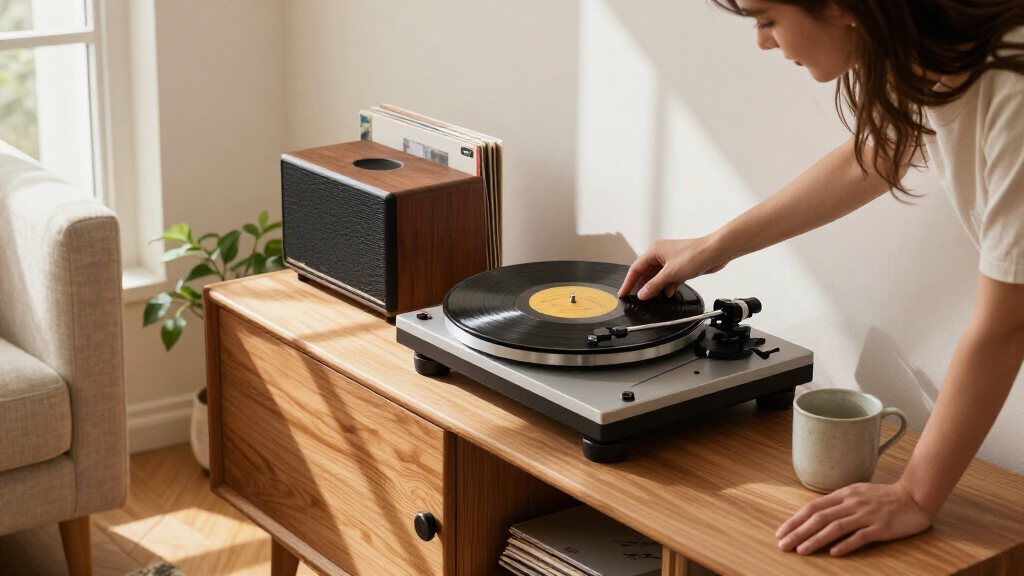
Wireless record players with speakers combine vinyl playback with Bluetooth streaming and built-in or bundled audio, so you get a complete listening setup without buying a separate receiver or amp. After comparing 12 options, the QLEARSOUL HiFire X stands out as my best overall pick for its 100W speaker system and VU meter that bridges convenience and HiFi ambition. The Sony PS-LX3BT is the smarter choice if you already own speakers, thanks to full-auto playback and trusted brand engineering, while the 1 BY ONE High Fidelity Belt Drive wins on value for first-time buyers. The core tradeoff in this category is between all-in-one simplicity and genuine sound quality, because built-in speakers rarely match a dedicated bookshelf pair. Read on for the full breakdown, including which models to skip and why.

Get audio and creator gear delivered free — and shop member deals
- Fast, free delivery on millions of items
- Access to Prime Big Deal Days deals on October 6–7
- Prime Video, Amazon Music and more included
Complete the kit


Key Takeaways
- Models with separate bookshelf speakers — the HiFire X, the 36W Bluetooth HiFi systems, and SeeYing — consistently outperform players with built-in drivers, confirming that speaker separation is the single biggest sound-quality factor in this category.
- The Audio-Technica AT-LP120XBT-USB is the only true audiophile entry, but it ships without speakers, so it only makes sense for buyers who already own or plan to buy a powered speaker system.
- The Portable Vintage-Style Bluetooth Speaker is more of a novelty — its white noise and lighting features serve mood, not music, making it the weakest vinyl performer of the twelve.
- The AT-3600L cartridge (found in the Retrolife and shared with several budget picks) is the de facto standard here; upgrade paths are limited on the cheapest models with fixed cartridges.
- Full-auto operation (Sony PS-LX3BT and 1 BY ONE Fully Automatic) is the most underrated feature for beginners because it prevents needle damage from manual cueing mistakes.
| Bluetooth Turntable Hi-Fi System with 36W Bookshelf Speakers |  | Best Overall | Speaker Power: 36W bookshelf pair | Platter: Iron alloy, 1.5 kg | Cartridge: AT-3600L | VIEW LATEST PRICE | See Our Full Breakdown |
| Retrolife 3-Speed Belt-Driven Vinyl Record Player with External Speakers and AT-3600L Cartridge |  | Best Value | Speeds: 33 1/3, 45, 78 RPM | Cartridge: Audio-Technica AT-3600L | Speakers: 2 x 15W external bookshelf | VIEW LATEST PRICE | See Our Full Breakdown |
| Seasonlife R612 Vintage Vinyl Record Player with Two External Speakers |  | Best for Style on a Budget | Drive: Belt drive | Speeds: 33 1/3, 45, 78 RPM | Record Sizes: 7, 10, 12 inches | VIEW LATEST PRICE | See Our Full Breakdown |
| Sony PS-LX3BT Wireless Bluetooth Turntable with Full-Auto Playback |  | Best Premium Wireless | Speeds: 33 1/3 and 45 RPM | Connectivity: Bluetooth (aptX Adaptive) and wired | Cartridge: Moving magnet | VIEW LATEST PRICE | See Our Full Breakdown |
| Portable Vintage-Style Bluetooth Speaker with Adjustable Lighting and White Noise |  | Not a Turntable — Skip It for This Roundup | Playback Modes: White noise, Bluetooth, TF card, AUX | White Noise Sounds: 4 natural sounds | Lighting Modes: 3 | VIEW LATEST PRICE | See Our Full Breakdown |
| SeeYing Vinyl Record Player with 36-Watt Stereo Bookshelf Speakers |  | Best for Digitizing Your Collection | Brand: SeeYing | Model: SY101 | Drive Type: Belt drive | VIEW LATEST PRICE | See Our Full Breakdown |
| 1 BY ONE High Fidelity Belt Drive Turntable with Built-in Speakers |  | Best All-in-One Design | Drive Type: Belt drive | Speeds: 33 1/3 and 45 RPM | Cartridge: Magnet type | VIEW LATEST PRICE | See Our Full Breakdown |
| QLEARSOUL HiFire X Vinyl Record Player with 100W Speakers & VU Meter |  | Best Premium Sound | Speaker Power: 100W RMS / 400W peak | Woofer Size: 5.3 inches | Tweeter: 1.5-inch silk dome | VIEW LATEST PRICE | See Our Full Breakdown |
| Qlearsoul SoulBox S1 Vinyl Record Player with Stereo Speakers |  | Best Tonearm and Build Quality | Drive Type: Belt-driven | Speeds: 33/45 RPM | Tonearm: 10-inch S-shaped, adjustable counterweight and anti-skating | VIEW LATEST PRICE | See Our Full Breakdown |
| 1 BY ONE Bluetooth Turntable HiFi System with 36-Watt Bookshelf Speakers |  | Best Balanced Starter System | Drive Type: Belt drive | Platter: Iron | Speaker Output: 36 watts | VIEW LATEST PRICE | See Our Full Breakdown |
| 1 BY ONE Fully Automatic Vinyl Record Player with Speakers |  | Best Effortless All-in-One | Operation: Fully automatic | Playback speeds: 33⅓ and 45 RPM | Cartridge stylus: AT-3600L | VIEW LATEST PRICE | See Our Full Breakdown |
| Audio-Technica AT-LP120XBT-USB-BK Wireless Direct-Drive Turntable |  | Best for Enthusiasts and Archivists | Drive: Direct-drive, DC servo motor | Operation: Fully manual | Speeds: 33⅓, 45, and 78 RPM | VIEW LATEST PRICE | See Our Full Breakdown |
| wireless record players with speaker | Connectivity | Cartridge | Speeds |
|---|---|---|---|
| Bluetooth Turntable Hi-Fi Syst | Bluetooth input, USB, dual RCA output | AT-3600L | — |
| Retrolife 3-Speed Belt-Driven | — | Audio-Technica AT-3600L | 33 1/3, 45, 78 RPM |
| Seasonlife R612 Vintage Vinyl | Bluetooth input, AUX input, dual RCA output | — | 33 1/3, 45, 78 RPM |
| Sony PS-LX3BT Wireless Bluetoo | Bluetooth (aptX Adaptive) and wired | Moving magnet | 33 1/3 and 45 RPM |
| Portable Vintage-Style Bluetoo | — | — | — |
| SeeYing Vinyl Record Player wi | Bluetooth, USB, RCA phono-line output | Moving magnet | 2-speed |
| 1 BY ONE High Fidelity Belt Dr | Bluetooth, Aux-in | Magnet type | 33 1/3 and 45 RPM |
| QLEARSOUL HiFire X Vinyl Recor | — | — | — |
| Qlearsoul SoulBox S1 Vinyl Rec | Streaming from smart devices | AT-3600L | 33/45 RPM |
| 1 BY ONE Bluetooth Turntable H | Bluetooth, USB, dual RCA | — | — |
| 1 BY ONE Fully Automatic Vinyl | — | — | — |
| Audio-Technica AT-LP120XBT-USB | Bluetooth, USB, and dual RCA outputs | AT-VM95E Dual Moving Magnet with elliptical stylus | 33⅓, 45, and 78 RPM |
More Details on Our Top Picks
Bluetooth Turntable Hi-Fi System with 36W Bookshelf Speakers
This option stands out for balancing real audiophile construction with a complete speaker package. The adjustable counterweight and anti-skating weight matter here because they let the AT-3600L cartridge track records with correct pressure — something the Seasonlife R612 simply doesn’t offer, and that difference shows up as less groove wear and cleaner high frequencies over time. The 1.5 kg iron-alloy platter adds rotational mass that steadies playback speed, while the included 36W bookshelf speakers deliver far more headroom than the Retrolife’s 15W pair. USB recording to MP3 is a genuine bonus for anyone archiving a collection. The main compromise: audio only travels one direction over Bluetooth — it receives streams but can’t send audio out to wireless speakers, so future system expansion means cables.
Pros:- Adjustable counterweight and anti-skate protect records and improve tracking accuracy
- 36W speakers provide room-filling volume that most bundled turntables can’t match
- USB recording converts vinyl to MP3 for digital archiving
- Switchable phono/line output makes it compatible with nearly any amplifier later
Cons:- Cannot transmit audio to Bluetooth speakers, limiting wireless expansion
- Larger bookshelf speakers demand more shelf space than suitcase-style alternatives
Best for: Buyers who want a proper upgradable hi-fi starter system with enough speaker power to fill a living room
Not ideal for: Households hoping to place Bluetooth speakers around the room wirelessly — this system only receives Bluetooth, it doesn’t transmit
- Speaker Power:36W bookshelf pair
- Platter:Iron alloy, 1.5 kg
- Cartridge:AT-3600L
- Connectivity:Bluetooth input, USB, dual RCA output
- Recording:USB to MP3 (Mac/PC)
- Output Mode:Switchable phono/line
Our verdict“This is the pick for someone who wants their first real turntable to also be their last for years.”
Retrolife 3-Speed Belt-Driven Vinyl Record Player with External Speakers and AT-3600L Cartridge
Retrolife’s HQ-KZ012 makes the list because it hits the sweet spot where modern wireless convenience meets a genuinely respectable cartridge. The AT-3600L — the same cartridge found on the pricier 36W system above — means records sound notably better than they would on the Seasonlife R612’s generic stylus. Bluetooth 5.3 is the newest wireless spec in this batch, and that translates to steadier streaming with fewer dropouts when a phone is across the room. The two 15W external speakers sacrifice roughly half the power of the 36W system, but they still beat built-in units for stereo separation since you can space them apart. Tradeoffs are real: the MDF-and-plastic enclosure looks less premium than all-wood rivals, and the belt will eventually need replacing.
Pros:- AT-3600L cartridge with square tonearm delivers precise tracking at a modest price point
- Bluetooth 5.3 provides the most stable wireless streaming in this batch
- Plays all three speeds (33 1/3, 45, 78 RPM) across 7, 10, and 12-inch records
- Separate bookshelf speakers allow flexible placement and real stereo separation
Cons:- Plastic enclosure components feel less premium than wooden alternatives
- Belt-driven mechanism will need belt replacement with heavy use
Best for: First-time buyers who want quality sound and wireless streaming without paying for a full hi-fi rig
Not ideal for: Collectors of 78s played loud at parties — the 15W speakers run out of headroom compared with the 36W or 100W options in this roundup
- Speeds:33 1/3, 45, 78 RPM
- Cartridge:Audio-Technica AT-3600L
- Speakers:2 x 15W external bookshelf
- Bluetooth:Version 5.3
- Drive:Belt drive
- Enclosure:MDF and plastic
- Power:DC 12V 2A adapter
- Warranty:1 year
Our verdict“The smartest spend for beginners who care about sound quality but aren’t ready for a component system.”
Seasonlife R612 Vintage Vinyl Record Player with Two External Speakers
The R612 earns its place through breadth of format support and a distinctive bark-red finish that stands apart from the black-and-wood sameness of most turntables. Like the Retrolife, it plays all three speeds and handles 7, 10, and 12-inch records, and its two external speakers give it a leg up over suitcase players with drivers buried in the lid. Where it falls short of the Retrolife is the cartridge: there’s no AT-3600L here, and no adjustable counterweight, so tracking precision depends entirely on factory setup. The RCA outputs do open an upgrade path to better speakers later, which partially offsets the sound ceiling. One credibility gap: the listing mentions a headphone output that the actual specifications don’t confirm — buyers who need private listening should verify before purchasing.
Pros:- Plays 33 1/3, 45, and 78 RPM records in all three standard sizes
- Two external speakers plus RCA outputs allow later speaker upgrades
- Bluetooth and AUX inputs double it as a general audio system
- Auto-stop and a detachable dust cover protect both records and the unit
Cons:- No adjustable counterweight or anti-skate, limiting tracking precision
- Headphone output listed in highlights but absent from confirmed specs
Best for: Casual listeners and decor-focused buyers who want a colorful, all-format player that plays everything out of the box
Not ideal for: Anyone prioritizing long-term record care — without an adjustable counterweight, tracking force can’t be fine-tuned
- Drive:Belt drive
- Speeds:33 1/3, 45, 78 RPM
- Record Sizes:7, 10, 12 inches
- Speakers:Two external speakers
- Connectivity:Bluetooth input, AUX input, dual RCA output
- Features:Auto stop, detachable dust cover
- Power:DC 12V, 2000mA adapter
- Color:Bark red
Our verdict“A fun, format-flexible choice for low-pressure listening where looks matter as much as fidelity.”
Sony PS-LX3BT Wireless Bluetooth Turntable with Full-Auto Playback
Sony’s PS-LX3BT is the most polished machine in this batch, though it takes a different approach: no speakers are included. Instead, it transmits wirelessly to whatever Bluetooth speakers or headphones you already own, and with Qualcomm aptX Adaptive at roughly 96 kHz/24-bit, it sends a higher-resolution signal than the standard Bluetooth on the Retrolife or the 36W system can carry. The full-auto operation — one button starts, stops, and returns the tonearm — is unique here and genuinely protects records from careless handling. The die-cast aluminum platter and pivot-bearing aluminum tonearm feel like a class above the plastic-and-MDF builds elsewhere. The obvious limitation: it skips 78 RPM, and the fixed 3.5 g tracking force is heavier than ideal for precious pressings. Budget for speakers, because silence comes free with the box.
Pros:- aptX Adaptive Hi-Res wireless audio (~96 kHz/24-bit) far exceeds standard Bluetooth quality
- Full-auto one-button operation protects records and simplifies every session
- Die-cast aluminum platter and aluminum tonearm outclass plastic rivals in stability
- Switchable phono EQ works with both line inputs and traditional phono stages
Cons:- No speakers included — requires an existing audio system
- Does not play 78 RPM records
- Fixed 3.5 g tracking pressure is heavier than adjustable designs allow
Best for: Buyers who already own good Bluetooth speakers or soundbars and want a premium, fully automatic turntable feeding them
Not ideal for: Anyone wanting an all-in-one solution — no speakers are bundled, so the true cost is higher than the sticker suggests
- Speeds:33 1/3 and 45 RPM
- Connectivity:Bluetooth (aptX Adaptive) and wired
- Cartridge:Moving magnet
- Tracking Force:3.5 ± 0.5 g
- Platter:Die-cast aluminum
- Operation:Full-auto start, stop, and return
- Extras:45 RPM adaptor, slip mat, dust cover
Our verdict“The choice for listeners with existing wireless audio gear who want turntable convenience without wires anywhere.”
Portable Vintage-Style Bluetooth Speaker with Adjustable Lighting and White Noise
In the interest of honest curation: this product plays no records at all. Despite appearing alongside turntables in search results, it is a standalone Bluetooth speaker with white noise, TF card, and AUX modes — there is no platter, no tonearm, and no way to spin vinyl. Judged purely as a speaker, its 360-degree sound and four natural white-noise tracks make it a pleasant bedside companion, and the three lighting modes add atmosphere that no turntable here offers. But stacked against the Retrolife with its dedicated 15W bookshelf pair, it can’t form a stereo image or reproduce the dynamics a record demands. The absence of any listed warranty is another red flag for a generic-brand purchase. Readers shopping specifically for wireless record players with speakers should pass on this one.
Pros:- Four natural white-noise sounds genuinely useful for sleep
- Three adjustable lighting modes suit bedroom or party ambience
- Compact, portable form factor with multiple playback modes
- 360-degree sound disperses audio evenly in small rooms
Cons:- Not a record player — it has no turntable functionality whatsoever
- No warranty coverage listed, unusual for electronics in this category
Best for: Sleep-focused shoppers who want a portable white-noise and Bluetooth speaker for a bedroom — not vinyl buyers
Not ideal for: Anyone in this roundup’s audience — it cannot play records in any capacity
- Playback Modes:White noise, Bluetooth, TF card, AUX
- White Noise Sounds:4 natural sounds
- Lighting Modes:3
- Sound:360-degree surround
- Color:White
- Turntable:None
Our verdict“A fine sleep speaker, but it doesn’t belong in a record player buying guide — skip it if you’re here for vinyl.”
SeeYing Vinyl Record Player with 36-Watt Stereo Bookshelf Speakers
What separates the SeeYing SY101 from most plug-and-play bundles is its USB vinyl recording feature, which lets you rip records straight to a computer. That alone gives it a role the 1 BY ONE B07H8VG9BB also fills, but SeeYing adds a cartridge alignment protractor in the box — a small inclusion that signals this brand expects you to care about setup precision. The two 18-watt bookshelf speakers deliver noticeably more presence than the built-in drivers on the 1 BY ONE B086WTSMQH, though they still trail the 100W QLEARSOUL HiFire X in raw power. The adjustable counterweight and moving-magnet cartridge mean stylus upgrades are cheap and easy down the road. The catch: a 30-day warranty is thin compared to the two-year coverage Qlearsoul offers, so buyers take on more long-term risk.
Pros:- USB recording makes digitizing records straightforward
- Two separate 18W bookshelf speakers outperform all-in-one units
- Moving-magnet cartridge and counterweight allow future upgrades
- Cartridge alignment protractor helps owners dial in accurate tracking
Cons:- Only 30 days of warranty coverage
- No published performance measurements or detailed setup documentation
Best for: Collectors who want to convert their vinyl library to digital files while still enjoying proper bookshelf speakers
Not ideal for: Buyers who prioritize long-term support — the 30-day return-and-replacement window offers little protection after the first month
- Brand:SeeYing
- Model:SY101
- Drive Type:Belt drive
- Speeds:2-speed
- Speaker Output:2 × 18 W
- Cartridge:Moving magnet
- Connectivity:Bluetooth, USB, RCA phono-line output
- Additional Features:Built-in preamp, USB vinyl recording, auto stop
Our verdict“This pick makes the most sense for vinyl fans who want their records on a phone or computer as well as on the shelf, provided they accept the short warranty.”
1 BY ONE High Fidelity Belt Drive Turntable with Built-in Speakers
If the thought of positioning two bookshelf speakers and running cables feels like homework, this model removes that step entirely: the speakers and amplifier live inside the turntable, so setup is a power cord and a record. Compared with the SeeYing SY101 or the SoulBox S1, both of which ship separate speakers, this 1 BY ONE trades expandability for simplicity. The standout spec is the Audio-Technica diamond-tipped stylus, a genuine upgrade over generic needles and a big reason its playback sounds cleaner than most suitcase-style competitors. The wood-and-metal layered build also looks far more furniture-like than plastic alternatives. The honest tradeoff: built-in drivers cannot match dedicated bookshelf pairs for bass depth or stereo separation, so listeners who eventually want bigger sound will need to start over rather than simply upgrading.
Pros:- True all-in-one design with no separate speakers or amplifier needed
- Audio-Technica diamond stylus delivers clearer playback than typical stock needles
- Bluetooth and Aux-in add streaming flexibility
- Wood and metal construction looks premium rather than toy-like
Cons:- Internal speakers lack the bass depth and stereo width of dedicated speaker pairs
- No easy upgrade path — the speakers can’t be replaced, only supplemented
Best for: First-time vinyl buyers and anyone who wants a single box, zero-cable-clutter setup on a desk or shelf
Not ideal for: Audiophiles and anyone planning to build a larger system later — the integrated speakers cap the ceiling and can’t be swapped out
- Drive Type:Belt drive
- Speeds:33 1/3 and 45 RPM
- Cartridge:Magnet type
- Stylus:Audio-Technica diamond-tipped
- Speakers:Built-in with internal amplifier
- Connectivity:Bluetooth, Aux-in
- Materials:Wood and metal
Our verdict“This model is better suited to simplicity-first buyers who value one-box convenience and a quality stylus over room-filling sound.”
QLEARSOUL HiFire X Vinyl Record Player with 100W Speakers & VU Meter
The HiFire X plays in a different league on power: 100W RMS (400W peak) driven through 5.3-inch woofers and silk dome tweeters roughly triples what the SeeYing or 1 BY ONE 36-watt bundles can produce, and the difference shows up as real bass authority rather than mere loudness. Its DSP preamp that adapts EQ per input source is genuinely useful, tailoring the signal whether you’re spinning vinyl, streaming over Bluetooth, or feeding a line-level device. The real-time analog VU meter and CNC-machined brushed aluminum panel give it a visual character nothing else in this lineup matches — this is the machine that guests will comment on. The tradeoffs are practical: the dual bookshelf speakers create a large footprint on smaller media consoles, and the absence of published cartridge or drive details makes it hard for enthusiasts to evaluate upgrade paths before buying.
Pros:- 100W RMS output dwarfs typical 36W bundles for bass and volume
- DSP preamp adjusts EQ for each input source automatically
- Dedicated woofers and silk dome tweeters deliver true two-way stereo sound
- Analog VU meter and machined aluminum panel add standout visual appeal
Cons:- Dual bookshelf speakers take up considerably more shelf space
- No cartridge, stylus, or drive-type specifications published
Best for: Listeners who want living-room-filling Hi-Fi volume and a statement piece with retro visual flair
Not ideal for: Apartments or small desks — the two-bookshelf-speaker footprint demands real space, and spec-light listings will frustrate detail-oriented buyers
- Speaker Power:100W RMS / 400W peak
- Woofer Size:5.3 inches
- Tweeter:1.5-inch silk dome
- Inputs:Phono, Bluetooth, LINE-IN
- Outputs:RCA LINE-OUT
- Control Panel:CNC-machined brushed aluminum
- Power Adapter:21V/5000mA
Our verdict“This option stands out for buyers who treat the record player as the centerpiece of a room and want serious power to match the looks.”
Qlearsoul SoulBox S1 Vinyl Record Player with Stereo Speakers
The SoulBox S1 earns its spot on tonearm engineering: a 10-inch S-shaped arm with adjustable counterweight and anti-skating is the kind of hardware found on proper hi-fi decks, not budget bundles. Paired with the widely respected AT-3600L cartridge and a 1.2 kg die-cast iron platter, it tracks records with a stability the plastic-clad SeeYing SY101 can’t quite match. The speakers use a 25 mm silk dome tweeter paired with a fiberglass cone, a two-way design that gives it more treble refinement than single-driver bundles. The two-year warranty also beats every other option in this batch, which matters when you’re buying a mechanical device with belts and bearings. Against its sibling HiFire X, the S1 is the more refined instrument but the less powerful entertainer. The main gripe: at 21 pounds, it’s the least portable thing here and demands a sturdy, permanent surface.
Pros:- 10-inch S-shaped tonearm with counterweight and anti-skating rivals separates-level decks
- AT-3600L cartridge is a proven, easily replaceable performer
- Heavy 1.2 kg die-cast platter reduces speed wobble and vibration
- Two-year warranty is the longest in this batch
Cons:- At 21 pounds, it’s heavy and awkward to relocate
- Speaker power trails the HiFire X, so it’s less suited to big rooms
Best for: Detail-focused listeners who want proper tonearm adjustments and long-term warranty protection, not just loud sound
Not ideal for: Dorm rooms or anyone who plans to move the system around — the 21-pound package wants a dedicated shelf
- Drive Type:Belt-driven
- Speeds:33/45 RPM
- Tonearm:10-inch S-shaped, adjustable counterweight and anti-skating
- Cartridge:AT-3600L
- Platter:1.2 kg die-cast iron
- Speaker Drivers:25 mm silk dome tweeter; 130 mm fiberglass cone
- Connectivity:Streaming from smart devices
- Warranty:2 years
- Weight:21 pounds
Our verdict“This pick makes the most sense for buyers who care more about accurate tracking and build durability than maximum volume.”
1 BY ONE Bluetooth Turntable HiFi System with 36-Watt Bookshelf Speakers
This system splits the difference between the all-in-one 1 BY ONE B086WTSMQH and the pricier separates-style bundles. You get 36 watts of bookshelf speakers, the same output class as the SeeYing SY101, but with a switchable phono/line preamp that keeps the door open for a receiver or powered monitors later — something the built-in-speaker model simply can’t offer. The iron platter, adjustable counterweight, and anti-skating combination gives it more stable playback than lightweight starter decks, and the USB-to-MP3 ripping matches SeeYing’s digitizing trick. The tradeoffs are modest but real: recording to MP3 requires a computer running the whole session, and any external speakers you add must be powered, since the internal amp only drives the included pair. Compared to the SoulBox S1, the tonearm hardware is simpler, but the price-to-capability balance is easier to justify for a first real system.
Pros:- Switchable phono/line preamp supports future system expansion
- 36W bookshelf speakers and iron platter punch above typical starter kits
- USB connection converts records to MP3 files
- Counterweight and anti-skating keep tracking consistent
Cons:- USB recording requires a tethered computer
- External speakers must be powered/active — the amp won’t drive passive upgrades
Best for: Newcomers who want a complete working system today but room to add better speakers or a receiver tomorrow
Not ideal for: Listeners who want a fully self-contained recording solution — MP3 ripping here always depends on a connected computer
- Drive Type:Belt drive
- Platter:Iron
- Speaker Output:36 watts
- Connectivity:Bluetooth, USB, dual RCA
- Preamp:Switchable phono/line
- Vinyl Recording:USB to computer; encode to MP3
- Adjustments:Adjustable counterweight and anti-skating
Our verdict“This model is better suited to first-time buyers who want upgrade-friendly connectivity without paying separates-level prices.”
1 BY ONE Fully Automatic Vinyl Record Player with Speakers
Most record players with built-in speakers ask you to lift, cue, and return the tonearm yourself, and that ritual isn’t for everyone. The 1 BY ONE Fully Automatic removes nearly all of it: one press starts playback, and the tonearm returns on its own at the end of a side. Compared with the 1 BY ONE Bluetooth Turntable HiFi System with 36-Watt Bookshelf Speakers, this model goes further by adding repeat playback, memory settings, and a remote, which makes it behave more like a streaming device than a traditional turntable. The DSP-tuned bookshelf pair (2 × 30W woofers, 2 × 10W tweeters) delivers noticeably more low-end authority than the compact Qlearsoul SoulBox S1. The tradeoff is a closed design: the AT-3600L cartridge can’t be upgraded, and you can’t jump to a specific track, so it suits listeners, not tinkerers.
Pros:- One-press fully automatic playback with auto tonearm return
- DSP-tuned bookshelf speakers with dedicated woofers and tweeters
- Wireless streaming plus remote, repeat mode, and memory settings
- Built-in amplifier removes the need for a separate receiver
Cons:- No track-specific selection, so you can’t skip to a chosen song on a record
- Cartridge upgrades are not supported, limiting future sound improvements
Best for: Casual listeners and vinyl newcomers who want press-and-play convenience with real speakers and no tonearm fuss
Not ideal for: Upgraders and hobbyists — the non-upgradeable cartridge and lack of track selection cap its long-term ceiling
- Operation:Fully automatic
- Playback speeds:33⅓ and 45 RPM
- Cartridge stylus:AT-3600L
- Speakers:Pair of bookshelf speakers; 2 × 30W woofers and 2 × 10W tweeters
- Amplifier:Built-in
- Wireless streaming:Supported
- Controls:Remote and on-device
- Finish:PVC wood-grain
Our verdict“Buy this if you want the most hands-off vinyl experience in the roundup with genuinely capable included speakers.”
Audio-Technica AT-LP120XBT-USB-BK Wireless Direct-Drive Turntable
This is the outlier in the roundup: the AT-LP120XBT-USB ships without speakers entirely, and that’s the point. Its budget goes into a direct-drive DC servo motor, a balanced S-shaped tonearm, and an AT-VM95E moving magnet cartridge — parts that every all-in-one option here, including the Retrolife 3-Speed Belt-Driven Record Player, quietly compromises on. Unlike anything else in this lineup, it plays 78 RPM records and connects over Bluetooth (with aptX), RCA, or USB, so you can rip vinyl to digital files or feed a proper hi-fi system. The AT-VM95E accepts styli from the whole VM95 series, giving it a genuine upgrade path. The catch: it’s fully manual, so unlike the Sony PS-LX3BT there’s no automatic cueing, and USB archiving means sitting at a computer with recording software.
Pros:- Direct-drive motor with quartz-locked pitch adjustment for stable speed
- Plays 33⅓, 45, and 78 RPM — the only three-speed option in this batch
- Bluetooth (aptX), RCA, and USB connectivity for streaming, hi-fi, and vinyl-to-digital ripping
- Cartridge accepts VM95 series replacement styli for easy upgrades
Cons:- Fully manual operation — every cue and return is done by hand
- USB vinyl conversion requires a computer and separate recording software
Best for: Vinyl enthusiasts and archivists who already own speakers or an amp and want a turntable they can grow with
Not ideal for: Buyers wanting an all-in-one with speakers included — you’ll need to budget for amplification and playback separately
- Drive:Direct-drive, DC servo motor
- Operation:Fully manual
- Speeds:33⅓, 45, and 78 RPM
- Connectivity:Bluetooth, USB, and dual RCA outputs
- Bluetooth codec:Qualcomm aptX support
- Preamplifier:Built-in switchable phono preamp
- Cartridge:AT-VM95E Dual Moving Magnet with elliptical stylus
- Tonearm:Balanced S-shaped tonearm
- Platter:Die-cast aluminum with felt mat
Our verdict“The clear pick if you’d rather invest in a serious turntable now and add speakers later, not the reverse.”
How We Picked
I ranked these wireless record players with speakers on four factors that actually change the listening experience: speaker architecture (built-in drivers versus separate bookshelf speakers, which affects stereo separation and bass), drive and tonearm quality (belt versus direct drive, cartridge type, and whether the stylus is upgradeable), wireless versatility (Bluetooth output for streaming vinyl to headphones or external speakers, and Bluetooth input for playing digital music through the same system), and usability (auto-return tonearms, speed switching, and how forgiving the unit is for a first-time vinyl owner).
The ranking logic favors systems that deliver real HiFi sound for the money, which is why speaker-and-turntable bundles sit near the top and pure novelties sit at the bottom. I also weighed brand track record — Audio-Technica and Sony earn premium positions on engineering credibility alone — and whether each product has a sensible upgrade path, since many buyers eventually outgrow an entry-level player. Products that lock you into a fixed cartridge or non-upgradable speakers were marked down, even when their convenience features were strong.
| wireless record players with speaker | Cartridge |
|---|---|
| Bluetooth Turntable Hi-Fi Syst | AT-3600L |
| Retrolife 3-Speed Belt-Driven | Audio-Technica AT-3600L |
| Seasonlife R612 Vintage Vinyl | — |
| Sony PS-LX3BT Wireless Bluetoo | Moving magnet |
| Portable Vintage-Style Bluetoo | — |
| SeeYing Vinyl Record Player wi | Moving magnet |
| 1 BY ONE High Fidelity Belt Dr | Magnet type |
| QLEARSOUL HiFire X Vinyl Recor | — |
| Qlearsoul SoulBox S1 Vinyl Rec | AT-3600L |
| 1 BY ONE Bluetooth Turntable H | — |
| 1 BY ONE Fully Automatic Vinyl | — |
| Audio-Technica AT-LP120XBT-USB | AT-VM95E Dual Moving Magnet with elliptical stylus |
Factors to Consider When Choosing Wireless Record Players With Speakers
Before choosing a wireless record player with speakers, it helps to understand what actually drives sound quality and long-term satisfaction in this category. These are the factors I weighed — and the mistakes buyers make most often.Built-In Speakers vs. Separate Bookshelf Speakers
This is the decision that shapes everything else. Built-in speakers sit inside the same cabinet as the turntable, which means vibration from the platter can feed back into the stylus and cause a thin, muddy sound at higher volumes — a physics problem no brand fully solves at this price. Separate bookshelf speakers, even modest 36W pairs like the ones bundled with several models here, physically decouple the audio from the record, delivering wider stereo imaging and noticeably better bass. The catch is footprint and cabling: a two-box system needs shelf space and speaker wire, while an all-in-one needs only a power outlet. My advice for anyone who listens actively rather than casually: always choose separate speakers. Choose built-in only if the player lives on a nightstand, desk, or kitchen counter where convenience genuinely wins.
Bluetooth Direction Matters More Than Bluetooth Existence
Buyers often assume ‘wireless record player’ means one thing, but Bluetooth works in two directions and most products only support one. Bluetooth output lets the turntable stream vinyl to wireless headphones or speakers — useful if you want private listening or already own nice powered speakers. Bluetooth input lets you play Spotify or podcasts through the record player’s own speakers, effectively doubling the device as a general audio system. The best bundles here do both, but many budget models only do input, which limits long-term usefulness. Check which direction each model supports before buying, especially if your plan is to upgrade speakers later while keeping the turntable.
Cartridge and Stylus Upgradeability
The Audio-Technica AT-3600L cartridge appears across this price range for good reason: it is cheap, replaceable, and sounds respectable. What matters more than the cartridge itself is whether it is mounted on a standard removable headshell or fixed permanently to the tonearm. A removable cartridge means you can upgrade to a noticeably better stylus later for a modest cost, extending the life of your purchase by years. Fixed cartridges — common on the cheapest all-in-ones — mean that when the stylus wears out, you are often replacing it with an identical budget part or replacing the whole unit. If you suspect vinyl might become a lasting hobby, this single feature is worth paying extra for.
Belt Drive vs. Direct Drive
Belt-drive turntables use a rubber belt to spin the platter, which dampens motor vibration and produces cleaner sound for sitting-and-listening sessions — which is why nearly every model in this roundup uses one. Direct drive, found on the Audio-Technica AT-LP120XBT-USB, connects the platter directly to the motor, giving faster startup, rock-stable speed, and durability for DJ-style use like scratching or back-cueing. For home listening, either works, but belt drives have a hidden maintenance cost: the belt stretches and needs replacement every few years, a cheap but often-forgotten part. Direct drive costs more upfront but removes that chore. Casual listeners should not pay a premium for direct drive; aspiring DJs and tinkerers should not buy anything else.
Manual vs. Full-Auto Operation
Full-auto players place and lift the tonearm at the push of a button, while manual players require you to lower the needle by hand. This sounds trivial until you consider the most common way beginners destroy records: dropping the stylus mid-groove or letting it sit in the run-out for an hour. Full-auto mechanisms — like those on the Sony PS-LX3BT and the 1 BY ONE Fully Automatic — protect both your records and your stylus with zero skill required. Manual operation gives you more control and fewer mechanical parts that can fail, which is why purists prefer it. If the player is a gift for someone new to vinyl, or for a household with kids, full-auto is cheap insurance. If you enjoy the ritual of vinyl, manual is part of the charm.
Common Mistakes to Avoid
The biggest mistake in this category is buying a self-contained ‘vintage suitcase’ style unit and expecting HiFi sound — the physics of small built-in drivers and shared cabinetry set a hard ceiling on quality, no matter the marketing. The second mistake is ignoring wattage claims: a ‘100W’ system like the HiFire X genuinely fills a room, while tiny built-in drivers rated optimistically will distort well before their claimed power. Third, buyers routinely forget to check speed support — all 33⅓, 45, and 78 RPM support matters if you inherited older records, since 78s need a special stylus anyway. Finally, never place any turntable on the same surface as vibrating speakers; even good systems will suffer feedback if the speakers sit directly under or on the plinth.
Frequently Asked Questions
Can I use a wireless record player with speakers I already own?
Yes, but only if the turntable supports Bluetooth output or has dedicated line-out connections. Models like the Sony PS-LX3BT and the Audio-Technica AT-LX120XBT-USB stream vinyl wirelessly to powered speakers, soundbars, and headphones, which makes them ideal upgrades for people who already have decent audio gear. Most budget all-in-one players only receive Bluetooth, meaning they play digital music through their own speakers but cannot send vinyl out. If future speaker upgrades are part of your plan, verify output capability before purchasing — it is the feature most often missing on cheap units and the one buyers regret losing most.
Do built-in speakers damage records or hurt sound quality?
Built-in speakers do not damage records directly, but they do compromise sound in two ways. First, speaker vibration inside the same cabinet can feed back through the platter into the stylus, adding muddiness at higher volumes. Second, small drivers simply cannot move enough air for real bass or wide stereo separation, since true stereo requires physically separated left and right channels. The bundled bookshelf-speaker systems in this roundup — like the 36W HiFi kits and the 100W HiFire X — solve both problems for usually modest additional cost. If sound quality is why you want vinyl in the first place, avoid single-cabinet players.
Is it worth paying more for a direct-drive turntable like the Audio-Technica AT-LX120XBT-USB?
Only for specific use cases. Direct drive offers faster startup, more stable speed, and the torque needed for DJ techniques, plus the AT-LX120XBT-USB adds USB ripping so you can digitize your records. But it ships without any speakers, so your real budget needs to include a powered speaker pair — making it the most expensive path in this roundup. For someone who just wants to listen at home, a belt-drive bundle with bookshelf speakers delivers more complete value. Choose direct drive if vinyl is a long-term hobby, you want to rip records, or DJing is on the horizon.
How much power do I actually need in the speakers?
For a bedroom or desk, a modest stereo pair is plenty — background listening demands far less power than people assume. For a living room or a space where you want the music to fill the room during conversation, the 36W bookshelf systems represent a sensible middle ground and appear across this roundup for good reason. The 100W HiFire X system is for larger rooms or listeners who like volume without distortion. Remember that wattage is only comparable within similar speaker designs; a 100W system with small drivers will not outperform well-built lower-wattage bookshelf speakers. Match power to your room size rather than chasing the biggest number on the box.
Which of these is best as a gift for someone new to vinyl?
The 1 BY ONE High Fidelity Belt Drive and the Sony PS-LX3BT are my gift picks, for different reasons. The 1 BY ONE bundles everything a beginner needs in one box at an approachable level of quality, so the recipient can start playing records immediately. The Sony adds full-auto operation, which protects records from handling mistakes and removes intimidation for someone who has never cued a tonearm. I would avoid the cheapest all-in-one units as gifts — they can sour someone on vinyl entirely if the sound disappoints. Skip the Audio-Technica for gifting unless the recipient already owns speakers.
Conclusion
The right pick here depends less on budget and more on what kind of listener you are. For the best overall experience, the QLEARSOUL HiFire X with its 100W speakers and VU meter delivers genuine room-filling sound and the most complete package in the lineup. For best value, the 1 BY ONE High Fidelity Belt Drive hits the sweet spot of price, sound, and simplicity that most first-time buyers actually need. The premium choice is the Audio-Technica AT-LX120XBT-USB for anyone serious about audio — provided they budget for speakers, since it is a turntable, not a system. For beginners who want zero learning curve, the Sony PS-LX3BT and its full-auto playback is the safest entry point, while the SeeYing and the 36W Bluetooth HiFi kits suit buyers who want the sound of separate speakers without the HiFire X’s extra power. Whatever you choose, avoid the trap of the cheapest all-in-one units: convenience is worth paying for, but only when the speakers can actually do your records justice.
Fall Picks
fall essentials
As an affiliate, we earn on qualifying purchases.