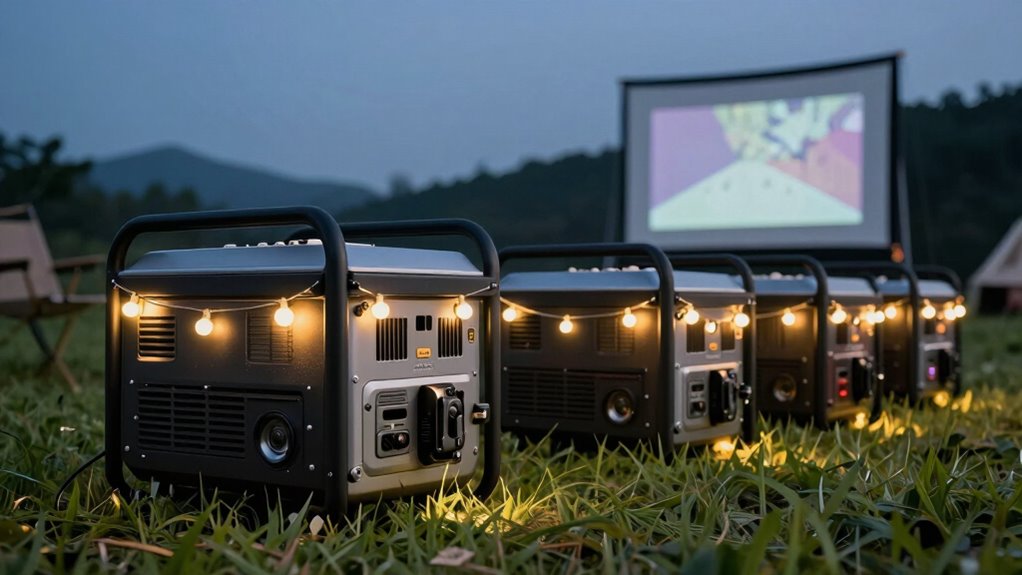

For an outdoor movie night, I’d start with the WEN 3600-Watt Portable Inverter Generator as the best overall balance of capacity and inverter design, while the PowerSmart 2500-Watt and Jackery Explorer 300 stand out for lighter setups that need less power or no engine noise. The main tradeoff is between the longer runtime and higher output of gas models and the quiet, limited energy supply of a battery power station. A generator’s advertised wattage also doesn’t tell you how loud it will sound at the audience’s seats. Match the unit to your projector, audio system, and planned movie length, then keep it well away from viewers. Read on for how all 15 options compare and which setup fits your screening.

Get audio and creator gear delivered free — and shop member deals
- Fast, free delivery on millions of items
- Access to Prime Big Deal Days deals on October 6–7
- Prime Video, Amazon Music and more included
Complete the kit


Key Takeaways
The WEN 3600-Watt is the strongest all-around fit in this lineup for buyers who want inverter power and more capacity than the compact 2400–2500-watt class.
The Jackery Explorer 300 is the quietest choice because it runs without a gas engine, though its 292Wh capacity makes it better for modest loads and shorter screenings than full-size generators.
Several 4000–5000-watt models offer ample headroom, but higher output alone does not make them better for a movie night; their sound, fuel use, weight, and distance from guests matter too.
Compact inverter models suit projector-and-speaker setups when the combined running load is modest, while an oversized unit can add bulk and fuel needs without improving the picture or sound.
Open-frame Oxseryn models trade convenience for capacity; buyers prioritizing a calmer viewing area should compare enclosed inverter options and battery power before choosing on wattage alone.
| Champion 4000-Watt RV-Ready Portable Inverter Generator |  | Best for Lightweight, Higher-Power Setups | Fuel: Gasoline | Starting watts: 4,000 W | Running watts: 3,000 W | VIEW ON AMAZON | See Our Full Breakdown |
| Pulsar PGD40ISCO 4000W Quiet Portable Gas Inverter Generator |  | Best for Lower Stated Noise | Fuel: Gasoline | Peak watts: 4,000 W | Noise level: 59 dB | VIEW ON AMAZON | See Our Full Breakdown |
| Westinghouse 5000 Peak Watt Portable Inverter Generator with Remote Electric Start |  | Best for Long Screenings | Fuel: Gasoline | Peak watts: 5,000 W | Noise output: As low as 52 dBA | VIEW ON AMAZON | See Our Full Breakdown |
| Oxseryn 2800-Watt Portable Inverter Generator |  | Best Compact Carry | Peak output: 2,800 W | Running output: 2,000 W | Engine: 79.8 cc, 4-stroke OHV | VIEW ON AMAZON | See Our Full Breakdown |
| 2800W Portable Inverter Generator – Quiet Gas Generator for Camping, RVs, and Home Backup |  | Best for Simple, Longer Light Loads | Starting wattage: 2,800 W | Running wattage: 2,000 W | Fuel: Gasoline | VIEW ON AMAZON | See Our Full Breakdown |
| WEN 3600-Watt Portable Inverter Generator (56360i) |  | Best for Extra Headroom | Engine: 149cc | Surge output: 3,600 watts | Weight: 46 pounds | VIEW ON AMAZON | See Our Full Breakdown |
| AIVOLT 1350W Portable Inverter Generator |  | Best Compact Pick | Running wattage: 1,350 watts | Peak wattage: 1,750 watts | Fuel type: Gasoline | VIEW ON AMAZON | See Our Full Breakdown |
| SIOKIUU 2500W Portable Inverter Generator with CO Sensor |  | Best for Long Screenings | Peak wattage: 2,500 watts | Running wattage: 1,900 watts | Engine: 80cc, 4-stroke | VIEW ON AMAZON | See Our Full Breakdown |
| Oxseryn 5000W Portable Open Frame Inverter Generator, Gas Powered |  | Best for High-Power Setups | Peak wattage: 5,000 watts | Running wattage: 4,000 watts | Engine: 223cc, 4-stroke OHV | VIEW ON AMAZON | See Our Full Breakdown |
| Oxseryn 4400-Watt Portable Open Frame Inverter Generator, Gas Powered with ECO Mode, RV Ready |  | Best for Runtime and Load Balance | Peak watts: 4,400 | Running watts: 3,400 | Fuel type: Gas | VIEW ON AMAZON | See Our Full Breakdown |
| PowerSmart 2500-Watt Portable Inverter Generator |  | Best for a Simple, Quiet Setup | Fuel: Gasoline | Starting / running wattage: 2,500 / 1,900 watts | Noise: 52 dBA at 23 feet and 25% load | VIEW ON AMAZON | See Our Full Breakdown |
| ERAYAK 2400W Portable Inverter Generator |  | Best for Longer Movie Nights | Peak / running power: 2,400 / 1,800 watts | Noise: 52.5 dB at 25% load and 7 meters | Runtime: Up to 16 hours at 25% load in Eco Mode | VIEW ON AMAZON | See Our Full Breakdown |
| Oxseryn 5000-Watt Portable Inverter Generator, Gas Powered for Home Backup, RV Ready |  | Best for High-Power Needs Away from the Audience | Fuel: Gas | Fuel tank: 2 gallons | Runtime: Up to 6 hours at 50% load | VIEW ON AMAZON | See Our Full Breakdown |
| Jackery Explorer 300 Portable Power Station, 292Wh Backup LiFePO4 Battery, Solar Generator |  | Best Silent Pick for a Small Projector Setup | Capacity: 292 Wh | Weight: 7.1 lbs | Dimensions: 9.1 × 5.2 × 7.8 in | VIEW ON AMAZON | See Our Full Breakdown |
| 3000W Portable Inverter Generator |  | Best for Extra Headroom in a Portable Gas Model | Starting / running power: 3,000 / 2,350 watts | Engine: 97.7 cc 4-stroke OHV | Total harmonic distortion: Under 3% | VIEW ON AMAZON | See Our Full Breakdown |
| quiet portable generators for outdoor movie night | Weight | Runtime | Outlets | Noise level |
|---|---|---|---|---|
| Champion 4000-Watt RV-Ready Po | Less than 49 lbs | Up to 10 hours at 25% load | 120V 25A TT-30R, 120V 20A household duplex, 12V automotive-style, and parallel outlets | 64 dBA at 23 feet |
| Pulsar PGD40ISCO 4000W Quiet P | — | Up to 4 hours at half load | — | 59 dB |
| Westinghouse 5000 Peak Watt Po | — | — | 120V household duplex, 30A RV outlet, and two USB outlets | — |
| Oxseryn 2800-Watt Portable Inv | 40 lbs | Up to 9 hours at 25% load | Two 120V AC, one 12V DC, one USB, and one USB-C | Under 58 dBA at 23 feet |
| 2800W Portable Inverter Genera | 40 lbs | Up to 10 hours at 25% load | Two 120V AC, one 12V DC, one USB, and one Type-C | 58 dB at 23 feet |
| WEN 3600-Watt Portable Inverte | 46 pounds | — | — | — |
| AIVOLT 1350W Portable Inverter | 27.6 pounds | Up to 7 hours at 25% load | — | 52 dBA |
| SIOKIUU 2500W Portable Inverte | 39.46 pounds | Up to 17 hours at 25% load; 8.6 hours at 50% load | — | Under 59 dBA at 23 feet |
| Oxseryn 5000W Portable Open Fr | 59 pounds | Up to 10 hours at 25% load | Two 120V AC, one 30A RV, one 12V DC | 70 dBA at 23 feet |
| Oxseryn 4400-Watt Portable Ope | 56 pounds | Up to 14 hours at 25% load with ECO mode | Two 120V AC, one 12V DC, one RV port | Under 72 dBA at 23 feet |
| PowerSmart 2500-Watt Portable | — | Up to 8 hours at 25% load | — | — |
| ERAYAK 2400W Portable Inverter | 42 lbs | Up to 16 hours at 25% load in Eco Mode | 2 AC, 2 USB, 1 DC | — |
| Oxseryn 5000-Watt Portable Inv | 60 lbs | Up to 6 hours at 50% load | 30A RV outlet | — |
| Jackery Explorer 300 Portable | 7.1 lbs | — | 2 AC, 1 USB-C PD (100W), 2 USB-A, 1 car port (120W) | — |
| 3000W Portable Inverter Genera | 41.8 lbs | — | — | — |
More Details on Our Top Picks
Champion 4000-Watt RV-Ready Portable Inverter Generator
The Champion 4000 pairs enough running output for a projector, speakers, and extra gear with a weight under 49 pounds, which helps when I need to move power away from the viewing area. Its TT-30R outlet also suits an RV-based movie setup, while clean inverter output is a good match for sensitive electronics. Compared with the lighter-duty Oxseryn 2800-Watt, it offers 1,000 more running watts, but that extra headroom comes with a higher stated noise level of 64 dBA at 23 feet. The listed runtime reaches 10 hours only at 25% load, so heavier use can mean more refueling. CO Shield adds a useful shutdown safeguard, though the generator still needs to sit well away from people and enclosed spaces.
Pros:- 3,000 running watts leave room for multiple movie-night devices
- Under 49 pounds for a generator in this power class
- Clean inverter power is suitable for sensitive electronics
- CO Shield shuts the engine off if unsafe carbon monoxide levels are detected
Cons:- 64 dBA at 23 feet is louder than the listed rating for the Westinghouse 5000
- The 10-hour runtime applies at only 25% load
- Parallel kit is sold separately
Best for: Movie-night hosts who need RV-ready power and extra capacity for a projector, sound system, and other equipment.
Not ideal for: Viewers prioritizing the lowest stated noise or a compact, low-output setup; the 64 dBA rating and larger capacity may be more than they need.
- Fuel:Gasoline
- Starting watts:4,000 W
- Running watts:3,000 W
- Noise level:64 dBA at 23 feet
- Runtime:Up to 10 hours at 25% load
- Weight:Less than 49 lbs
- Fuel tank:1.54 gallons
- Outlets:120V 25A TT-30R, 120V 20A household duplex, 12V automotive-style, and parallel outlets
Our verdict“Choose the Champion if you want a relatively portable, RV-ready generator with more power headroom than the Oxseryn 2800 and can accommodate its higher noise rating.”
Pulsar PGD40ISCO 4000W Quiet Portable Gas Inverter Generator
The Pulsar PGD40ISCO earns its place for movie nights where generator sound is a priority: its stated 59 dB rating is lower than the Champion 4000’s 64 dBA figure. It also supplies 3,200 rated watts, so a projector and audio gear have useful capacity, with stated compatibility for air conditioners up to 13,500 BTU if the same setup also serves an RV. The tradeoff is the one-gallon tank: four hours at half load means I would plan for refueling during a longer event or reduce the load. Unlike the Westinghouse 5000, its supplied details give no remote-start option or long maximum-runtime figure. It is a focused choice for sound-conscious setups, but the rating alone cannot promise an inaudible generator at a nearby audience.
Pros:- 59 dB stated noise rating
- 3,200 rated watts for a projector and supporting equipment
- Inverter output is described as suitable for sensitive electronics
- Parallel-ready design can support adding compatible capacity
Cons:- One-gallon fuel tank limits runtime between refills
- Runtime is specified only as four hours at half load
- Supplied product details do not specify starting methods or outlet types
Best for: RV owners and outdoor movie hosts who want 4,000-watt peak capacity and a lower stated noise rating than the Champion 4000.
Not ideal for: People running long screenings at substantial load who want fewer fuel stops; the stated runtime is four hours at half load from a one-gallon tank.
- Fuel:Gasoline
- Peak watts:4,000 W
- Noise level:59 dB
- Fuel tank:1 gallon
- Runtime:Up to 4 hours at half load
- Air conditioner compatibility:Up to 13,500 BTU
- Parallel ready:Yes
Our verdict“Pick the Pulsar when its lower stated noise rating matters more than long runtime or detailed starting and outlet options.”
Westinghouse 5000 Peak Watt Portable Inverter Generator with Remote Electric Start
For a movie night that may run late, the Westinghouse 5000 has the strongest stated endurance here: up to 18 hours of runtime with economy mode and a 3.4-gallon tank. Its noise output is listed as low as 52 dBA, below the Pulsar PGD40ISCO’s 59 dB rating, though actual sound can vary with load and placement. Remote, electric, and recoil starts give me options for starting it without walking back to the unit during setup. The digital display can help track fuel and remaining runtime, a practical advantage over the simpler Oxseryn 2800. At 3,900 rated watts, it offers substantial headroom, but its larger tank and wheel kit make it a bulkier choice than the 40-pound models. The 18-hour figure is a maximum, not a guarantee at movie-night loads.
Pros:- Up to 18 hours of stated runtime with economy mode
- Noise output listed as low as 52 dBA
- Remote, electric, and recoil starting options
- Digital display tracks fuel, output, runtime, voltage, and operating hours
Cons:- Maximum runtime varies with load
- Gasoline operation requires fuel and routine maintenance
- The listed wheel and handle kit points to a bulkier setup than the 40-pound Oxseryn models
Best for: Hosts planning extended screenings who value long stated runtime, multiple start methods, and a display for monitoring generator operation.
Not ideal for: People who need a particularly light generator to carry over a distance; the 40-pound Oxseryn models are lighter by the listed weight.
- Fuel:Gasoline
- Peak watts:5,000 W
- Noise output:As low as 52 dBA
- Fuel tank:3.4 gallons
- Maximum runtime:Up to 18 hours
- Starting methods:Remote, electric, and recoil
- Outlets:120V household duplex, 30A RV outlet, and two USB outlets
- Total harmonic distortion:Less than 3%
Our verdict“Choose the Westinghouse if long screenings and convenient monitoring matter more than the lighter carry weight of the Oxseryn 2800.”
Oxseryn 2800-Watt Portable Inverter Generator
The Oxseryn 2800 is the compact carry pick for a simple outdoor screening: at 40 pounds, it is easier to move than the Champion 4000 or Westinghouse 5000, and its listed noise level is under 58 dBA at 23 feet. Its 2,000 running watts can suit a projector and modest audio setup, while USB and USB-C ports let me charge smaller devices directly. That lower output is the main boundary: unlike the higher-wattage Champion, this model leaves less room for additional equipment or demanding loads. The stated nine hours applies at 25% load, so I would not read it as a full-load runtime. ECO mode and less than 3% THD make it appealing for a restrained setup, but the listing does not include a high-altitude kit.
Pros:- 40-pound weight with a built-in handle
- Under 58 dBA stated noise at 23 feet
- USB-C and USB ports can charge small devices directly
- Less than 3% THD and ECO mode
Cons:- 2,000 running watts limits capacity for additional or high-draw equipment
- Nine-hour runtime is stated only at 25% load
- High-altitude kit is not included
Best for: Campers and movie-night hosts who can keep their equipment load modest and want a 40-pound generator with USB-C.
Not ideal for: People powering an RV air conditioner or several higher-draw devices alongside the screening; 2,000 running watts offers less headroom than the Champion 4000.
- Peak output:2,800 W
- Running output:2,000 W
- Engine:79.8 cc, 4-stroke OHV
- Fuel:Gasoline
- Fuel tank:1.1 gallons
- Runtime:Up to 9 hours at 25% load
- Noise level:Under 58 dBA at 23 feet
- Weight:40 lbs
- Outlets:Two 120V AC, one 12V DC, one USB, and one USB-C
Our verdict“Choose the Oxseryn 2800 for a portable, modest-load screening setup when easy carrying matters more than the Champion 4000’s added output.”
2800W Portable Inverter Generator – Quiet Gas Generator for Camping, RVs, and Home Backup
This 40-pound 2800W inverter makes sense for buyers who want a lightweight generator with a little more stated light-load runtime than the Oxseryn 2800: its listing claims up to 10 hours at 25% load, versus nine hours for the Oxseryn. Both provide 2,000 running watts, less than 3% THD, and USB-C alongside AC outlets, so either can suit a modest projector-and-speaker setup. The stated 58 dB noise level at 23 feet is close to the Oxseryn’s under-58 dBA figure; those specifications do not establish a meaningful noise advantage for either model. This product’s listing gives a 40-pound weight and dimensions, but no warranty details. Runtime can drop at higher loads, and gasoline brings fuel storage and maintenance needs.
Pros:- 40-pound weight with carry handle
- Up to 10 hours stated at 25% load
- Less than 3% THD for sensitive electronics
- USB-C, USB, DC, and AC outlets
Cons:- Runtime drops significantly at higher loads
- No warranty details are listed
- Gasoline requires fuel storage and maintenance
Best for: Movie-night hosts seeking a 40-pound, 2,000-running-watt option for light loads who value USB-C and a stated 10-hour runtime at 25% load.
Not ideal for: Buyers who need documented warranty coverage or plan to run several high-draw devices; warranty details are not listed and capacity is 2,000 running watts.
- Starting wattage:2,800 W
- Running wattage:2,000 W
- Fuel:Gasoline
- Runtime:Up to 10 hours at 25% load
- Noise level:58 dB at 23 feet
- Weight:40 lbs
- Dimensions:18.2 × 11.3 × 19 inches
- Outlets:Two 120V AC, one 12V DC, one USB, and one Type-C
- Total harmonic distortion:Less than 3%
Our verdict“Choose this model over the Oxseryn 2800 if its stated extra hour at 25% load and listed dimensions fit your light-load setup, while accepting the missing warranty details.”
WEN 3600-Watt Portable Inverter Generator (56360i)
The WEN’s 2,900 rated watts give an outdoor movie setup more room for a projector, speakers, and a few extra devices than the AIVOLT 1350W, whose 1,350 running watts call for a simpler load. Its 46-pound weight also keeps it manageable to move, though it is heavier than that smaller AIVOLT. Clean inverter power is designed for sensitive electronics, a useful fit for a projector, and the outlets include USB and 12V DC connections alongside the 120V receptacles. The tradeoff is that the supplied details do not state a noise level or runtime, so I can’t place it confidently for a quiet screening or a long evening without checking those figures. I’d choose it for capacity and outlet variety, with noise performance still to verify.
Pros:- 2,900 rated watts provide more running capacity than the AIVOLT 1350W
- Inverter output is designed for sensitive electronics such as projectors
- 46-pound body is relatively portable for its output class
- Includes 120V, RV, 12V DC, and USB connections
Cons:- No noise figure is provided in the supplied product details
- No runtime figure is provided, making event planning harder
- At 46 pounds, it is heavier than the AIVOLT 1350W
Best for: Movie-night hosts who need room for a projector, audio gear, and additional small devices and can verify noise levels before buying
Not ideal for: Buyers prioritizing a documented quiet operating level or the lightest generator to carry
- Engine:149cc
- Surge output:3,600 watts
- Weight:46 pounds
- Receptacles:Two three-prong 120V, one TT-30R RV, one 12V DC
- USB ports:Two 5V
- Warranty:Three years
Our verdict“Choose the WEN if your screening setup needs extra running capacity and varied outlets, and confirm its noise level suits your venue.”
AIVOLT 1350W Portable Inverter Generator
At 27.6 pounds and a stated 52 dBA, the AIVOLT is the clearest fit here for a small, portable movie setup where generator noise and carrying effort matter. Its 1,350 running watts can suit a projector and modest audio gear, but leave less room for add-ons than the WEN 3600i or either Oxseryn open-frame model. Low-THD output is designed for sensitive electronics, while CO detection and protective shutdowns add safeguards during operation. The stated runtime reaches up to seven hours at 25% load, but that light-load figure may not reflect a projector and speaker combination. I’d also account for the fact that engine oil is not included. This is the easiest model in this group to carry, provided its lower output matches your equipment.
Pros:- 27.6-pound weight makes transport easier than the WEN and Oxseryn models
- 52 dBA noise rating is the lowest stated figure among these five products
- Low-THD inverter output is designed for sensitive electronics
- CO sensor, low-oil shutdown, and overload protection are included
Cons:- 1,350 running watts limits capacity for extra equipment
- Up to seven hours of runtime is specified only at 25% load
- Engine oil is not included
Best for: Solo movie-night hosts or couples carrying a compact projector and modest audio setup to a campsite
Not ideal for: Groups running several powered devices or buyers who need a runtime estimate at higher loads
- Running wattage:1,350 watts
- Peak wattage:1,750 watts
- Fuel type:Gasoline
- Runtime:Up to 7 hours at 25% load
- Noise level:52 dBA
- Weight:27.6 pounds
- THD:Less than 3%
- Safety features:CO sensor with auto shutoff, low-oil shutdown, overload protection
Our verdict“Pick the AIVOLT for a lightweight, quiet setup with modest power needs, and skip it if your movie night depends on multiple high-draw devices.”
SIOKIUU 2500W Portable Inverter Generator with CO Sensor
The SIOKIUU’s standout is its stated up to 17 hours at 25% load, which could cover a long evening without a mid-show refuel if the actual load stays low. That figure falls to 8.6 hours at 50% load, so a projector and other equipment can change the plan. With 1,900 running watts, it offers more room than the AIVOLT 1350W but less capacity than the WEN 3600i. Its inverter output has less than 3% THD, and a CO sensor can shut it down if levels rise. The tradeoff for its greater capacity and runtime is carrying 39.46 pounds, plus the listed noise level is under 59 dBA at 23 feet rather than the AIVOLT’s 52 dBA. It suits longer screenings where moderate capacity matters more than minimal weight.
Pros:- Up to 17 hours at 25% load can support a long low-load event
- 1,900 running watts exceed the AIVOLT 1350W’s capacity
- Less than 3% THD is specified for sensitive electronics
- CO sensor, ECO mode, and parallel capability are included
Cons:- Runtime drops to 8.6 hours at the specified 50% load
- 39.46-pound weight is notably more than the AIVOLT 1350W
- Noise rating is under 59 dBA at 23 feet, louder on paper than the AIVOLT’s 52 dBA
Best for: Hosts planning extended outdoor screenings with a projector and modest accessories who can keep the load controlled
Not ideal for: Buyers who need the lightest carry or have a high-draw setup that pushes runtime well beyond the listed light-load conditions
- Peak wattage:2,500 watts
- Running wattage:1,900 watts
- Engine:80cc, 4-stroke
- Fuel tank capacity:1.06 gallons
- Runtime:Up to 17 hours at 25% load; 8.6 hours at 50% load
- Noise level:Under 59 dBA at 23 feet
- Weight:39.46 pounds
- Total harmonic distortion:Less than 3%
Our verdict“Choose the SIOKIUU for a longer, moderate-load screening where its runtime advantage matters more than the AIVOLT’s lighter weight and lower stated noise.”
Oxseryn 5000W Portable Open Frame Inverter Generator, Gas Powered
With 4,000 running watts, this Oxseryn has the most stated running capacity in this batch, giving a screening setup room for more than a projector and basic speakers. That headroom comes with a clear acoustic cost: its 70 dBA at 23 feet is far above the AIVOLT’s 52 dBA and the SIOKIUU’s under-59-dBA figure. For a movie night, placement well away from the audience may matter as much as its output. The inverter design provides clean power for sensitive electronics, and the 2-gallon tank is rated for up to 10 hours at 25% load. At 59 pounds, it is heavier than the 56-pound Oxseryn 4400W, though it delivers more running wattage. I’d reserve it for larger setups where power needs outweigh quiet operation.
Pros:- 4,000 running watts provide the highest stated capacity in this batch
- Inverter technology is designed to supply clean power to sensitive electronics
- Two-gallon tank is rated for up to 10 hours at 25% load
- Includes a 30A RV outlet and built-in fuel gauge
Cons:- 70 dBA at 23 feet is much louder on paper than the AIVOLT and SIOKIUU
- 59-pound weight makes transport harder than the Oxseryn 4400W
- Runtime is stated at 25% load, which may not match a larger screening setup
Best for: Hosts powering a projector, larger audio system, and additional equipment at a venue where the generator can sit well away from viewers
Not ideal for: Small yards, quiet neighborhoods, or screenings where the generator must sit close to the audience
- Peak wattage:5,000 watts
- Running wattage:4,000 watts
- Engine:223cc, 4-stroke OHV
- Fuel tank capacity:2 gallons
- Runtime:Up to 10 hours at 25% load
- Noise level:70 dBA at 23 feet
- Weight:59 pounds
- Outlets:Two 120V AC, one 30A RV, one 12V DC
Our verdict“Choose this Oxseryn when your movie setup needs substantial power and can be placed far from the audience; skip it when quiet is the priority.”
Oxseryn 4400-Watt Portable Open Frame Inverter Generator, Gas Powered with ECO Mode, RV Ready
The 4400W Oxseryn lands between the WEN 3600i and the 5000W Oxseryn on output, with 3,400 running watts and a lower listed weight of 56 pounds. Its ECO mode supports a claimed runtime of up to 14 hours at 25% load, longer than the 5000W model’s stated 10 hours at the same load. That makes it a more appealing fit for a long screening when you want extra capacity but do not need the larger unit’s 4,000 running watts. The sound specification is still under 72 dBA at 23 feet, so it is not the quiet choice beside an audience; the AIVOLT and SIOKIUU have lower stated figures. Runtime is also based on light load. I’d pick it for capacity and endurance only when it can be stationed well away from viewers.
Pros:- 3,400 running watts offer substantial capacity for a movie setup with accessories
- Up to 14 hours at 25% load exceeds the 5000W Oxseryn’s stated 10 hours
- 56-pound weight is lighter than the 5000W Oxseryn
- ECO mode and RV-ready outlet support flexible use
Cons:- Under 72 dBA at 23 feet is not a quiet operating specification for a nearby screening
- Runtime claim is based on 25% load
- Open-frame design is less suited to audiences seated close to the generator
Best for: Hosts with a multi-device screening setup who need extended light-load runtime and can position the generator away from viewers
Not ideal for: Buyers seeking low noise near the audience or a runtime estimate that reflects heavier loads
- Peak watts:4,400
- Running watts:3,400
- Fuel type:Gas
- Fuel tank capacity:2 gallons
- Runtime:Up to 14 hours at 25% load with ECO mode
- Noise level:Under 72 dBA at 23 feet
- Weight:56 pounds
- Outlets:Two 120V AC, one 12V DC, one RV port
Our verdict“Pick the 4400W Oxseryn for extended, higher-capacity movie nights when you can place it at a distance, and choose the AIVOLT or SIOKIUU for a quieter setting.”
PowerSmart 2500-Watt Portable Inverter Generator
The PowerSmart 2500 suits a movie night where the generator can sit well away from the audience and the load is modest. Its stated 52 dBA noise level is measured at 23 feet and 25% load, and the inverter’s under-3% THD is a useful fit for a projector and streaming gear. Compared with the ERAYAK 2400, PowerSmart offers slightly more running wattage but a shorter stated runtime: up to eight hours at 25% load versus ERAYAK’s up to 16 hours in Eco Mode. Its 1.06-gallon tank and household, DC, and USB ports cover a straightforward setup, though runtime falls as load rises. I’d choose it for a compact evening kit, but skip it if you need longer operation between refueling or plan to run several high-draw devices.
Pros:- 52 dBA stated noise level at 23 feet and 25% load
- Under-3% THD inverter output for sensitive electronics
- Up to eight hours of runtime at 25% load
- Household, DC, and USB connections
Cons:- Runtime varies with load and may require refueling during heavier use
- Gasoline operation requires carrying and replenishing fuel
Best for: Movie-night hosts running a projector and a few small devices who want a modest, quiet gasoline generator.
Not ideal for: Viewers planning long screenings with several power-hungry accessories, since runtime is stated at only up to eight hours under a light load.
- Fuel:Gasoline
- Starting / running wattage:2,500 / 1,900 watts
- Noise:52 dBA at 23 feet and 25% load
- Runtime:Up to 8 hours at 25% load
- Fuel tank:1.06 gallons
- Power quality:Less than 3% THD
- Engine:4-stroke, 80 cc
- Outlets and ports:120V 20A duplex, 12V 8A DC, two 5V 2.1A USB
- Warranty:2-year limited warranty; lifetime technical support
Our verdict“Choose the PowerSmart for a modest movie-night setup where its quiet stated operation and multiple ports matter more than extended runtime.”
ERAYAK 2400W Portable Inverter Generator
For a screening that may run late, the ERAYAK 2400 has the strongest stated runtime among these small gas models: up to 16 hours at 25% load in Eco Mode. That gives it an edge over the PowerSmart 2500’s stated eight hours at the same load, despite ERAYAK’s slightly lower 1,800-watt running output. Its 52.5 dB rating is specified at 7 meters and 25% load, so keep the generator well away from listeners and check the conditions when comparing noise figures. At 42 pounds, it’s manageable to transport, though the wheel kit and telescoping handle are compatible accessories rather than listed inclusions. I’d favor it for a low-draw projector setup and a long runtime; the Oxseryn 5000 supplies much more output, but its 70 dB rating makes it a poorer fit near a quiet audience.
Pros:- Up to 16 hours at 25% load in Eco Mode
- 52.5 dB stated noise at 7 meters and 25% load
- 42-pound weight and compact listed dimensions
- AC, USB, and DC outputs for a mixed device setup
Cons:- 1,800 watts of running power limits heavier combined loads
- Wheel kit and telescoping handle are compatible accessories, not listed as included
- Fuel use and runtime vary with load
Best for: Campers and backyard hosts who want a light-load projector setup to run for a long evening with fewer refueling interruptions.
Not ideal for: Buyers who need high running wattage or want wheels and a telescoping handle included for transport.
- Peak / running power:2,400 / 1,800 watts
- Noise:52.5 dB at 25% load and 7 meters
- Runtime:Up to 16 hours at 25% load in Eco Mode
- Weight:42 lbs
- Dimensions:18.82 × 11.73 × 18.11 in
- Total harmonic distortion:0.2%–1.2%
- Fuel consumption:0.2375 gal/hour at full load; 0.21 gal/hour at 25% load
- Outlets:2 AC, 2 USB, 1 DC
- Warranty:3-year limited warranty
Our verdict“Pick the ERAYAK if a long, low-load screening and manageable transport matter more than extra wattage.”
Oxseryn 5000-Watt Portable Inverter Generator, Gas Powered for Home Backup, RV Ready
The Oxseryn 5000 makes sense when the movie setup shares power with equipment that exceeds what compact generators can handle. Its 4,000 rated watts and 30A RV-ready outlet offer substantially more capacity than the PowerSmart 2500 or ERAYAK 2400. That headroom can support a broader outdoor setup, but it comes with a pronounced compromise for this roundup: the listed 70 dB at 23 feet is far louder than those smaller models’ stated figures. I’d place it well away from the viewing area, where distance and layout can help keep its sound from competing with dialogue. The 60-pound open frame and up to six hours at 50% load also make it less appealing for frequent repositioning or a long screening. Choose it for power needs first, quiet seating second.
Pros:- 4,000 rated watts provide more capacity than the compact PowerSmart and ERAYAK models
- 30A RV-ready outlet supports compatible equipment
- ECO mode is available for fuel efficiency
- Inverter output with less than 5% THD
Cons:- 70 dB at 23 feet is a poor match for placement near movie viewers
- 60-pound weight makes frequent repositioning harder
- Up to six hours at 50% load may not cover an extended event
Best for: Hosts powering a projector alongside higher-draw equipment who can place the generator well away from the audience.
Not ideal for: Small-yard movie hosts who need a quiet generator close to the seating area or want a longer run between refuels.
- Fuel:Gas
- Fuel tank:2 gallons
- Runtime:Up to 6 hours at 50% load
- Noise:70 dB at 23 feet
- Weight:60 lbs
- Dimensions:19 × 15 × 18 in
- Outlets:30A RV outlet
- Power quality and compliance:Less than 5% THD; EPA compliant
Our verdict“Choose the Oxseryn when your shared outdoor setup needs substantial power and you can park the generator well away from the screen and seats.”
Jackery Explorer 300 Portable Power Station, 292Wh Backup LiFePO4 Battery, Solar Generator
When generator noise would spoil the soundtrack, the Jackery Explorer 300 avoids a fuel-burning engine altogether. Its 292Wh capacity and 300W rated output are suited to a small projector and light charging, not a full outdoor entertainment rig; check the combined wattage and expected runtime of your devices before setting off. At 7.1 pounds, it’s much easier to carry than the 42-pound ERAYAK, and it can power multiple devices through AC, USB, and a car port. The tradeoff is limited capacity: unlike the gas options, it cannot keep supplying power by refueling, and solar charging needs a separately sold panel. Its LiFePO4 cells are rated for 4,000-plus charge cycles to 70% capacity, which may appeal to frequent campers. I’d pick it when silence and portability outweigh long runtime.
Pros:- Battery-powered operation avoids engine noise during the screening
- 7.1-pound weight is far below the gas generator options
- LiFePO4 battery rated for 4,000-plus charge cycles to 70% capacity
- AC, USB-C, USB-A, and car-port outputs support several device types
Cons:- 300W rated output limits projector and accessory choices
- 292Wh capacity can restrict runtime for a movie setup
- Solar panel is sold separately
Best for: Campers with a low-wattage projector who prioritize silent operation, light carry weight, and charging small devices.
Not ideal for: Hosts running equipment above its 300W rated output or planning a long screening without a way to recharge.
- Capacity:292 Wh
- Weight:7.1 lbs
- Dimensions:9.1 × 5.2 × 7.8 in
- Battery chemistry:LiFePO4
- AC charging time:4 hours
- Outlets:2 AC, 1 USB-C PD (100W), 2 USB-A, 1 car port (120W)
- Voltage:120 volts
Our verdict“Choose the Jackery for a genuinely quiet, low-wattage movie setup that benefits from easy carrying and can work within its limited battery capacity.”
3000W Portable Inverter Generator
This 3000W Portable Inverter Generator balances more running capacity than the PowerSmart 2500 with a listed weight under 42 pounds. Its 2,350 running watts can give a projector setup more room for additional gear, while under-3% THD is suited to sensitive electronics. The stated 53–56 dB at 23 feet is close to the PowerSmart’s 52 dBA, though the figures may reflect different conditions and should not be treated as a direct comparison. Eco Mode may lower engine speed when demand is light, and parallel capability offers a way to expand output with a compatible unit. That extra flexibility comes with gasoline handling and no runtime or tank-capacity figure in the supplied data, making it harder to plan a full screening. Compared with the silent Jackery, it offers far more output but brings engine noise.
Pros:- 2,350 running watts provide more headroom than the PowerSmart 2500
- Under-3% THD inverter output suits sensitive electronics
- 41.8-pound weight is manageable for a gasoline generator
- Eco Mode, parallel connection, AC, USB, and 12V outputs
Cons:- Gasoline engine produces noise, unlike the Jackery battery station
- Runtime and fuel tank capacity are not provided in the supplied product data
- Listed noise range may still be noticeable during a quiet film
Best for: Movie hosts who need more capacity than a compact 1,900-watt generator and want a portable gasoline option.
Not ideal for: Buyers who need documented runtime for planning or want silent operation near the audience.
- Starting / running power:3,000 / 2,350 watts
- Engine:97.7 cc 4-stroke OHV
- Total harmonic distortion:Under 3%
- Noise:53–56 dB at 23 feet
- Weight:41.8 lbs
- Dimensions:20.08 × 13.39 × 19.69 in
- AC outlets:2 × 120V 20A
- Other outputs:USB-A and USB-C (5V/3.6A); 12V DC
- Features:Eco Mode, parallel connection, status indicators, AC reset
Our verdict“Pick this model if you want more output than the PowerSmart in a portable gas generator and can plan around unspecified runtime.”

How We Picked
I ranked these options around the needs of a real outdoor screening: enough output for a projector and audio equipment, manageable sound near a viewing area, and practical runtime for a full movie. I gave more weight to inverter designs and compact formats because they are generally a better match for sensitive electronics and mobile setups than open-frame designs. I also considered portability, controls such as electric or remote start, safety features, and whether a battery unit’s stored energy is enough for the intended load.
The ranking favors balanced, movie-night-ready choices over the highest advertised wattage. Models with 2400–3600 watts can offer a useful mix of capacity and portability for common AV setups, while 4000–5000-watt options make more sense when extra equipment or other loads need power. The Jackery earns a distinct role for silent operation, with a clear capacity limit. Product names and listed specifications do not provide comparable sound measurements or runtime under a specific AV load, so I avoid treating wattage as a proxy for quietness or promising a particular screening duration.
Factors to Consider When Choosing Quiet Portable Generators For Outdoor Movie Night
I’d size a movie-night power source around the actual equipment and venue, not around a generator’s biggest headline number. These choices differ most in sound at the seats, usable energy over the whole screening, and how much setup effort they demand.
Add up running watts and startup surges
Write down the projector, receiver or powered speakers, streaming device, and any lighting you plan to run, then check both running watts and startup demand. A device with a brief startup surge can trip an otherwise adequate generator even when its steady draw seems low. Leave headroom rather than sizing right at the combined running load, especially if you might add a second speaker or charge equipment. Avoid assuming the generator’s peak-watt figure is available continuously; compare its rated output with your load. A larger model can help when the setup grows, but it may bring extra weight and noise that a simple screening does not need. For a projector and modest sound system, a compact inverter may be the more practical match if its rated output covers the equipment comfortably.
Judge noise where the audience will sit
Noise ratings are only useful when you know the measurement distance and operating load, and the models in this group do not all provide directly comparable figures. A generator placed close to the screen can distract from quiet scenes even if its published rating sounds low. Plan the cable run and place a gas unit downwind and well away from the audience, following its operating instructions and local safety rules. Longer extension cords can reduce convenience and may require a heavier gauge for the load, so factor cable choice into the site plan. Battery power removes engine noise and exhaust at the generator, but stored energy limits how long and how much it can run. Treat quietness as a combination of source, distance, load, and placement.
Estimate energy for the full screening
Watts describe how much power equipment draws at a moment; watt-hours help estimate how long a battery can supply it. Add the expected movie duration, setup time, and any intermission, then allow extra capacity because real-world output and usable battery energy vary. The Jackery Explorer 300’s 292Wh capacity is a different proposition from a fuel-powered generator that can be refilled, so it suits smaller loads and shorter plans more readily. With gas models, runtime depends on load, tank size, and operating mode, and a model name or wattage does not settle that question. Check the manufacturer’s runtime information at a load close to yours. If the screening cannot pause for refueling or recharging, favor a plan with a comfortable energy margin.
Choose between gas and battery operation
Gas generators make sense when a long event or higher combined load exceeds what a portable battery can comfortably supply. They also require fuel, outdoor operation, and attention to exhaust placement, so they add setup tasks. A battery power station runs quietly and avoids local engine exhaust, which can matter in a compact yard or campsite with strict rules. Its limit is stored energy: adding brighter lighting, larger speakers, or a longer program can shorten runtime quickly. Some buyers can pair a compatible battery unit with solar charging, but charging speed depends on the equipment and conditions and may not support an uninterrupted event. Choose the energy source around the venue’s rules and your load rather than assuming one type is universally better.
Account for transport, setup, and safety
Moving a generator from a vehicle to a field is a different job from rolling one across a patio, so check weight, handles, and any wheel kit before buying. Remote or electric start can simplify setup, but it does not remove the need to position the unit correctly or check fuel and maintenance requirements. A carbon monoxide sensor, such as the feature listed on the SIOKIUU 2500W, is an added safety measure rather than permission to run an engine near people or enclosed spaces. Operate fuel-powered equipment outdoors and follow the manual’s clearances and grounding guidance. Keep cords out of walkways and use equipment rated for the outdoor conditions. A little planning often matters more to a smooth screening than unused excess output.
Frequently Asked Questions
Can a 2400–2500-watt generator run a projector and speakers together?
It can if the combined running demand and startup surges stay within the generator’s rated output. Check the labels or manuals for the projector and audio gear, including powered subwoofers and receivers, which can add meaningful load. Leave capacity for a streaming device or small light if those will share the outlet. A higher-wattage model gives more room for additions, but it does not guarantee quieter operation. If your equipment load is modest, a compact inverter in this range may be easier to transport and place.
Is a battery power station enough for a whole movie night?
That depends on the total wattage and how long the projector and audio system will run. The Jackery Explorer 300 has 292Wh of listed capacity, so compare that figure with the equipment’s energy draw and account for conversion losses and any other devices. A low-draw projector with modest speakers is a more plausible match than a bright projector and powerful sound system. Battery power provides quiet operation, but it cannot be refilled mid-screening like a gas generator. If the runtime estimate is close, choose a larger capacity or reduce the load.
Will an inverter generator be quiet enough if it sits near the audience?
Inverter design alone does not establish how loud a particular unit will sound at your seats. Load, distance, placement, and the manufacturer’s measurement method all affect the experience, and published figures may not be directly comparable. Place a gas generator as far from viewers as practical while keeping to the manual’s operating guidance and using correctly rated cords. Listen for noise at the seating area during a trial run before guests arrive. If the venue is noise-sensitive, a battery station avoids engine sound altogether, subject to its capacity limits.
Should I choose a 4000–5000-watt model for extra headroom?
Extra capacity is useful if you will power multiple AV components, lighting, or other equipment at the same time. For a basic projector-and-speaker setup, a much larger generator may add transport and placement burdens without improving the screening. Compare rated output, noise information, weight, and runtime instead of choosing from peak watts alone. Open-frame models in this range may be less appealing when audience comfort is the priority. Size up only when your measured load or likely future additions justify it.
What should I check before running a generator at a campsite or park?
Check the site’s rules first: some locations restrict fuel generators or set quiet hours. For a gas model, follow the manual’s outdoor placement and clearance instructions, keep exhaust well away from people and structures, and never run it in an enclosed or partly enclosed area. Confirm that your extension cords are suitable for the load and outdoor use, and route them so guests cannot trip. Bring enough fuel for the planned run only where storage and transport are permitted. A battery power station can sidestep engine restrictions, though you still need to confirm its capacity can cover the AV setup.
Conclusion
Best overall: I’d choose the WEN 3600-Watt Portable Inverter Generator for a balanced combination of inverter design and capacity. Best value: the PowerSmart 2500-Watt is a sensible compact-class candidate for a modest projector-and-speaker setup, provided its rated output meets your load. Best premium: buyers who need broad capacity and convenient starting features should look closely at the Westinghouse 5000 Peak Watt model, while checking its noise and runtime details for their venue. Best for beginners: the AIVOLT 1350W is the simplest fit only for a low-draw setup after confirming the equipment load; it is not for a full AV rig. Best for specific needs: choose the Jackery Explorer 300 when silent battery operation matters more than long runtime, or a 4000–5000-watt inverter when extra equipment demands more output. Match the choice to your measured load, movie duration, and audience distance from the power source.
Fall Picks
fall essentials
As an affiliate, we earn on qualifying purchases.