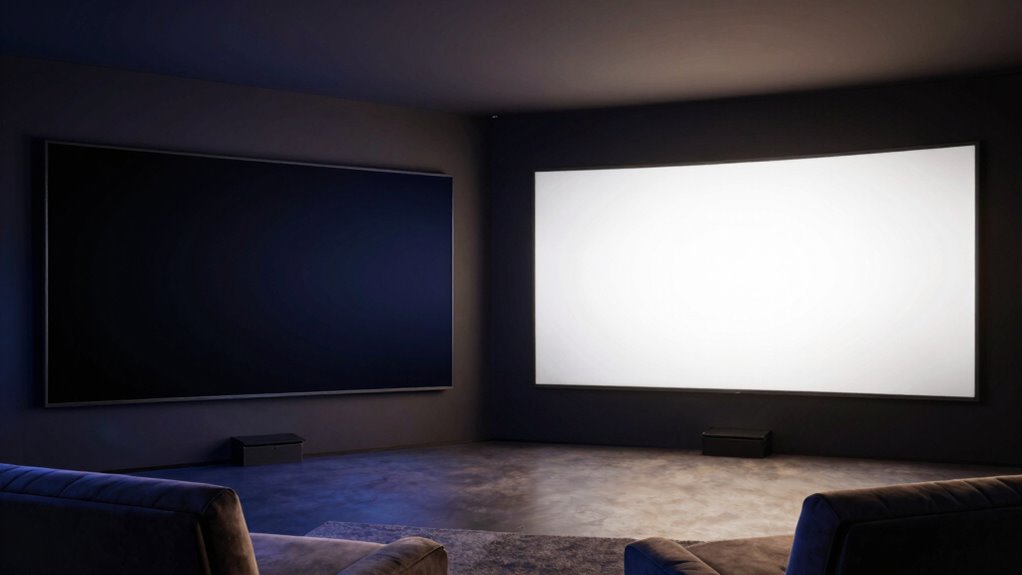

For your home theater, OLED offers stunning contrast and deep blacks, perfect for dark rooms, but beware of burn-in with static images. Mini-LEDs are more durable, brighter, and better suited for well-lit spaces or static content, making them ideal for long-term use. If you prioritize vivid images and longevity, Mini-LED might be the way to go. Want to discover more about which technology matches your viewing habits? Keep exploring to find out.
Key Takeaways
- OLED delivers superior contrast and deep blacks, ideal for dark-room home theater viewing.
- Mini-LEDs offer brighter images and better resistance to burn-in, suitable for well-lit rooms.
- OLED screens are more prone to burn-in with static content, less ideal for prolonged menu or logo display.
- Mini-LEDs provide longer durability and are better for consistent use with static images.
- Power consumption varies based on scene brightness; OLEDs excel in dark scenes, Mini-LEDs in bright environments.
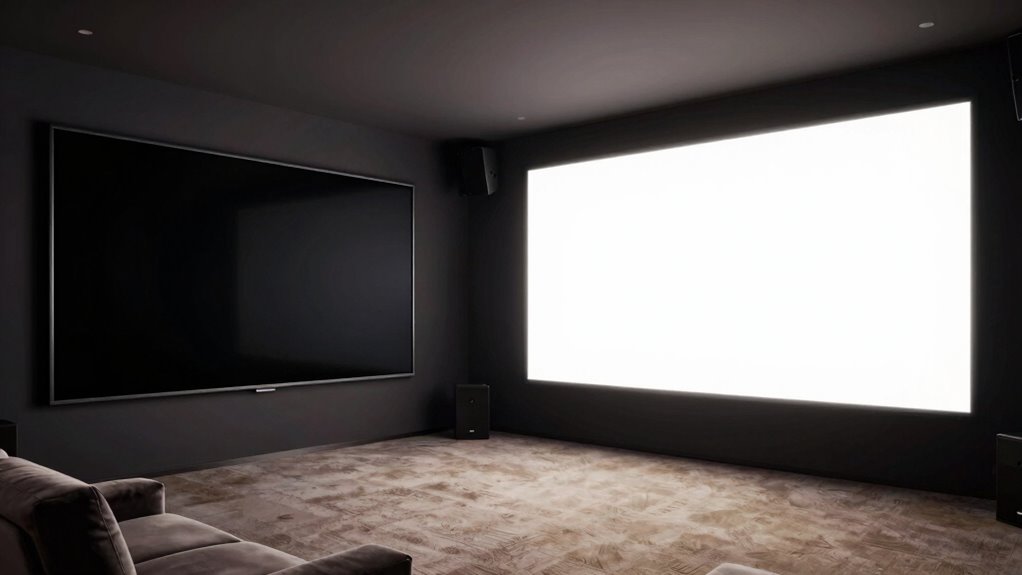
When choosing a display for your home theater, understanding the differences between OLED and Mini-LED technology can considerably impact your viewing experience. Both options deliver stunning picture quality, but they differ markedly in aspects like screen durability and power consumption, which are vital for real-world use.
OLED screens are renowned for their exceptional contrast and deep blacks, thanks to individual pixel illumination. However, their screen durability can be a concern over time. Because each pixel emits its own light, there’s a risk of burn-in if static images, like logos or menus, are displayed for extended periods. This makes OLED less ideal if you often watch channels with persistent graphics or use your TV as a computer monitor. In contrast, Mini-LED displays use thousands of tiny LEDs behind an LCD panel, which are less susceptible to burn-in and generally offer longer-lasting performance. The backlighting system in Mini-LEDs also contributes to improved durability, making them better suited for heavy daily use where static images are common. Additionally, screen longevity** is an important factor to consider when selecting a display for consistent, long-term use. The use of advanced backlighting techniques in Mini-LEDs further enhances their durability and ability to deliver bright, uniform images. Moreover, Mini-LEDs often incorporate local dimming technology, which improves contrast and black levels by adjusting the backlight in specific areas of the screen. In addition, manufacturing complexity** of Mini-LEDs can influence their initial cost and repairability over time.
OLEDs offer deep blacks but risk burn-in; Mini-LEDs are more durable and better for static images.
Power consumption is another vital factor. OLED screens tend to use less power when displaying darker images because black pixels are turned off completely. This efficiency is advantageous if you’re conscious of energy use or want to minimize electricity costs. On the other hand, Mini-LEDs, with their extensive backlighting, often consume more power, especially during bright scenes where many LEDs are lit simultaneously. However, in scenes with a lot of white or bright colors, OLEDs might also draw comparable or slightly higher power, depending on the content. If low power consumption is a priority, OLEDs can be more efficient, but if your viewing involves mostly bright, colorful content, Mini-LEDs might be more energy-friendly.
In real-world, room-use scenarios, these differences matter. OLED’s superior contrast and color accuracy make it ideal for dark-room viewing, but its vulnerability to burn-in and potentially higher power draw during bright scenes are drawbacks. Mini-LEDs provide brighter images with less risk of burn-in and generally better durability, especially in well-lit rooms or for prolonged use. While they might consume more power during bright scenes, their longevity and resilience can translate to fewer worries about screen damage over time. Ultimately, your choice hinges on your viewing habits, room lighting conditions, and how much you prioritize energy efficiency versus picture quality and screen longevity.

Samsung 65-Inch Class OLED S90F 4K Smart TV (2025 Model) NQ4 AI Gen3 Processor Upscaling Pro HDR +, Motion Xcelerator 144Hz, Vision Alexa Built-in
- Advanced 4K AI Processor: Powered by 128 neural networks for optimal picture and sound
- 4K Upscaling for All Content: Transforms and enhances everything to 4K resolution
- High Brightness and Deep Contrast: Boosts brightness and contrast for detailed visuals
As an affiliate, we earn on qualifying purchases.
As an affiliate, we earn on qualifying purchases.
Frequently Asked Questions
Which Technology Is More Energy-Efficient for Long-Term Use?
You’ll find that Mini-LED TVs are generally more energy-efficient over long-term use compared to OLEDs. Mini-LEDs use less power because their backlighting is more controlled, improving energy efficiency. OLEDs, while offering better color accuracy and wider viewing angles, tend to consume more energy especially when displaying bright scenes. So, if saving energy is your priority, Mini-LEDs are the better choice, even if OLEDs excel in color and angles.
How Do OLED and Mini-Led Compare in Terms of Durability?
Think of your screen as a seasoned traveler, constantly exposed to new adventures. OLED screens tend to have excellent color stability but may face issues like burn-in over time, affecting screen longevity. Mini-LEDs, however, offer robust durability with less risk of burn-in, maintaining their integrity longer. So, if you seek lasting performance and consistent color, Mini-LEDs might be your more resilient companion.
Can Mini-Led TVS Achieve True Black Levels Like OLEDS?
Mini-LED TVs can’t quite achieve true black levels like OLEDs do, but they come close. You’ll notice improved contrast and better color accuracy compared to older LED options. Although viewing angles aren’t as wide as on OLEDs, modern Mini-LEDs reduce blooming and maintain good picture quality from various positions. While they don’t perfectly match OLEDs’ perfect blacks, Mini-LEDs offer impressive performance for most home theater setups.
What Are the Maintenance Requirements for Each Display Type?
You’ll find that OLED screens require less maintenance, mostly occasional screen calibration to prevent burn-in, which affects about 2% of users. Mini-LEDs need regular dust removal from vents and careful cleaning to avoid dust accumulation that can impact picture quality. Both types benefit from keeping screens clean and dust-free, but OLEDs generally demand less ongoing upkeep. Proper maintenance guarantees your display stays vibrant and functional longer.
How Do Ambient Lighting Conditions Affect Each Display’s Performance?
Ambient lighting conditions considerably impact each display’s performance. With OLEDs, ambient contrast can be reduced by bright surroundings, causing less vibrant blacks and colors. Mini-LEDs handle ambient lighting better, as their brightness can combat lighting reflection, maintaining clearer picture quality. To optimize viewing, control lighting to minimize reflections, especially for OLEDs, and consider room lighting that complements each display’s strengths for the best home theater experience.

Samsung 55-Inch Class M80H Series, Mini LED, 4K, Smart TV, 2026 Model
- Mini LED with AI Mode: Enhanced brightness and contrast with AI
- Motion Xcelerator 144Hz: Smooth fast-paced motion for gaming
- Variable Refresh Rate: Eliminates stutter and tearing
As an affiliate, we earn on qualifying purchases.
As an affiliate, we earn on qualifying purchases.
Conclusion
When choosing between OLED and Mini-LED for your home theater, consider your priorities like contrast, brightness, and budget. Did you know OLEDs offer perfect blacks thanks to their self-emitting pixels, while Mini-LEDs can reach higher brightness levels for a brighter room experience? Ultimately, your choice depends on what matters most for your viewing. Either way, you’re set to enjoy stunning visuals that elevate your movie nights and gaming sessions.

Roku 65-Inch Smart TV – Plus Series, 4K QLED Mini-LED TV – RokuTV
- Stunning 4K QLED Picture: Mini-LED backlighting and Dolby Vision
- Vast Content Library: Access to diverse entertainment options
- Free Streaming Channels: Over 500 channels including live TV
As an affiliate, we earn on qualifying purchases.
As an affiliate, we earn on qualifying purchases.

LG 65-Inch OLED C3 HDR 4K Smart OLED TV Bundle – 120 HZ Refresh Rate + UAX 4K HDMI 2.0 Cable + CPS 24 Months Protection and Streaming Kit with Alexa
- Stunning Visuals: OLED evo panel with AI Processor Gen6
- Immersive Audio: Dolby Atmos and AI Sound Pro
- Gaming Optimization: 120Hz refresh rate with G-Sync and FreeSync
As an affiliate, we earn on qualifying purchases.
As an affiliate, we earn on qualifying purchases.