When evaluating subwoofer size, don’t rely solely on driver diameter. Focus on the entire system, including frequency response, enclosure type, and room acoustics. A smaller driver in a finely-tuned enclosure can deliver deep, accurate bass, while a larger driver in a poor setup might fall short. Your room size and system synergy also matter. To get the best sound, consider all these factors—if you continue exploring, you’ll discover how they work together for peak performance.
Key Takeaways
- Prioritize frequency response and enclosure design over driver size for accurate, deep bass performance.
- Consider the enclosure type (sealed or ported) to optimize how driver movement translates into sound.
- Evaluate how well the subwoofer integrates with your main speakers and room acoustics.
- Recognize that smaller drivers with proper tuning can outperform larger drivers in optimal enclosures.
- Focus on overall system synergy and setup rather than just driver diameter for the best listening experience.
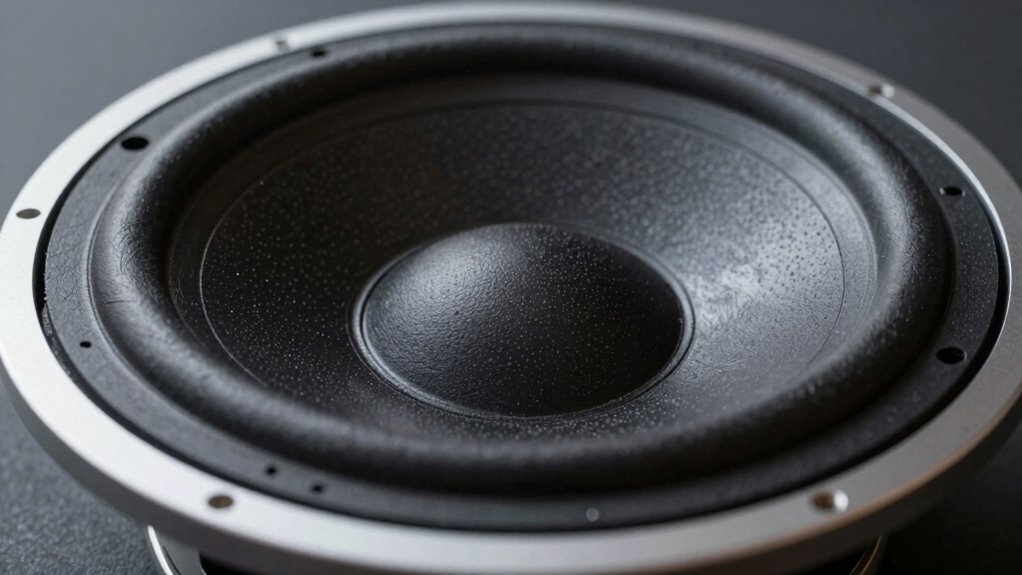
When choosing a subwoofer, many people focus solely on driver diameter, but that’s only part of the story. The size of the driver doesn’t tell the whole tale about how the subwoofer will perform. To get a true sense of what you’re investing in, you need to look at other factors like frequency response and enclosure design. These elements shape the overall sound quality and how well the subwoofer integrates into your system.
Frequency response is a key factor because it tells you the range of bass frequencies the subwoofer can reproduce. A broader frequency response means you’ll hear deeper and more accurate bass notes, which can make your listening experience more immersive. For example, a subwoofer with a frequency response extending down to 20Hz will produce those deep, rumbling lows that give music and movies their impact. Conversely, a narrower response might cut off the lowest frequencies, making the bass sound less full and powerful. So, don’t just look at the driver size; pay attention to the specified frequency response to ensure your subwoofer can handle the depth of sound you desire.
A wider frequency response delivers deeper, more accurate bass for an immersive sound experience.
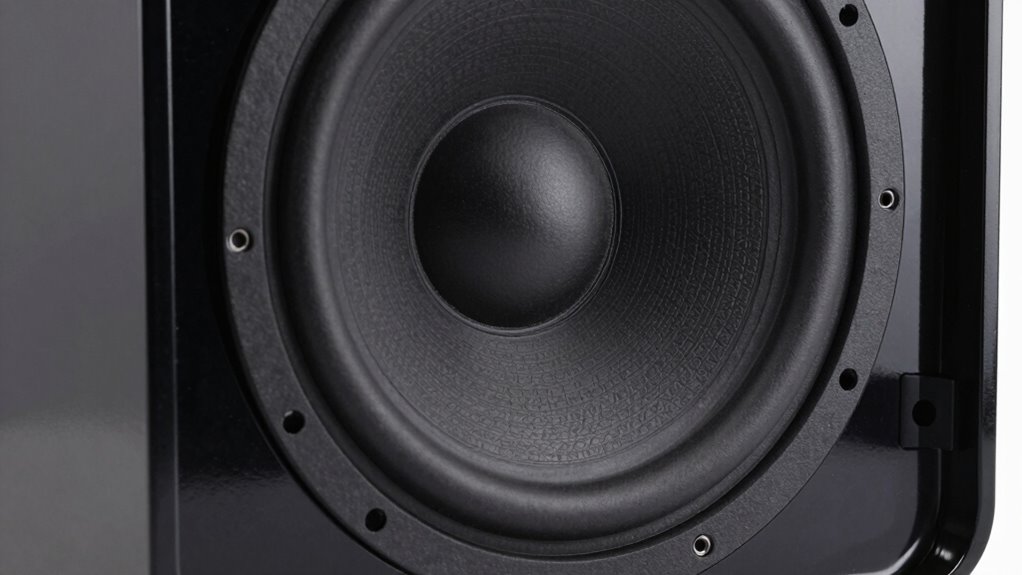
Enclosure design plays a vital role in how well your subwoofer performs and sounds. The enclosure determines how the driver’s motion translates into sound waves, affecting clarity, efficiency, and overall output. There are mainly two types: sealed and ported enclosures. Sealed boxes tend to produce tighter, more accurate bass, making them ideal for music where precision is important. Ported enclosures, on the other hand, are designed to increase output at specific low frequencies, providing more volume for home theater setups. The right enclosure design depends on your listening preferences and space constraints. A larger driver paired with a well-designed enclosure can outperform a bigger driver in a poorly designed box.
It’s also worth noting that a larger driver isn’t automatically better if the enclosure isn’t optimized or if the frequency response isn’t suitable for your needs. A smaller driver in a carefully chosen enclosure with a wide frequency response can deliver more satisfying bass than a larger, less well-designed subwoofer. Additionally, driver size should be considered in conjunction with other factors, like enclosure type and room acoustics, to achieve the best results. Considering the overall system setup can help you select a subwoofer that complements your main speakers and room environment. In fact, system synergy—how well the subwoofer works with your main speakers and room environment—is often overlooked but crucial for optimal sound. Keep in mind that system synergy matters, too; the subwoofer’s design should complement your main speakers and room size. Additionally, considering the driver’s size in conjunction with other factors can help you make a more informed decision. By considering both frequency response and enclosure design, you’re better equipped to select a subwoofer that will deliver the sound quality you’re after, rather than just chasing after the largest driver.
best subwoofer with wide frequency response
As an affiliate, we earn on qualifying purchases.
As an affiliate, we earn on qualifying purchases.
Frequently Asked Questions
How Does Enclosure Type Affect Subwoofer Performance?
The enclosure type directly impacts your subwoofer’s performance, affecting sound quality and output. A sealed enclosure offers tight, accurate bass, while ported enclosures provide louder, deeper sound. Your choice also influences enclosure aesthetics, blending with your vehicle or room decor. Proper subwoofer placement within the enclosure guarantees ideal sound dispersion. Ultimately, selecting the right enclosure type enhances your listening experience, making sure your subwoofer performs at its best.
What Role Does Cone Material Play in Sound Quality?
You might think cone material doesn’t matter much, but it considerably impacts sound quality. A durable cone resists wear and tear, ensuring longevity, while material resonance influences clarity. For crisp, accurate bass, opt for cones made from stiff, lightweight materials like polypropylene or kevlar. These materials reduce unwanted vibrations, resulting in cleaner sound. So, investing in quality cone material enhances both durability and sound fidelity, giving you richer, more precise audio.
How Important Is Power Handling Capacity in Subwoofer Choice?
Power handling capacity is vital when choosing a subwoofer because it determines how much bass response it can produce without distortion or damage. A subwoofer with higher power handling can better handle your desired crossover frequency, delivering clear, deep bass at higher volumes. If you plan on playing loud music or movies, prioritize a subwoofer that can manage increased power, ensuring consistent performance and avoiding potential damage.
Can Multiple Subwoofers Improve Overall Bass?
Multiple subwoofers are like a symphony of bass, filling your space more evenly. They can notably improve overall bass by reducing dead spots and increasing sound pressure. Proper subwoofer placement and acoustic tuning are key—placing them strategically and fine-tuning your system enhances clarity and depth. This setup ensures powerful, balanced bass that feels immersive, rather than overwhelming, creating a richer listening experience for your entire room.
How Does Room Size Influence Subwoofer Size Selection?
Room size directly influences your subwoofer choice because larger rooms need bigger subwoofers to fill the space with deep bass. Consider room acoustics, like shape and materials, which affect sound distribution. You should also think about your listener preferences; if you want powerful, room-filling bass, opt for a larger subwoofer. For smaller spaces or softer bass, a smaller subwoofer with good acoustic treatment might be ideal.
sealed vs ported subwoofer enclosure
As an affiliate, we earn on qualifying purchases.
As an affiliate, we earn on qualifying purchases.
Conclusion
Understanding subwoofer size isn’t just about the number on the driver; it’s about feeling the heartbeat of your music and the thunder of your movies. Think of it as tuning into a symphony where every element, from size to enclosure, crafts a vivid landscape of sound. When you look beyond the diameter, you reveal a world of depth and emotion—transforming your space into a sanctuary where bass becomes the soul of your experience.
compact subwoofer for small rooms
As an affiliate, we earn on qualifying purchases.
As an affiliate, we earn on qualifying purchases.
subwoofer system for home theater
As an affiliate, we earn on qualifying purchases.
As an affiliate, we earn on qualifying purchases.