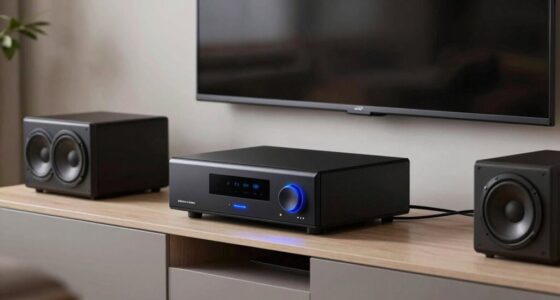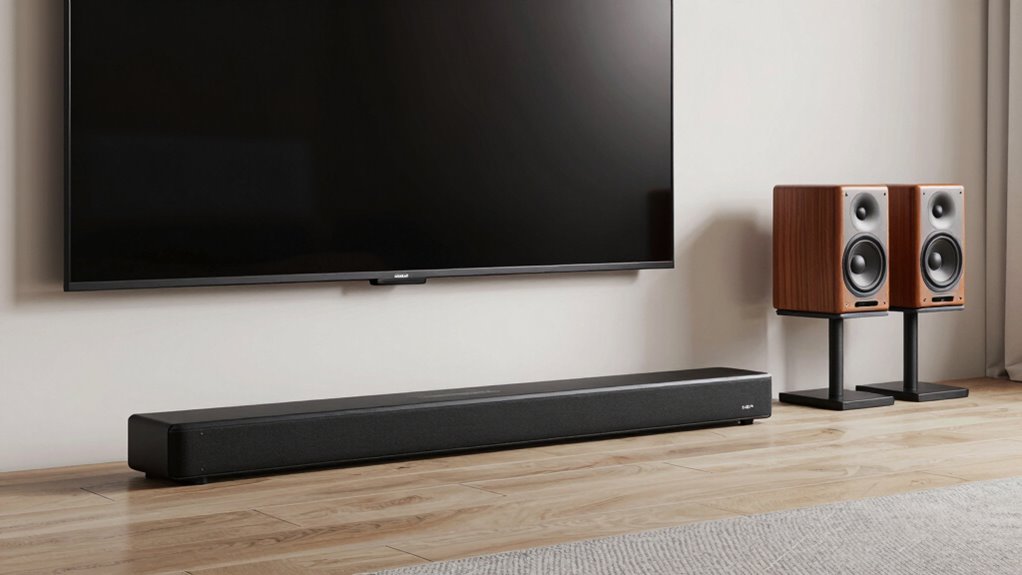

If you prioritize quick setup and simple streaming, a soundbar offers great convenience with minimal fuss, especially in smaller or cluttered rooms. On the other hand, separate speakers give you more flexibility to customize sound placement and expand your system over time, which might require more effort initially. The right choice depends on whether you prefer ease or tailored sound environments. Want to discover how to balance both options effectively? Keep going for insights that can help.

Get audio and creator gear delivered free — and shop member deals
- Fast, free delivery on millions of items
- Access to Prime Big Deal Days deals on October 6–7
- Prime Video, Amazon Music and more included
Key Takeaways
- Soundbars offer quick, easy setup and minimal calibration, ideal for users prioritizing convenience.
- Separate speakers provide customizable placement for enhanced sound quality but require more complex setup.
- Wireless connectivity in soundbars simplifies device streaming, while separate speakers may need additional network configuration.
- Larger, challenging rooms benefit from the flexibility of separate speakers, whereas small spaces favor soundbars for simplicity.
- The choice involves balancing the ease of use of soundbars against the tailored, expandable capabilities of separate speaker systems.

When choosing between a soundbar and separate speakers, convenience often takes center stage, but it’s important to weigh the flexibility each option offers. As you consider your setup, room acoustics play a vital role. Soundbars are designed to deliver a streamlined audio experience, adjusting well to most living spaces with minimal tweaking. They often have built-in processing that compensates for room imperfections, helping you get clear sound without extensive calibration. Conversely, separate speakers—such as bookshelf or floor-standing models—can be more sensitive to your room’s acoustics. Proper placement becomes essential, as their sound quality can vary depending on how they interact with furniture, walls, and corners. If your room is small or cluttered, a soundbar might be more forgiving and easier to optimize, while larger or more acoustically challenging spaces can benefit from the precise positioning of separate speakers. Additionally, room acoustics significantly influence how well your audio setup performs, especially when using separate speakers. Wireless connectivity is another major factor in your decision. Soundbars typically come equipped with built-in Wi-Fi, Bluetooth, or both, making it simple to stream music from your devices without tangled cables. The convenience of wireless connectivity means you can place your soundbar anywhere within range, avoiding the hassle of running wires across the room. Many high-end models even support multi-room streaming or integration with smart home systems, giving you seamless control and flexibility. When it comes to separate speakers, wireless options exist too, but they often require more setup and maintenance. You might need to connect each speaker to your Wi-Fi network or use wireless transmitters, which can add complexity but also allow for more tailored speaker placement. This adaptability can lead to a richer, surround-sound experience, especially if you’re willing to experiment with speaker positioning. Moreover, understanding Wireless connectivity options helps you select a system that best fits your lifestyle and technical comfort level. Considering room size and layout can further influence your choice, as different setups respond differently based on space dimensions and furniture arrangement. For example, a larger room may require more powerful or strategically placed speakers to fill the space effectively. Ultimately, your choice hinges on balancing convenience with adaptability. If you prioritize simplicity and a clean look with minimal fuss, a soundbar with robust wireless connectivity is likely your best bet. It offers quick setup, easy control, and decent room acoustics handling for most spaces. However, if you’re an audiophile or someone who wants a customized sound environment, separate speakers provide the flexibility to optimize placement for your room’s unique acoustics. They also give you the option to expand your system over time, adding more speakers or upgrading individual units. Whichever route you choose, understanding how room acoustics and wireless connectivity influence your setup helps guarantee you get the best sound experience tailored to your space and lifestyle.
wireless soundbar with Bluetooth
As an affiliate, we earn on qualifying purchases.
As an affiliate, we earn on qualifying purchases.
Frequently Asked Questions
How Does Sound Quality Compare Between Soundbars and Traditional Speakers?
Soundbars generally offer good audio clarity and create impressive surround sound effects, but they often can’t match the depth and richness of traditional speakers. If you’re after a more immersive experience with detailed audio, traditional speakers typically outperform soundbars. However, for convenience and space-saving design, soundbars provide a solid compromise, delivering decent surround sound without the complexity of multiple speakers. Your choice depends on whether you prioritize convenience or ultimate sound quality.
Are Soundbars Compatible With All TV Brands and Models?
Most soundbars are compatible with a wide range of TV brands and models, making setup straightforward. However, you should check TV compatibility before buying, as some soundbars may have brand limitations or require specific connections like HDMI ARC or optical audio. Compatibility varies depending on your TV’s ports and features. To avoid issues, review your TV’s specifications and the soundbar’s compatibility details to guarantee seamless integration.
What Is the Average Cost Difference Between Soundbars and High-End Speakers?
You’re curious about the cost comparison between soundbars and high-end speakers. Typically, soundbars are more affordable, averaging around $150 to $500, while high-end speakers can range from $1,000 to over $5,000. Price variability depends on features, brand, and sound quality. The difference is significant, but if audio quality is your priority, investing in premium speakers might be worth the extra expense—though it’s a gamble worth considering.
Can Soundbars Be Easily Upgraded or Expanded Over Time?
Soundbars generally aren’t easily upgraded or expanded because they lack modular design, which limits your upgrade potential. Most are built as integrated units, making it difficult to add or replace components over time. If you want flexibility for future upgrades, consider traditional speakers or modular systems. These allow you to expand or upgrade parts as needed, offering better long-term adaptability compared to standard soundbars.
How Do Soundbars Impact Room Aesthetics Compared to Speaker Setups?
Did you know 78% of people prefer a sleek, minimalist look in their living rooms? Soundbars typically impact room decor positively by offering a streamlined, integrated design that blends seamlessly with your TV. Unlike traditional speaker setups, they don’t clutter your space, enhancing visual integration. This makes soundbars an attractive choice if you want excellent sound without sacrificing aesthetic appeal or creating visual chaos.
bookshelf speakers for home theater
As an affiliate, we earn on qualifying purchases.
As an affiliate, we earn on qualifying purchases.
Conclusion
Choosing between a soundbar and separate speakers is like picking between a cozy blanket and a full wardrobe — each offers comfort in its way. If you value simplicity and minimal setup, a soundbar is your best bet. But if you crave versatility and richer sound, separate speakers give you more control. Remember, the right choice depends on what you prioritize most. It’s all about finding the perfect fit for your space and lifestyle, like a puzzle piece slipping perfectly into place.
multi-room wireless speaker system
As an affiliate, we earn on qualifying purchases.
As an affiliate, we earn on qualifying purchases.
compact soundbar for small rooms
As an affiliate, we earn on qualifying purchases.
As an affiliate, we earn on qualifying purchases.
Evergreen bestsellers Picks
bestsellers
As an affiliate, we earn on qualifying purchases.