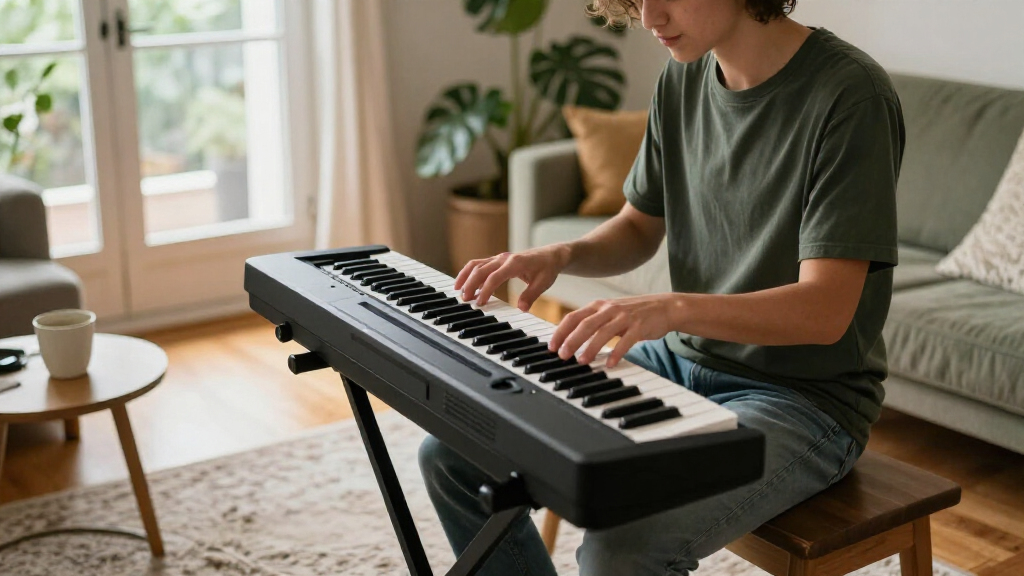

The best portable digital piano for most players is the Yamaha P-145BT, which pairs a full 88-key weighted action with Bluetooth for a more piano-like practice setup. The Roland FP-10 is another strong choice if weighted keys matter more than extra connectivity, while the Yamaha PSR-E283 suits beginners who want a lighter 61-key keyboard with learning features. The main tradeoff is between realistic full-size keys and the lighter, easier-to-carry bodies and bundled extras found on many 61-key models. Foldable options save storage space, but their key feel and playing experience differ from conventional digital pianos. Read on for the full breakdown and a guide to choosing the right portable setup.

Get audio and creator gear delivered free with Prime
- Fast, free delivery on millions of items
- Prime Video, Amazon Music and more included
- Member-only deals all year
Complete the kit


Key Takeaways
- Full-size weighted keys separate piano-focused picks from general-purpose keyboards: the Yamaha P-145BT, Yamaha P71, and Roland FP-10 are better suited to building piano technique than the 61-key models.
- Bluetooth is not the same as built-in lesson content: the Yamaha P-145BT offers Bluetooth, while beginner keyboards such as the Yamaha PSR-E283 focus more on onboard learning and accompaniment features.
- Accessory bundles can reduce setup friction but do not make a keyboard more piano-like: the Alesis Melody 61 and Donner DEK-610S include starter gear, while their 61-key layouts remain a compromise for repertoire that spans a full piano range.
- Foldable designs prioritize storage and transport over conventional key feel: the Rhymo and FingerBallet models appeal to space-limited players, but neither is the closest match for an acoustic-piano action.
- The strongest choice depends on the job, not the number of included extras: weighted 88-key models suit piano study, 61-key kits suit casual beginners, and lighted keys or Bluetooth MIDI address narrower learning and connectivity needs.
| Zilvok 88-Key Digital Piano with Semi-Weighted Keys and Beginner Accessory Kit |  | Best All-in-One 88-Key Starter Kit | Keys: 88 | Key type: Semi-weighted | Tones: 1,000 | VIEW LATEST PRICE | See Our Full Breakdown |
| Yamaha P71 88-Key Weighted-Action Digital Piano with Sustain Pedal and Power Supply |  | Best for Piano-Focused Practice | Keys: 88 | Key action: Weighted hammer action | Voices: 10 | VIEW LATEST PRICE | See Our Full Breakdown |
| Roland FP-10 88-Key Digital Piano |  | Best for App-Connected Learning | Keys: 88 | Keyboard: PHA-4 Standard | Sound engine: SuperNATURAL Piano | VIEW LATEST PRICE | See Our Full Breakdown |
| 61-Key Portable Electronic Keyboard Piano with Dual Speakers and Microphone |  | Best Battery-Powered Pick | Keys: 61 | Tones: 100 | Rhythms: 10 | VIEW LATEST PRICE | See Our Full Breakdown |
| Alesis Melody 61-Key Beginner Keyboard with Stand, Bench, and Headphones |  | Best for a Ready-to-Play Beginner Setup | Keys: 61 | Sounds: 300 | Rhythms: 300 | VIEW LATEST PRICE | See Our Full Breakdown |
| Alesis Recital Play 88-Key Portable Keyboard Bundle |  | Best Full-Range Beginner Bundle | Keys: 88 full-size, touch-sensitive keys | Sounds: 480 instrument sounds | Rhythms: 160 | VIEW LATEST PRICE | See Our Full Breakdown |
| Donner DEK-610S 61-Key Beginner Keyboard Piano Kit with Stand, Bench, and Microphone |  | Best Complete 61-Key Starter Kit | Keys: 61 | Voices and rhythms: 249 voices and 249 rhythms | Polyphony: 32 notes | VIEW LATEST PRICE | See Our Full Breakdown |
| JIKADA 61-Key Portable Electronic Keyboard Piano Set with Lighted Keys |  | Best for Visual Learning | Keys: 61 | Teaching modes: 3 | Tones and rhythms: 255 tones and 255 rhythms | VIEW LATEST PRICE | See Our Full Breakdown |
| RockJam RJ5061 61-Key Keyboard Piano Kit with Stand, Bench, and Headphones |  | Best for Shared-Space Practice | Keys: 61 full-size keys | Tones and rhythms: 200 tones and 200 rhythms | Controls and display: Pitch bend wheel and LED panel | VIEW LATEST PRICE | See Our Full Breakdown |
| Rhymo 61-Key Folding Digital Piano with Bluetooth MIDI |  | Best for Fold-and-Go Portability | Keys: 61 touch-sensitive, slightly weighted keys | Polyphony: 128 notes | Timbres: 128 | VIEW LATEST PRICE | See Our Full Breakdown |
| FingerBallet BX20 88-Key Foldable Semi-Weighted Digital Piano |  | Best Foldable 88-Key Option | Keys: 88 full-size keys | Key type: Touch-sensitive, semi-weighted | Tones and rhythms: 128 tones; 128 rhythms | VIEW LATEST PRICE | See Our Full Breakdown |
| Alesis Melody 61 MK4 61-Key Portable Keyboard |  | Best Feature-Rich Beginner Keyboard | Keys: 61 compact keys | Built-in sounds and rhythms: 300 sounds; 300 accompaniment rhythms | Demo songs: 30 | VIEW LATEST PRICE | See Our Full Breakdown |
| 61-Key Portable Electronic Keyboard Piano with Built-In Speaker and Microphone |  | Best for Casual Play and Singing | Keys: 61 | Demonstration tracks: 100 | Timbres and rhythms: 100 timbres; 10 rhythms | VIEW LATEST PRICE | See Our Full Breakdown |
| Yamaha P-145BT 88-Key Digital Piano with Weighted Keys and Bluetooth |  | Best for Piano-Style Touch on the Go | Keys: 88 weighted, touch-sensitive keys | Key action: Graded Hammer Compact | Connectivity: Bluetooth audio | VIEW LATEST PRICE | See Our Full Breakdown |
| Yamaha PSR-E283 61-Key Portable Keyboard for Beginners |  | Best Beginner Learning Companion | Keys: 61 full-sized keys | Learning and play features: Quiz Mode, Smart Chord, Portable Grand Piano button, built-in songs | Connectivity: USB, auxiliary | VIEW LATEST PRICE | See Our Full Breakdown |
| portable digital piano | Keys | Connectivity | Weight | Power |
|---|---|---|---|---|
| Zilvok 88-Key Digital Piano wi | 88 | Bluetooth, USB-MIDI | — | — |
| Yamaha P71 88-Key Weighted-Act | 88 | USB, auxiliary input, sustain jack, headphone jack | 25 pounds | — |
| Roland FP-10 88-Key Digital Pi | 88 | Bluetooth, USB MIDI | 27 pounds | — |
| 61-Key Portable Electronic Key | 61 | — | — | Adapter or 4 AA batteries (not included) |
| Alesis Melody 61-Key Beginner | 61 | USB-MIDI, 1/4-inch sustain input, 1/8-inch auxiliary input, 1/8-inch headphone output | 6.6 pounds | — |
| Alesis Recital Play 88-Key Por | 88 full-size, touch-sensitive keys | USB-MIDI, sustain pedal input, auxiliary input, and headphone output | 5.5 kg | Power adapter or 6 AA batteries (not included) |
| Donner DEK-610S 61-Key Beginne | 61 | 3.5 mm headphone jack | 9.9 lb | Corded electric |
| JIKADA 61-Key Portable Electro | 61 | Auxiliary input/output, microphone jack, 3.5 mm headphone jack, and UDISK port | — | Corded electric |
| RockJam RJ5061 61-Key Keyboard | 61 full-size keys | 3.5 mm headphone jack, auxiliary, and USB | 3.3 kg | Battery powered |
| Rhymo 61-Key Folding Digital P | 61 touch-sensitive, slightly weighted keys | Bluetooth MIDI and USB Type-C | Listed as 2.3 kg in the description and 3.63 kg in product information | — |
| FingerBallet BX20 88-Key Folda | 88 full-size keys | Bluetooth MIDI; USB | 5.64 kg | Battery powered |
| Alesis Melody 61 MK4 61-Key Po | 61 compact keys | USB-MIDI, USB Type B, 3.5 mm jack, 6.35 mm jack | 3 kg | AC adapter or 6 AA batteries (not included) |
| 61-Key Portable Electronic Key | 61 | — | — | AC adapter or 4 AA batteries (not included) |
| Yamaha P-145BT 88-Key Digital | 88 weighted, touch-sensitive keys | Bluetooth audio | 24.5 lb | Corded electric |
| Yamaha PSR-E283 61-Key Portabl | 61 full-sized keys | USB, auxiliary | 8.8 lb | AC adapter or batteries |
More Details on Our Top Picks
Zilvok 88-Key Digital Piano with Semi-Weighted Keys and Beginner Accessory Kit
The Zilvok suits beginners who want a full-size keyboard and the basic setup pieces in one bundle. Its 88 semi-weighted keys offer more room for two-handed practice than the 61-key Alesis Melody, though they provide less resistance than the weighted hammer action on the Yamaha P71. A large collection of tones, rhythms, and demo songs gives new players plenty to explore, while recording, USB-MP3 playback, and Bluetooth add practice options beyond straightforward piano playing. The included stand, carrying case, headphones, and sustain pedal reduce the need to source accessories separately. The tradeoff is that its broad feature set does not make the keys a close substitute for an acoustic piano action, and the double-X stand may not fit every playing space.
Pros:- Full 88-key layout supports practice across a wider range than 61-key models.
- Semi-weighted keys provide more resistance than unspecified-action beginner keyboards.
- Includes a stand, carrying case, headphones, sustain pedal, and music rest.
- Bluetooth, USB-MIDI, recording, and USB-MP3 playback expand practice options.
Cons:- Semi-weighted keys offer less resistance than the weighted hammer action on the Yamaha P71.
- The included double-X stand may not suit every setup.
- Its many tones and rhythms may be less useful to buyers focused mainly on piano technique.
Best for: Beginners who want 88 keys, a carrying case, and a broad set of practice features in a single starter bundle.
Not ideal for: Players developing an acoustic-style touch or shoppers who need a particularly stable, customized stand setup.
- Keys:88
- Key type:Semi-weighted
- Tones:1,000
- Rhythms:1,000
- Demo songs:150
- Connectivity:Bluetooth, USB-MIDI
- Functions:Recording and playback, dual keyboard, USB-MP3 playback
- Included accessories:Sustain pedal, power supply, stand, carrying case, headphones, key stickers, music rest
Our verdict“Choose the Zilvok if you want a full-size beginner setup with accessories and features, but not if realistic weighted action is your priority.”
Yamaha P71 88-Key Weighted-Action Digital Piano with Sustain Pedal and Power Supply
The Yamaha P71 is the most direct fit here for players who value piano feel over an abundance of built-in activities. Its 88 touch-sensitive, weighted keys provide a more piano-oriented playing experience than the semi-weighted Zilvok, while its 10 voices keep the control layout relatively simple. The Yamaha grand piano voice, built-in speakers, and included sustain pedal cover the essentials for home practice without requiring a separate sound system. Duo Mode can split the keyboard into matching ranges for lessons, and voice layering adds some variety. Compared with the Roland FP-10, the P71 has fewer connectivity options and lacks Bluetooth; its simpler feature set is a plus for focused practice but a limitation for app-based learning. At 25 pounds and over 52 inches wide, it is portable between setups, not a compact travel keyboard.
Pros:- Weighted hammer action and touch sensitivity support piano-style playing.
- Includes a Yamaha grand piano voice alongside nine other voices.
- Duo Mode and voice layering offer useful lesson and practice options.
- Sustain pedal and power supply are included.
Cons:- No Bluetooth or MIDI connectivity is listed, unlike the Roland FP-10’s Bluetooth and USB MIDI.
- Its 52.25-inch width requires a substantial stand or surface.
- The 10-voice selection is limited compared with feature-rich beginner keyboards.
Best for: Piano students who want a full 88-key weighted action and a straightforward instrument for home practice or lessons.
Not ideal for: Buyers seeking Bluetooth app connections, extensive sound libraries, or a small battery-powered keyboard for frequent travel.
- Keys:88
- Key action:Weighted hammer action
- Voices:10
- Modes:Duo Mode; Dual Mode for layering voices
- Connectivity:USB, auxiliary input, sustain jack, headphone jack
- Dimensions:52.25 × 11.5 × 6 inches
- Weight:25 pounds
- Included components:Sustain pedal, power supply
Our verdict“Pick the P71 for simple, weighted 88-key piano practice, and choose the Roland FP-10 instead if Bluetooth and USB-MIDI matter more.”
Roland FP-10 88-Key Digital Piano
The Roland FP-10 pairs a full 88-key layout with a PHA-4 Standard keyboard, making it a stronger choice for developing piano technique than the 61-key Alesis Melody or the semi-weighted Zilvok. Its SuperNATURAL piano tones keep the sound focus on piano, while Bluetooth and USB MIDI support connections to apps, computers, and music software. Twin Piano mode is especially useful for lessons because student and teacher can play in matching ranges. Built-in speakers work for casual practice, and the headphone output offers a quieter option. Compared with the Yamaha P71, the FP-10 adds Bluetooth and app integration, though it also weighs more at 27 pounds and its listed dimensions call for ample room. The matching stand is sold separately, and its corded power limits where it can be set up.
Pros:- PHA-4 Standard 88-key keyboard supports expressive piano practice.
- Bluetooth and USB MIDI offer flexible connections to apps and computers.
- Twin Piano mode can support student-teacher lessons.
- Built-in speakers and headphone output suit shared and quiet practice.
Cons:- Matching stand is sold separately.
- Corded electric power restricts placement near an outlet.
- At 27 pounds, it is heavier than the 25-pound Yamaha P71.
Best for: Students who want a full-size piano keyboard with Bluetooth or USB-MIDI for lessons, practice apps, or computer-based music work.
Not ideal for: Players who need battery operation, a stand included in the package, or a compact instrument to carry often.
- Keys:88
- Keyboard:PHA-4 Standard
- Sound engine:SuperNATURAL Piano
- Connectivity:Bluetooth, USB MIDI
- Modes:Twin Piano
- Weight:27 pounds
- Dimensions:54.45 × 15.94 × 11.1 inches
- Included accessories:DP-2 foot switch, sheet music rest
Our verdict“Choose the FP-10 if app connectivity and lesson-friendly features are worth the added setup needs and carrying weight.”
61-Key Portable Electronic Keyboard Piano with Dual Speakers and Microphone
This 61-key Ugrfw keyboard is the most flexible choice in this group for playing away from an outlet: it can run on an adapter or four AA batteries, while the 88-key Yamaha P71 and Roland FP-10 require corded power. Its lightweight ABS body and dual speakers make it easier to move around a home or take to a casual gathering. Beginners also get recording and playback, chord practice, rhythm programming, and 100 tones to explore. Those features make it more activity-focused than the Alesis Melody, which offers USB-MIDI and interactive lesson software. A key limitation is that the listing does not specify the key action or touch sensitivity, so buyers cannot judge how closely it supports piano technique. Batteries are also not included.
Pros:- Can run from an adapter or four AA batteries for flexible placement.
- Lightweight ABS construction supports easier movement than the full-size 88-key models.
- Includes recording, playback, chord practice, and rhythm programming.
- Dual speakers and microphone support suit casual, interactive playing.
Cons:- Four AA batteries are not included.
- Key action and touch sensitivity are not specified.
- Its 61-key range is narrower than the Zilvok, Yamaha P71, and Roland FP-10.
Best for: Families or beginners who want a lightweight keyboard for flexible rooms, casual play, and battery-powered use.
Not ideal for: Learners prioritizing known key action, touch-sensitive dynamics, or computer-based music connections.
- Keys:61
- Tones:100
- Rhythms:10
- Demo songs:100
- Speakers:Built-in dual speakers
- Power:Adapter or 4 AA batteries (not included)
- Functions:Recording and playback, rhythm programming, single-finger and multi-finger chords
- Sound effects:Sustain, vibrato, echo
Our verdict“Pick this keyboard for portable, battery-powered beginner play, but skip it if you need confirmed touch-sensitive keys or a full 88-key range.”
Alesis Melody 61-Key Beginner Keyboard with Stand, Bench, and Headphones
The Alesis Melody stands out as a practical starter bundle for someone who needs a place to sit and play as much as a keyboard. Its stand, bench, headphones, music rest, and power adapter make it more immediately set up than the Roland FP-10, whose matching stand is sold separately. The 61-key layout and 6.6-pound weight are easier to move than the full-size 88-key options, though they leave less range for advanced repertoire. A metronome, recording, Split Mode, and access to Skoove and Melodics add useful learning support. It also provides USB-MIDI and headphone output, unlike the more activity-focused Ugrfw keyboard, but computer-based lesson software needs a Mac or PC. Batteries are sold separately, and the unspecified key action makes it less suitable for buyers focused on piano feel.
Pros:- Bundle includes a stand, bench, headphones, music rest, and power adapter.
- At 6.6 pounds, the keyboard is easy to move between practice spots.
- USB-MIDI, metronome, recording, and Split Mode support varied practice.
- Skoove and Melodics compatibility offers additional learning options.
Cons:- The 61-key layout offers less range than the Zilvok, Yamaha P71, and Roland FP-10.
- Batteries are sold separately.
- Computer-based learning software requires a Mac or PC, and key action is not specified.
Best for: New players who want a lightweight 61-key keyboard with a stand, bench, headphones, and structured learning features.
Not ideal for: Pianists who need 88 keys, weighted action, or battery power included without a separate purchase.
- Keys:61
- Sounds:300
- Rhythms:300
- Demo songs:30
- Features:Built-in speaker, digital display, metronome, recording, Split Mode
- Connectivity:USB-MIDI, 1/4-inch sustain input, 1/8-inch auxiliary input, 1/8-inch headphone output
- Weight:6.6 pounds
- Included accessories:Stand, bench, headphones, music rest, power adapter
Our verdict“Choose the Alesis Melody for a light, accessory-rich first setup, but choose an 88-key model if piano range and technique are the priority.”
Alesis Recital Play 88-Key Portable Keyboard Bundle
For a beginner who wants to practice across the full piano range without assembling a kit, the Alesis Recital Play is the strongest fit in this group. Its 88 touch-sensitive keys offer more room for learning piano repertoire than the 61-key Donner DEK-610S, while the adjustable response gives new players a way to tailor how the keys react. The included stand, pedal, headphones, and carry case make it a more complete portable setup than buying a keyboard alone, and lesson and recording modes add useful practice options. Its 480 sounds and 160 rhythms also offer more variety than a piano-focused instrument needs. The tradeoff is that this is a sizable 88-key instrument, not the easiest choice for tight storage or frequent travel; cordless use also requires six AA batteries, which are not included.
Pros:- Full 88-key layout supports practice across a wider range than the 61-key options.
- Adjustable touch response lets beginners tailor key sensitivity.
- Lesson, recording, split, and metronome features support varied practice.
- Bundle includes a stand, sustain pedal, headphones, and carry case.
Cons:- Its 88-key dimensions make it less convenient to store and carry than compact 61-key keyboards.
- Six AA batteries are not included for cordless use.
- The listed headphone connection is described as both 1/8-inch and 3.5 mm, so buyers may want to confirm the connection they need.
Best for: New piano learners who want 88 keys, practice features, and the main setup accessories in one portable bundle.
Not ideal for: Players who need a compact travel keyboard or want weighted piano action; its full-size footprint is less convenient than a 61-key model such as the RockJam RJ5061.
- Keys:88 full-size, touch-sensitive keys
- Sounds:480 instrument sounds
- Rhythms:160
- Practice features:Lesson, recording, split, metronome, transpose, and reverb
- Connectivity:USB-MIDI, sustain pedal input, auxiliary input, and headphone output
- Power:Power adapter or 6 AA batteries (not included)
- Weight:5.5 kg
- Included accessories:Adjustable keyboard stand, music/tablet stand, sustain pedal, headphones, carry case, and power adapter
Our verdict“Choose the Recital Play if you want full-range beginner practice and a ready-to-use accessory bundle more than the smallest travel footprint.”
Donner DEK-610S 61-Key Beginner Keyboard Piano Kit with Stand, Bench, and Microphone
The Donner DEK-610S earns its place as a practical starter kit for learners who want a seat and stand included, not just a keyboard. Its adjustable bench, keyboard stand, sheet music stand, and microphone make it a more classroom-like setup than the RockJam RJ5061, which includes a padded bench but not a microphone. Three teaching functions and app courses give beginners a path into guided practice, while 249 voices and 249 rhythms leave plenty to explore beyond basic piano sounds. The compact 61-key range is easier to fit into a room than the Alesis Recital Play’s 88 keys, but it limits pieces that require a wider range. Its 32-note polyphony is also modest, and corded-only power makes it less suitable for playing away from an outlet.
Pros:- Includes an adjustable bench, keyboard stand, sheet music stand, and microphone.
- Three teaching functions and Donner Music app courses support beginner learning.
- A broad selection of 249 voices and 249 rhythms encourages musical exploration.
- At 9.9 lb, the keyboard itself is relatively easy to move.
Cons:- The 61-key layout can restrict repertoire compared with the Alesis Recital Play’s 88 keys.
- Corded electric power limits use away from an outlet.
- 32-note polyphony may constrain sustained or layered passages.
Best for: First-time players or families setting up a home practice station who want an included adjustable bench, stand, and guided lessons.
Not ideal for: Learners who need all 88 keys, want cordless practice, or expect to use dense layered sounds that benefit from higher polyphony.
- Keys:61
- Voices and rhythms:249 voices and 249 rhythms
- Polyphony:32 notes
- Teaching functions:3
- Speakers:Two built-in 10 W speakers
- Connectivity:3.5 mm headphone jack
- Power:Corded electric
- Weight:9.9 lb
- Included components:Keyboard stand, adjustable bench, sheet music stand, microphone, and power adapter
Our verdict“Pick the DEK-610S for an at-home beginner setup with a bench and learning tools, but skip it if full-range keys or cordless use are priorities.”
JIKADA 61-Key Portable Electronic Keyboard Piano Set with Lighted Keys
The JIKADA is the clearest choice here for learners who benefit from visual prompts: its light-up keys and three teaching modes make guided practice a central part of the package. It also arrives with a stand, folding stool, headphones, microphone, and music rest, so a beginner can set up a practice space without adding those basics separately. Compared with the Donner DEK-610S, the JIKADA adds illuminated keys and a larger stated set of keyboard percussion types; the Donner, by contrast, specifies 10 W speakers and app courses. The JIKADA’s 255 tones and 255 rhythms invite experimentation, but its 61-key layout is less suitable for full-range piano repertoire than the Alesis Recital Play. It needs corded power, and the product is not intended for users under 12.
Pros:- Light-up keys and three teaching modes provide visible practice guidance.
- Includes an X-shaped stand, folding stool, headphones, microphone, and music rest.
- 255 tones, 255 rhythms, and 61 keyboard percussion types offer varied sounds.
- Recording and playback let learners revisit practice sessions.
Cons:- The 61-key range is more limiting for piano repertoire than the 88-key Alesis Recital Play.
- Corded electric power restricts playing locations.
- Not intended for users under 12.
Best for: Learners aged 12 and older who prefer illuminated-key guidance and want a bundled stool, stand, and headphones for home practice.
Not ideal for: Players seeking an 88-key instrument, cordless portability, or a keyboard for a child under 12.
- Keys:61
- Teaching modes:3
- Tones and rhythms:255 tones and 255 rhythms
- Demo songs:50
- Keyboard percussion:61 types
- Connectivity:Auxiliary input/output, microphone jack, 3.5 mm headphone jack, and UDISK port
- Power:Corded electric
- Dimensions:36.4 × 13.4 × 3.5 in
- Included accessories:X-shaped stand, folding stool, headphones, microphone, music rest, power adapter, and piano note stickers
Our verdict“Choose the JIKADA if visual lesson cues and an included home-practice setup matter more than full-range keys or cordless portability.”
RockJam RJ5061 61-Key Keyboard Piano Kit with Stand, Bench, and Headphones
The RockJam RJ5061 suits beginner practice in a shared home: the included headphones allow quieter sessions, while the stand, padded bench, sheet music stand, and note stickers cover practical setup needs. Its pitch bend wheel gives it a more expressive control than the JIKADA’s listed light-up learning approach, though the JIKADA supplies a microphone and more tones and rhythms. With 200 tones and 200 rhythms, the RockJam offers enough variety for exploration without matching the Alesis Recital Play’s larger sound library. Its 61 full-size keys keep the instrument easier to place than an 88-key keyboard, but the narrower range can become limiting as repertoire expands. Battery power supports use away from an outlet, though the supplied information does not specify battery life or whether batteries are included.
Pros:- Headphones support quieter practice in shared spaces.
- Includes a stand, padded bench, sheet music stand, note stickers, and Simply Piano lessons.
- Pitch bend wheel adds expressive control beyond basic preset selection.
- Battery-powered design offers placement flexibility away from an outlet.
Cons:- The 61-key layout is less capable for full-range pieces than the Alesis Recital Play’s 88 keys.
- The supplied details do not state battery life or whether batteries are included.
- Beginner-focused features may not satisfy players seeking weighted action or advanced controls.
Best for: Beginner players in shared homes who need headphones, a bench, and a stand, with the option to play where an outlet is not handy.
Not ideal for: Pianists progressing to full-range repertoire or buyers seeking weighted action and more advanced playing control.
- Keys:61 full-size keys
- Tones and rhythms:200 tones and 200 rhythms
- Controls and display:Pitch bend wheel and LED panel
- Connectivity:3.5 mm headphone jack, auxiliary, and USB
- Power:Battery powered
- Weight:3.3 kg
- Dimensions:11.2 × 36.8 × 3.1 in
- Included components:Stand, padded bench, headphones, note stickers, sheet music stand, and Simply Piano lessons
Our verdict“The RJ5061 is a sensible beginner kit for quiet, flexible home practice, but players who need a full piano range should choose an 88-key option.”
Rhymo 61-Key Folding Digital Piano with Bluetooth MIDI
Among these five, the Rhymo FP61A is the one designed most directly around travel: it folds to half its unfolded length and comes with a padded gig bag. A rechargeable battery rated for up to 10 hours of cordless use also makes it less dependent on an outlet than the corded Donner DEK-610S and JIKADA. Touch-sensitive, slightly weighted keys and Bluetooth MIDI add more performance and device-connection flexibility than the basic practice focus of the RockJam RJ5061. That portability comes with clear compromises. The 61-key layout cannot match the range of the Alesis Recital Play, and the keys are not described as fully weighted, so it is less suited to players seeking a traditional piano feel. The listed weight also conflicts between the description and product information.
Pros:- Folds to a compact size and includes a padded gig bag for storage and travel.
- Rechargeable battery provides up to 10 hours of cordless use.
- Touch-sensitive, slightly weighted keys offer more response than a basic unweighted keyboard.
- Bluetooth MIDI and USB-C support device connectivity.
Cons:- Its 61 keys provide less range than the Alesis Recital Play’s 88-key layout.
- Slightly weighted keys are not a substitute for fully weighted piano action.
- Weight is listed as both 2.3 kg and 3.63 kg across the supplied product information.
Best for: Traveling beginners or casual players who need a compact folding keyboard, cordless sessions, and MIDI connection to a compatible device.
Not ideal for: Pianists seeking 88 keys, fully weighted action, or a confirmed precise carry weight for frequent transport.
- Keys:61 touch-sensitive, slightly weighted keys
- Polyphony:128 notes
- Timbres:128
- Connectivity:Bluetooth MIDI and USB Type-C
- Battery life:Up to 10 hours
- Recharge time:1.5 hours
- Dimensions:Unfolded: 90 × 19 cm; folded: 45 × 11 × 19 cm
- Weight:Listed as 2.3 kg in the description and 3.63 kg in product information
- Included accessory:Padded gig bag
Our verdict“Choose the Rhymo for foldable, cordless travel and device connectivity, not for a full-range or fully weighted piano experience.”
FingerBallet BX20 88-Key Foldable Semi-Weighted Digital Piano
The FingerBallet BX20 is the clearest fit here for buyers who need a full 88-key range but cannot leave a piano set up. Its folding design, 5.64 kg weight, included carrying bag, and battery operation make moving and storing it easier than the corded Yamaha P-145BT. The semi-weighted, touch-sensitive keys also offer a more piano-shaped playing layout than the 61-key Alesis Melody 61 MK4, though they will not match the Yamaha’s Graded Hammer Compact weighted action. Bluetooth MIDI can connect it to compatible music apps, while its many tones and rhythms add variety beyond straightforward piano practice. The tradeoff is that its operating system and sound profile are not specified, and semi-weighted keys may disappoint players seeking a traditional weighted feel.
Pros:- Folding design and included carrying bag simplify storage and transport.
- Full-size, touch-sensitive 88-key layout provides a broader range than 61-key options.
- Battery power supports playing away from an outlet.
- Bluetooth MIDI and USB provide ways to connect with compatible devices.
Cons:- Semi-weighted keys do not provide the feel of the Yamaha P-145BT’s weighted hammer action.
- The product information does not specify its operating system or sound profile.
- Battery type and runtime are not provided.
Best for: Players who need all 88 keys in a foldable, battery-powered instrument that can be stored or carried between locations.
Not ideal for: Pianists focused on acoustic-style key resistance or buyers who want clearly specified piano sounds and operating details.
- Keys:88 full-size keys
- Key type:Touch-sensitive, semi-weighted
- Tones and rhythms:128 tones; 128 rhythms
- Connectivity:Bluetooth MIDI; USB
- Power:Battery powered
- Weight:5.64 kg
- Included accessories:Carrying bag, music holder, charger, USB cable, sustain pedal, manual
- Headphone jack:3.5 mm
Our verdict“Choose the BX20 if foldable portability and a full 88-key range matter more than fully weighted action or detailed sound specifications.”
Alesis Melody 61 MK4 61-Key Portable Keyboard
The Alesis Melody 61 MK4 makes portability useful for practice, not just carrying: its 3 kg weight and option to run on six AA batteries suit lessons, shared rooms, or playing away from a power outlet. Its 300 sounds and 300 accompaniment rhythms give beginners plenty to explore, while split and layer modes, a metronome, and recording support more varied practice than the simpler Yamaha PSR-E283. The Yamaha counters with 61 full-sized keys and learning games, so it is the stronger pick for buyers who prioritize developing technique over sound variety. The Melody’s compact keys are a real compromise for piano practice, and its batteries are not included. It also cannot match the 88-key range or piano-oriented weighted action of the Yamaha P-145BT.
Pros:- Light 3 kg body and battery option make it easy to move and play without mains power.
- 300 sounds and 300 accompaniment rhythms offer broad variety for exploration.
- Split, layer, metronome, and recording features support different practice activities.
- Includes a sheet music and tablet stand, power adapter, and access to online lessons.
Cons:- Compact keys are smaller than the Yamaha PSR-E283’s full-sized keys.
- Six AA batteries are required for battery use and are not included.
- Its 61-key layout is more limited than the 88-key FingerBallet BX20.
Best for: New players who want a lightweight, battery-capable keyboard with built-in practice tools, many sounds, and accompaniment options.
Not ideal for: Learners who need full-size keys to build piano technique or players who want an 88-key range and weighted action.
- Keys:61 compact keys
- Built-in sounds and rhythms:300 sounds; 300 accompaniment rhythms
- Demo songs:30
- Features:Split and layer modes, metronome, recording, built-in speakers, digital display
- Connectivity:USB-MIDI, USB Type B, 3.5 mm jack, 6.35 mm jack
- Power:AC adapter or 6 AA batteries (not included)
- Weight:3 kg
- Dimensions:36 × 9.12 × 2.88 in
Our verdict“Pick the Melody 61 MK4 if you want a lightweight beginner keyboard rich in sounds and practice features, and can accept compact keys.”
61-Key Portable Electronic Keyboard Piano with Built-In Speaker and Microphone
This 61-key keyboard with a microphone is aimed at casual play and sing-along use rather than building a piano-style setup. The included microphone, recording and playback, and eight percussion panels give younger beginners ways to experiment that the Yamaha PSR-E283 does not emphasize. It also runs from an AC adapter or four AA batteries, making it easier to move around the home than the corded Yamaha P-145BT. On the other hand, the PSR-E283 offers full-sized keys and more focused learning tools, which make it a better choice for lessons and technique practice. This keyboard lists 100 demonstration tracks and 100 timbres, but only 10 rhythms; the product details also leave the adapter and USB connection specifics unclear. Buyers should treat its software compatibility claims as secondary to its basic wired connections.
Pros:- Included microphone supports singing and casual performance.
- Recording and playback let beginners listen back to their playing.
- AC or four-AA-battery power offers flexible placement.
- Demonstration tracks, timbres, rhythms, and percussion panels provide varied activities.
Cons:- Key size and key action are not specified, making it harder to judge suitability for piano technique.
- Only 10 rhythms are listed, fewer than the Alesis Melody 61 MK4’s 300 accompaniment rhythms.
- Four AA batteries are not included, and adapter and USB connection details are unclear.
Best for: Families seeking an entry-level keyboard for casual music play, microphone sing-alongs, and simple recording at home or on the go.
Not ideal for: Students taking piano lessons who need specified full-size keys, a defined keyboard action, or clearly documented connection details.
- Keys:61
- Demonstration tracks:100
- Timbres and rhythms:100 timbres; 10 rhythms
- Built-in features:Speaker, microphone, recording and playback, 8 percussion panels
- Effects:Sustain, vibrato, echo
- Power:AC adapter or 4 AA batteries (not included)
- Dimensions:30 × 9.4 × 2.4 in
- Included accessories:Microphone, USB cable
Our verdict“Choose this model for microphone-led casual play and basic recording, not as the most clearly specified option for formal piano study.”
Yamaha P-145BT 88-Key Digital Piano with Weighted Keys and Bluetooth
For buyers who want a portable instrument to feel more like a piano, the Yamaha P-145BT stands apart from the lighter, foldable FingerBallet BX20. Its 88 touch-sensitive weighted keys use Graded Hammer Compact action, offering a more piano-oriented playing feel than the BX20’s semi-weighted keys or the compact keys on the Alesis Melody 61 MK4. Bluetooth audio is useful for playing along with streamed music, and built-in speakers mean you do not need a separate speaker for everyday practice. The tradeoff is portability: at 24.5 pounds, it is much heavier than the BX20, and it requires corded electric power. Its full 88-key layout and weighted action make it the strongest piano-focused choice here, but less convenient for frequent trips or playing outdoors.
Pros:- 88 weighted, touch-sensitive keys with Graded Hammer Compact action offer a piano-oriented feel.
- Built-in speakers support practice without separate audio equipment.
- Bluetooth audio lets players accompany streamed music.
- Includes a music rest, sustain foot switch, and AC adapter.
Cons:- At 24.5 pounds, it is heavier to carry than the FingerBallet BX20.
- Corded electric power rules out battery-powered playing away from an outlet.
- Its 88-key body is less compact to transport than a 61-key beginner keyboard.
Best for: Piano students and returning players who want full-range weighted keys, built-in speakers, and Bluetooth audio for home practice or occasional transport.
Not ideal for: Frequent travelers or players who need a folding design, battery power, or a lighter instrument for regular carrying.
- Keys:88 weighted, touch-sensitive keys
- Key action:Graded Hammer Compact
- Connectivity:Bluetooth audio
- Built-in speakers:Yes
- Power:Corded electric
- Weight:24.5 lb
- Dimensions:10.55 × 52.21 × 5.08 in
- Included components:Music rest, sustain foot switch, AC adapter
Our verdict“Choose the P-145BT if weighted 88-key action matters more than battery power and easy carrying.”
Yamaha PSR-E283 61-Key Portable Keyboard for Beginners
The Yamaha PSR-E283 is the most lesson-oriented choice among the compact keyboards in this group. Its 61 full-sized keys give beginners a more familiar playing surface than the Alesis Melody 61 MK4’s compact keys, while quiz games, Smart Chord, built-in songs, and a dedicated Portable Grand Piano button make practice approachable. Compared with the 88-key Yamaha P-145BT, it gives up the full range and weighted action, but its smaller format and battery option make it easier to move and set up. It is a digital keyboard, not a substitute for a weighted digital piano, so players aiming for acoustic-style touch may outgrow it. Battery operation also requires separate batteries, and the listed connectivity is USB and auxiliary rather than Bluetooth.
Pros:- Full-sized keys provide a more familiar layout than the Alesis Melody 61 MK4’s compact keys.
- Quiz Mode and Smart Chord add structured learning and accessible accompaniment.
- Built-in songs and a Portable Grand Piano button support straightforward practice.
- AC or battery power and an 8.8-pound weight suit a portable setup.
Cons:- The 61-key range is narrower than the 88-key Yamaha P-145BT and FingerBallet BX20.
- It does not list weighted key action.
- Batteries for portable use are separate, and Bluetooth connectivity is not listed.
Best for: Beginning students who want full-sized keys, built-in learning activities, and an instrument they can move between rooms or take to lessons.
Not ideal for: Players who need 88 weighted keys, Bluetooth audio, or a piano action suited to developing advanced touch technique.
- Keys:61 full-sized keys
- Learning and play features:Quiz Mode, Smart Chord, Portable Grand Piano button, built-in songs
- Connectivity:USB, auxiliary
- Headphone jack:6.35 mm
- Power:AC adapter or batteries
- Weight:8.8 lb
- Dimensions:12.5 × 37 × 4.1 in
- Included components:Owner’s manual, music rest, AC adapter
Our verdict“Pick the PSR-E283 for beginner lessons and learning features in a portable 61-key format, rather than for weighted piano action.”
How We Picked
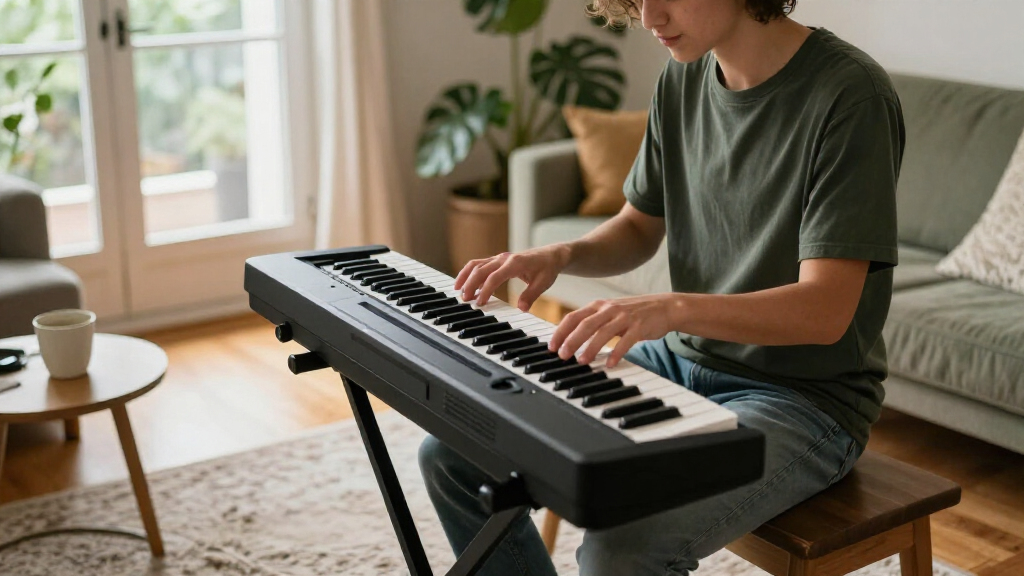
I compared these portable digital pianos by how well they serve distinct jobs: piano practice, first-time learning, casual music-making, or compact transport. Key count and action type carried the most weight because they shape what a player can practice and how closely the instrument responds like a piano. I also considered portability, onboard sound and speaker practicality, useful learning or connection features, and whether included accessories help create a usable setup.
The ranking favors instruments that balance a credible playing experience with practical portability, rather than models that stand out only through a long feature list or bundled add-ons. The Yamaha P-145BT leads for its combination of weighted 88-key playability and Bluetooth; the Roland FP-10 and Yamaha P71 remain strong alternatives for piano-first buyers with different feature priorities. Lighter 61-key keyboards rank higher for beginner convenience or kit value, while folding models serve a more specialized storage need. Since the listed products span different classes, I judged each against its intended buyer rather than treating a bundled keyboard as equivalent to a weighted digital piano.
Factors to Consider When Choosing Portable Digital Pianos
Portable digital pianos range from full-size weighted instruments to compact keyboards built for basic learning and easy storage. I would start with the way you plan to play, then check whether the physical setup and connections support that use. These choices can matter more than a long list of tones or bundled accessories.
Decide Whether You Need 88 Keys
A full 88-key layout gives you the complete piano range and avoids running out of notes as your repertoire develops. That matters for formal lessons, classical pieces, and players who want familiar spacing from the start. A 61-key keyboard can be a sensible first instrument for simple melodies, songs, and casual practice, but its shorter range may call for octave shifts or limit some pieces. Do not assume every beginner needs 88 keys: a smaller layout can be easier to carry and place in a shared room. Instead, match the range to the music you expect to play over the next year, not only the first few lessons. If piano study is the main goal, the extra size of a full keyboard is usually a more useful compromise than learning on a limited range.
Match Key Action to Your Practice Goals
Key count and key action are separate decisions: an 88-key instrument may still have a lighter action than a piano-focused player wants. Weighted keys provide resistance that can help develop finger control and dynamic playing, while semi-weighted or unweighted keys tend to be easier to carry and press. A light action is not automatically a flaw; it may suit young beginners, casual use, or players focused on synthesizer-style parts. The common mistake is choosing by the word “piano” in a product name without checking the action type. If lessons or long-term piano technique are your priority, favor a weighted model and accept the additional bulk. If your main aim is portable entertainment, key feel may be a lower priority than size and sound options.
Check the Whole Carry-and-Setup Routine
Portability includes more than the keyboard’s dimensions: think about where it will be stored, how often it will move, and what else must travel with it. A stand, bench, pedal, power supply, and headphones can add bulk even when a keyboard itself is light. Bundled kits can make a first setup simpler, but included accessories may not be the best fit for frequent transport or long practice sessions. Folding designs can reduce storage demands, though they may trade a familiar playing surface for compactness. Before buying, measure the space where you will practice and the bag or case you expect to carry. A keyboard that is easy to move but awkward to play at home may not be portable in the ways that matter to you.
Choose Learning Features You Will Actually Use
Beginner features vary: lighted keys can guide note-finding, lesson functions can structure practice, and accompaniment styles can make casual playing more engaging. These tools may help a new player get started, but they do not replace steady practice or a clear lesson plan. Bluetooth also needs a closer look: it can support wireless audio or app connections, while Bluetooth MIDI serves a different role by sending performance data to compatible software. Do not treat all wireless features as interchangeable. Pick one or two functions that solve a real problem, such as connecting to a learning app or practicing with backing tracks. Paying for a crowded feature set makes less sense if you expect to use only a basic piano sound and a metronome.
Plan for Sound, Headphones, and Connections
Built-in speakers make a keyboard convenient for quick practice, but their loudness and fullness can vary, so a portable instrument may still need headphones for focused playing. Headphone use is especially helpful in shared homes and can reveal whether a model has the connection you need before purchase. Check whether the instrument supports a sustain pedal if you want a more complete piano setup; a pedal can change the feel of practice and performance even though it does not affect portability much. USB or MIDI connections matter if you plan to record or use music software, while audio connections are useful for listening through external speakers. Avoid paying extra for a connection just because it appears on a spec list: confirm that it matches the phone, tablet, computer, or audio gear you already use. A simple setup that works reliably is often more useful than a keyboard with many connections you never touch.
Spend More for the Playing Experience, Not the Bundle
A package with a stand, bench, headphones, or microphone can be convenient when you have no accessories, but those items do not improve the keyboard’s action or key range. If piano feel is the priority, it can make sense to put more of the budget toward a weighted 88-key instrument and add accessories later. If the player is a beginner who needs a ready-to-use setup, a kit may reduce shopping and assembly decisions. A common mistake is comparing bundle contents as if every included item has equal value to the instrument itself. Decide which parts you would buy separately, then judge the keyboard on its own playing experience. This keeps convenience from overshadowing the feature that will shape daily practice most.
Frequently Asked Questions
Should I choose an 88-key portable piano or a 61-key keyboard for a first instrument?
Choose 88 keys if the player expects piano lessons, wants to learn full-range repertoire, or plans to keep the instrument as skills develop. A 61-key keyboard can work well for simple songs, early exploration, and a setup that needs to stay light or compact. The action matters alongside the key count: weighted keys support piano-style technique more closely, while lighter keys can be easier for casual playing. If you are unsure, think about whether portability or piano practice is the stronger need. The right first instrument is the one that fits both the learner’s likely music and the space available.
Does Bluetooth mean I can play audio through the piano speakers?
Not always, because Bluetooth can refer to different functions. Some instruments use it for wireless audio playback, while Bluetooth MIDI sends note and performance information to compatible devices or apps. Those uses are not interchangeable, so check the connection details for the exact model and the app or device you plan to use. If playing backing tracks through the instrument is your goal, confirm that it supports audio reception rather than assuming Bluetooth MIDI will do that. A wired connection may be more dependable if wireless audio is not supported.
Are foldable portable pianos suitable for regular piano lessons?
They can suit basic note practice and players with severe storage limits, but foldable models are not automatically equivalent to a conventional 88-key digital piano. Their action, layout, and playing surface may feel different from weighted instruments used for piano study. Ask the teacher whether the instrument’s key count and action will support the assignments the student is receiving. For casual practice, travel, or a temporary setup, folding can be a useful compromise. For long-term technique work, a standard weighted model is usually a closer match to piano playing.
Is a keyboard bundle a better choice than buying the instrument alone?
A bundle is useful when its included stand, bench, headphones, or pedal match what the player needs and saves separate setup work. It is not automatically the better instrument: the bundle does not change the keyboard’s action, range, or sound. Compare the included pieces against the accessories you already own and the way you will practice. If the keyboard is intended for piano lessons, prioritize key feel and range before accessories. If the buyer is a casual beginner with no equipment, a practical kit can make the first setup easier.
What should I prioritize if I need a piano for both home practice and travel?
Start by deciding how often you will carry it and whether full-size weighted keys are necessary for your practice. Frequent travel favors a lighter, smaller model, while regular piano study tends to favor an 88-key weighted instrument even if it takes more effort to move. Account for the stand, power supply, headphones, and any pedal, since those items affect the real load. If you have access to a separate home instrument, a compact travel keyboard may be a reasonable companion. If this will be your only instrument, choose the best compromise you can comfortably store and transport without giving up the features your lessons require.
Conclusion
For most players who want a portable instrument for serious piano practice, I would choose the Yamaha P-145BT as the best overall pick: its weighted 88-key format covers piano study, while Bluetooth adds a useful connection option. The best value for a ready-to-start beginner setup is the Alesis Melody 61, though its shorter range and lighter keyboard format make it less suited to piano-focused lessons. For a learner who wants onboard beginner-oriented features in a compact layout, the Yamaha PSR-E283 is the clearest fit. The best premium piano-first alternative is the Roland FP-10 for buyers who want a weighted 88-key experience and do not need the P-145BT’s Bluetooth feature. For tight storage or travel, consider the Rhymo folding keyboard; for lighted-key guidance, the JIKADA addresses a more specific beginner need. Choose based on the playing feel and portability you will use most, not the longest accessory list.