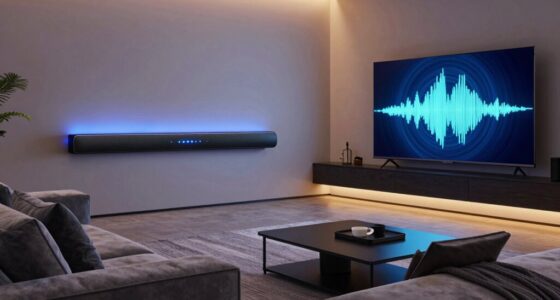
When you see HDR or Dolby Vision labels on streaming content, they show the picture quality and device support. HDR indicates a standard that improves brightness and colors, while Dolby Vision offers even better contrast, color accuracy, and scene-by-scene adjustments. Your device needs to support these formats to enjoy the full benefits. If you’re curious about how these labels affect your viewing experience and what differences to expect, there’s more to discover below.
Key Takeaways
- “HDR” indicates basic HDR support, enhancing contrast and color but with limited scene-specific adjustments.
- “Dolby Vision” offers advanced, scene-by-scene optimization, providing richer colors and higher contrast.
- HDR labels help identify content quality and device compatibility for optimal viewing experiences.
- Devices must support Dolby Vision to fully experience its superior picture quality; otherwise, fallback occurs.
- Understanding these labels guides viewers to select content that matches their device’s capabilities for the best image quality.

Have you ever wondered how streaming services communicate the quality of high dynamic range (HDR) content? When you see labels like “HDR,” “Dolby Vision,” or “HDR10” on your screen, it’s their way of indicating the level of picture quality you can expect. But what do these labels really mean, and how do they impact what you see? Understanding these labels helps you make better choices for your viewing experience, especially regarding color accuracy and device compatibility.
HDR labels are fundamentally signals about the content’s technical quality and the capabilities of your device. For example, a simple “HDR” label suggests that the content meets a basic standard, but it doesn’t specify much about how well it displays. Dolby Vision, on the other hand, is a more advanced format that offers a higher level of color accuracy, deeper contrast, and brighter highlights. When a streaming service labels content as Dolby Vision, it’s highlighting that your device can deliver a richer, more vibrant picture. But to enjoy these benefits fully, your device needs to be compatible with Dolby Vision. If it isn’t, you might not see the full range of colors or the improved contrast it provides. That’s why device compatibility is key—without it, the label doesn’t guarantee the quality you’re expecting.
HDR labels indicate content quality and device compatibility, ensuring you experience the full benefits of advanced formats like Dolby Vision.
The purpose of these labels is to help you understand what your device can handle and what kind of picture quality you’ll get. While HDR10 is widely supported and offers good improvements over standard dynamic range, Dolby Vision and HDR10+ are more sophisticated, offering dynamic metadata that adjusts settings scene-by-scene for ideal color accuracy and contrast. This means that with compatible devices, you’ll experience more precise colors and a more lifelike image, making your viewing more immersive. Additionally, content providers often specify the HDR format to guide viewers toward the best possible experience. However, if your device isn’t compatible with these advanced formats, the content might fallback to a lower standard with less impressive color reproduction.
In fundamentally, the labels are a quick guide that tell you about the quality and compatibility of the content. They’re there to inform you whether your device can handle the advanced features of Dolby Vision or HDR10+ and whether you’ll see the content’s intended visual quality. To get the most out of HDR content, you need a combination of the right label, a compatible device, and a display that can accurately reproduce the enhanced color and contrast. By understanding these labels, you’ll be better equipped to choose content that truly elevates your viewing experience, ensuring vibrant colors and accurate images every time you stream.

Herdio 6.5 Inch 800W Outdoor Bluetooth Speakers Wired Waterproof with Multifunctional Amplifier, Wall Mount Speaker System for Patio Home Poolside Deck Backyard(2 Pairs,Black)
【Full-Range Speakers】The high powered full range indoor outdoor speakers wired waterproof has a maximum power output of 800...
As an affiliate, we earn on qualifying purchases.
Frequently Asked Questions
How Do HDR Labels Affect Viewing Experience Quality?
HDR labels directly impact your viewing experience by indicating the quality of color accuracy and contrast enhancement. When a device has a higher or more specific HDR label, you’ll notice richer colors and deeper blacks, making scenes more vibrant and realistic. This enhances your overall immersion. So, paying attention to these labels helps you choose content that delivers the best picture quality, ensuring you enjoy more vivid, true-to-life visuals.
Can I See a Difference Between HDR and Dolby Vision?
Yes, you can see a difference between HDR and Dolby Vision. Dolby Vision offers better color accuracy and brightness enhancement, resulting in more vibrant, lifelike images. It dynamically adjusts brightness and contrast on a scene-by-scene basis, giving you richer visuals. HDR generally provides improved contrast and color, but Dolby Vision takes it further with enhanced detail and depth, making your viewing experience more immersive and visually stunning.
Are All Devices Compatible With Dolby Vision HDR?
Not all devices are compatible with Dolby Vision HDR, so you’ll want to check device compatibility first. Many newer TVs, smartphones, and streaming boxes support Dolby Vision, but older models might only handle standard HDR or HDR10. Keep in mind, content formats matter too—if the content isn’t encoded in Dolby Vision, your device won’t display it in that format. Always verify your device supports Dolby Vision for the best experience.
Does HDR Content Consume More Internet Bandwidth?
Yes, HDR content generally consumes more internet bandwidth because it delivers higher quality visuals with increased data. This bandwidth impact means your connection needs to be stable and fast enough for smooth streaming. To handle this, streaming services often use streaming optimization techniques, adjusting quality based on your network. So, when you watch HDR content, expect a slight increase in bandwidth use, but it’s worth it for the improved picture quality.
Is Dolby Vision Superior to Standard HDR for All Content?
Think of Dolby Vision as a master painter, capturing every hue with exquisite precision, making standard HDR feel like a sketch. While Dolby Vision often offers better HDR calibration and richer color grading, it isn’t always superior for all content. Some shows or movies might look just as stunning in standard HDR. Ultimately, Dolby Vision shines brightest in scenes demanding meticulous detail, but your experience depends on your device and the content itself.

STUDIOFINIX 6.5 Inch Outdoor Speakers Wall-Mounted 800W - Waterproof and High-Performance Audio Solution for Indoor/Outdoor,Home,Patio,Garden,Backyard(4 Passive Speakers Bundle/Black)
〖Powerful Performance〗: Boasting a peak power handling of 800 watts, it delivers a full range of dynamic sound...
As an affiliate, we earn on qualifying purchases.
Conclusion
Understanding streaming HDR labels is like learning a new language for your screen. While “HDR” signals better colors and contrast, “Dolby Vision” offers a premium experience with dynamic metadata that adapts scene by scene. Knowing the difference helps you make smarter choices and access your content’s true potential. Think of it as upgrading from a black-and-white sketch to a vibrant, lifelike masterpiece—you’ll see your favorite shows in a whole new light.

Polk Audio Atrium 4 Weatherproof Outdoor Speakers with Powerful Bass (Pair, Black), All-Weather Durability, Broad Sound Coverage, Speed-Lock Mounting System
EASY INSTALLATION - One-click speed-lock mounting bracket offers anti-slip, one-handed installation. Mount these outdoor speakers wired vertically or...
As an affiliate, we earn on qualifying purchases.

6.5 Inch Max 800W Outdoor Bluetooth Speakers Waterproof Wired with Multifunctional Amplifier Wall Mount Outdoor Speaker System for Patio Garden Poolside Home(4 Speakers,Black)
Powerful Acoustics: Unmatched Sound Output,Each speaker pumps out an impressive 200 watts, with a pair delivering a combined...
As an affiliate, we earn on qualifying purchases.