
TL;DR

Get audio and creator gear delivered free with Prime
- Fast, free delivery on millions of items
- Prime Video, Amazon Music and more included
- Member-only deals all year
IdeaClyst creates a digital war room that combines AI council deliberations, real-time research, and a founder’s workspace—all stored locally on your machine. It helps founders cut through the noise, validate ideas faster, and make confident decisions without the risk of cloud data leaks.
Ever sit with three promising ideas, feeling that knot tighten in your stomach? The build part’s easy now—thanks to rapid prototyping and AI tools—but choosing the right idea? That’s where most founders trip up. You need more than gut feeling or optimistic spreadsheets—you need a clear, defendable strategy. Enter IdeaClyst: a digital war room designed to turn messy brainstorms into sharp, validated plans.
This isn’t just about throwing ideas into a chatbot and hoping for the best. It’s about a structured, local-first environment that simulates a team of advisors arguing their way through every angle—product, tech, risks, and validation—so you can confidently pick your winner.
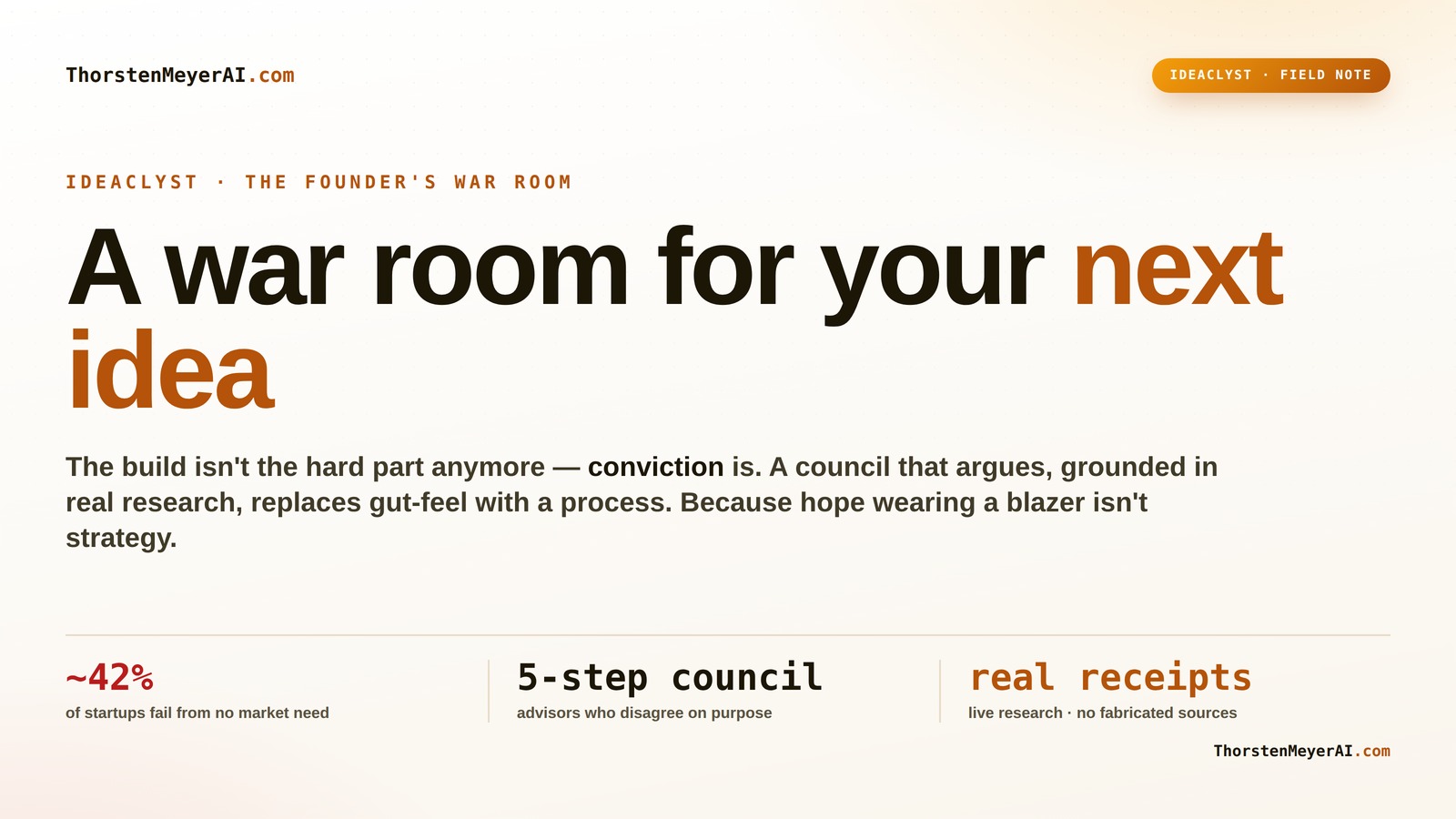
A war room for your next idea
The build isn’t the hard part anymore — conviction is. Knowing which idea deserves the next six months, and being able to defend it. Most founders answer with gut feel and optimistic math. That’s hope wearing a blazer. IdeaClyst replaces it with a process.
The most expensive decision is what to build
The single most valuable thing a tool can do is talk you out of the wrong six months. The numbers make the case better than any pitch.
Three tools in one — on your own machine
Strip away the framing and IdeaClyst is three things at once, all running locally with nothing leaving your laptop.
An AI council
Pressure-tests an idea you bring it — advisors who argue on purpose.
A discovery engine
Finds ideas you didn’t know to look for by hunting real demand signals.
A founder’s workspace
Carries winners from “interesting” all the way to “ready to build.”
Advisors who disagree on purpose
Not one confident, agreeable answer — a structured five-step deliberation where models play different roles and turn on their own work. The disagreement is the feature.
The five-step deliberation
A council that leads with the bad news surfaces the objections you’d otherwise find the expensive way, on month five.
Product strategy
Who’s it for, what’s the wedge, why now, what’s the business model.
Technical architecture
What would it actually take to build — and where’s the risk.
Critique pass
The council turns on its own work. Where’s the hand-waving? What kills this?
Second, independent critique
A different voice, a different angle — so blind spots don’t survive.
Final synthesis
Everything into one coherent founder packet: strategy, architecture, validation, plan.
When IdeaClyst cites a source, it actually fetched it
The hard departure from “ask an AI what it thinks of my startup.” It runs in a strict, real-data-only mode — if it can’t gather genuine evidence, it says so plainly rather than inventing a plausible paragraph.
Confidence with receipts
No fabricated statistics, no imaginary competitors, no made-up citations. The packet survives a skeptical co-founder or a sharp investor because the reasoning has receipts.
Market research first
Scouts the landscape before the council reasons about anything.
Competitor read
Real positioning, pricing signals, feature claims — differentiation vs. reality.
Validation with links
Not “talk to customers” — concrete signals & sources you can click.
From the blank page to build-ready
Evaluation is half the problem; the blank page is the other half. And a plan is worthless if it dies in a tab you never reopen.
Bring a space, not an idea
“AI for accountants,” “tools for indie game studios” — plus your goal and real capacity. It hunts demand signals across HN, Reddit, Product Hunt, GitHub, pricing pages.
- An honest market read — leads with the bad news when a space is hard
- An opportunity map — high pain, thin competition
- Ranked candidates — wedge, who pays, effort, risk, confidence
- each with KILL CRITERIA — when to walk away
A home and a forward path
Every promising idea gets carried forward, with every artifact in plain files on your disk.
- Validation tooling — sprint board, interview list, evidence browser
- Founder profile — a personal-fit lens; same discovery, different advice
- Build workspaces — funnel, personas, landing draft, version history
- “Build this idea” → a PRD + task queue, ready for a coding agent
Key Takeaways
- IdeaClyst turns idea validation into a structured debate, reducing blind spots and bias.
- A local-first, open-source environment keeps your data secure and under your control.
- Combining AI council with live research accelerates decision-making from months to hours.
- Designing a focused, organized workspace—digital or physical—maximizes productivity.
- Start small, keep it simple, and update regularly to maintain an effective digital war room.
local AI-powered idea validation software
As an affiliate, we earn on qualifying purchases.
As an affiliate, we earn on qualifying purchases.
What is a war room, and why does it matter for your ideas?
A war room in the startup world is a dedicated space—physical or digital—where teams gather to focus intensely on a project or idea. It’s a hub for visibility, collaboration, and rapid iteration. Imagine a whiteboard-filled room with sticky notes covering every inch, where everyone’s voice shapes the next move.
In today’s fast-paced environment, a war room keeps your team aligned and motivated, especially when decision fatigue hits. It’s the difference between working in chaos and operating with clarity. For founders, it’s the place where ideas get tested, refined, and ready for action—without losing momentum or clarity.
As an affiliate, we earn on qualifying purchases.
How IdeaClyst turns your messy ideas into clear, validated plans
At its core, IdeaClyst is a digital war room that combines AI council deliberations, discovery, and a personal workspace—all on your own machine. It’s like having a team of advisors arguing over your idea, uncovering blind spots, and suggesting improvements, all in a structured, transparent way.
Why does this matter? Because raw ideas often carry biases, assumptions, and overlooked risks. The AI council’s structured debates help surface these blind spots systematically, rather than relying on intuition or incomplete research. The real-time web research ensures your validation is current, reducing the risk of pursuing outdated or irrelevant data. Producing a comprehensive plan from this process means you’re making decisions based on a balanced, well-informed perspective—crucial for avoiding costly missteps and ensuring your idea’s viability before investing heavily.
Deeply understanding this process reveals its value: it not only accelerates validation but also fosters a culture of disciplined inquiry. Founders learn to challenge their assumptions rigorously, which can reveal hidden flaws or opportunities that might otherwise be overlooked. The implications are profound—by systematically surfacing biases and risks early, startups can pivot more confidently, potentially saving months of development time and thousands of dollars. The trade-off is that it requires disciplined effort and honest critique, but the payoff is a more resilient, validated idea ready for execution.
As an affiliate, we earn on qualifying purchases.
Physical vs. digital war rooms — which works best for founders?
| Feature | Physical War Room | Digital War Room (IdeaClyst) |
|---|---|---|
| Setup | Whiteboards, sticky notes, large wall space | Computer, local files, AI tools |
| Flexibility | Limited once set up, harder to change quickly | Highly adaptable, easy to update |
| Mobility | Fixed location, sometimes portable with effort | Portable, works anywhere on your laptop |
| Collaboration | In-person, real-time | Remote, with AI and web research support |
While physical war rooms foster face-to-face energy and quick brainstorming, digital war rooms like IdeaClyst offer unmatched flexibility, especially for remote or distributed teams. But the choice isn’t always clear-cut: physical spaces can inspire immediate creativity and foster a shared energy that’s hard to replicate digitally. On the other hand, digital war rooms excel at maintaining organized, versioned, and accessible records, which are essential for iterative validation and long-term tracking. Many startups find the optimal approach combines both—using physical spaces for intense sprints and digital tools for ongoing validation and refinement—balancing immediacy with structure.
Understanding these tradeoffs helps founders align their environment with their goals. Learn more about creating effective digital workspaces. Physical spaces promote spontaneous collaboration and can inspire breakthroughs through tactile engagement, but they often lack scalability and flexibility. Digital war rooms, like IdeaClyst, enable continuous, disciplined validation cycles, offering a structured environment for iterative testing. The tradeoff lies in the immediacy versus the rigor—effective founders often blend both, leveraging the strengths of each to maximize innovation speed and decision quality.
AI research assistant for entrepreneurs
As an affiliate, we earn on qualifying purchases.
As an affiliate, we earn on qualifying purchases.
Designing a productive digital war room for your startup
- Pick a dedicated workspace on your laptop—your ‘war room’ folder. This ensures all related files are organized and easily accessible, reducing cognitive load and preventing disorganized chaos.
- Gather essential tools: a markdown editor, web browser, and local data storage. These tools enable you to document, research, and store data securely without reliance on cloud services, safeguarding your ideas.
- Create sections for research, strategy, critique, and validation—think of it like chapters in a comprehensive plan. This structure helps in systematically addressing each aspect of your idea, ensuring no critical detail is overlooked.
- Use IdeaClyst’s AI council to challenge your ideas from multiple angles. The AI’s structured debates force you to confront weaknesses and assumptions, fostering deeper insight and more robust plans.
- Keep the workspace clutter-free with clear labels and versioned files. Regularly review and prune outdated or irrelevant data to maintain clarity and focus, which is essential for efficient decision-making and avoiding analysis paralysis.
Deeply organizing your digital war room allows you to identify gaps early, compare options systematically, and build confidence in your decisions. For insights on cloud-based collaboration tools, check this. It’s not just about storage but creating a disciplined environment where every piece of data serves a purpose. The tradeoff is that initial setup takes time, but this investment pays off by reducing the chaos of unstructured research and scattered notes. For example, a SaaS founder might dedicate a folder with clearly labeled subfolders for customer interviews, technical risks, and validation results, ensuring each is revisited and updated regularly. This disciplined approach enhances clarity, speeds up iteration, and ultimately leads to more confident, validated decisions.
Tools and artifacts that make IdeaClyst a killer decision engine
- AI council modules for strategy, tech, and critique—structured debates that surface blind spots and challenge assumptions, leading to more resilient ideas.
- Live web research snippets—current market data pulled directly into your plan, ensuring your validation reflects the latest trends and information, which is crucial in fast-moving markets.
- Markdown documents—well-organized, versioned, and easy to share or revise, providing a clear audit trail that supports iterative development and accountability.
- Local storage—your data stays on your machine, safe from breaches and privacy concerns, which is increasingly important as data security becomes a top priority for startups.
These tools and artifacts serve as a backbone for disciplined decision-making. They allow founders to build an evidence-based narrative around their ideas, ensuring every critique, insight, and validation step is documented and revisit-able. This transparency reduces ambiguity, minimizes biases, and creates a clear path for refinement. The implications are significant: with a well-maintained set of artifacts, startups can pivot more confidently, defend their decisions with data, and accelerate their path to market. The tradeoff involves discipline—regular updates and honest critique are necessary—but the payoff is a robust, defendable strategy that withstands scrutiny and market pressures.
How collaboration inside IdeaClyst sparks smarter decisions
Inside IdeaClyst, collaboration is baked into the design. The AI council debates your idea from multiple angles, revealing flaws and strengths you might miss alone. This structured debate helps surface biases and blind spots, fostering a more holistic view of your idea’s viability. You can also add comments, notes, and revisions directly into your Markdown files, creating a persistent feedback loop that is easy to track and revisit.
For example, a startup founder might run a critique pass, then share the plan with a co-founder for further input—without ever leaving their local environment. This seamless integration of critique and revision accelerates consensus-building, reduces miscommunication, and leads to higher-quality decisions. The local-first setup means you retain control over your data, avoiding the pitfalls of cloud dependency while still enabling collaborative workflows. This approach emphasizes the importance of structured, ongoing dialogue—ensuring that every member’s insight contributes meaningfully to refining the idea. It also means that mistakes or overlooked assumptions can be caught early, saving time and resources in later stages of development. The ability to collaborate effectively while maintaining control over sensitive data is a key advantage that supports smarter, more confident decisions.
Avoid these common mistakes with your digital war room
- Overloading it with too many ideas or files—keep things focused. An overloaded war room hampers clarity and decision speed, so prioritize the most promising ideas and discard or archive the rest regularly.
- Neglecting regular updates—your war room must evolve with your project. Without continuous refinement, it becomes outdated and less effective, leading to poor decisions based on stale data.
- Ignoring structured critiques—diverse perspectives prevent blind spots. Without formalized critique processes, biases can dominate, and opportunities for improvement are missed.
- Relying on AI alone—use real research and human judgment too. AI is a powerful tool but not infallible; combining it with human insight ensures more balanced, nuanced decisions.
For instance, a founder once kept piling notes into their digital war room, losing track of the core idea. Regular pruning and structured updates prevented that chaos, keeping the process sharp and productive. Recognizing that a cluttered, unorganized war room can lead to missed insights or decision paralysis is vital. The tradeoff involves discipline: dedicating time for regular reviews and structured critique sessions ensures the environment remains useful. This disciplined approach enhances clarity, reduces cognitive overload, and keeps the focus on high-value insights—ultimately leading to better, faster decisions.
Startups, product teams, and innovation groups — who benefits most?
Anyone trying to turn ideas into reality benefits from a war room—especially startups and innovative teams. For small teams, it acts as a shared brain, keeping everyone aligned and accountable. Larger organizations can use it for rapid prototyping and cross-functional collaboration. The key is that a well-structured war room fosters discipline, transparency, and speed—critical factors for successful innovation.
Imagine a small SaaS startup using IdeaClyst to validate a new feature—saving months of development and thousands of dollars. Or a product team at a big company running quick design sprints, all stored and versioned locally for easy review. The flexibility of a digital, local-first environment means these teams can iterate rapidly without worrying about data breaches or cloud outages, thus maintaining control and security while scaling their innovation efforts. This advantage becomes especially clear when considering the tradeoffs: smaller teams gain agility and security, but may need to invest in discipline and consistent process. Larger teams benefit from structured, scalable validation cycles, yet must manage complexity and coordination. Ultimately, the benefit lies in the ability to focus, iterate quickly, and maintain control—factors that significantly increase the chances of successful innovation outcomes.
Frequently Asked Questions
What exactly is an IdeaClyst war room?
It’s a digital workspace that combines AI-driven debate, live research, and organized documentation—all stored locally on your machine—to help you develop, critique, and validate ideas efficiently.Can I use IdeaClyst without an internet connection?
Yes. IdeaClyst runs entirely on your local machine, meaning all data stays on your device. It’s designed for secure, offline use, perfect for sensitive ideas or remote work.How does IdeaClyst improve decision accuracy?
By staging structured debates among AI models, backing ideas with real-time research, and providing clear documentation, it surfaces blind spots and strengthens your conviction—making decisions more reliable.Is this tool suitable for small startups or solo founders?
Absolutely. Its local-first design and focus on structured validation make it ideal for small teams or solo entrepreneurs seeking clarity without cloud dependencies.What’s the first step to creating my own war room with IdeaClyst?
Start by creating a dedicated folder on your machine, gather your initial ideas, and begin structuring your workspace with sections for research, strategy, critique, and validation—then run the AI council for feedback.Conclusion
The modern war room isn’t just a physical space—it’s a mindset, amplified by tools like IdeaClyst that bring clarity, speed, and confidence to your decision process. Your next big idea deserves a battlefield built for winners.
Set up your digital war room today, and turn chaos into a clear, validated plan. After all, the only thing standing between you and success is a well-armed mind—and maybe a local-first AI council.
Halloween Picks
halloween
As an affiliate, we earn on qualifying purchases.