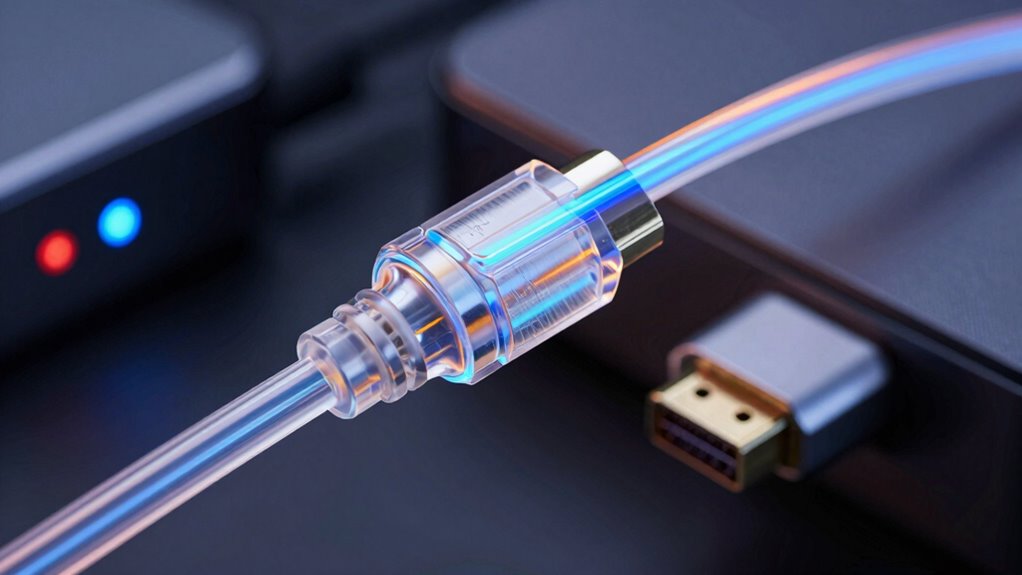

You should choose a fiber HDMI cable when you need to transmit high-definition audio and video over long distances without interference, especially in professional or high-end residential setups. It’s ideal if you want reliable, pristine signal quality over hundreds of meters, immune to electromagnetic interference and signal loss. However, handling requires care and some technical knowledge. To discover more about when a fiber HDMI cable becomes the best choice for your needs, keep exploring the details.

Get audio and creator gear delivered free — and shop member deals
- Fast, free delivery on millions of items
- Access to Prime Big Deal Days deals on October 6–7
- Prime Video, Amazon Music and more included
Key Takeaways
- When transmitting high-definition audio and video over long distances without signal degradation or interference.
- In professional or broadcast environments requiring stable, high-quality signals over hundreds of meters.
- In electrically noisy settings where immunity to electromagnetic interference ensures a clear signal.
- For setups needing future-proof solutions with minimal signal loss and high reliability.
- When installing in environments demanding minimal signal interference and maximum transmission integrity.
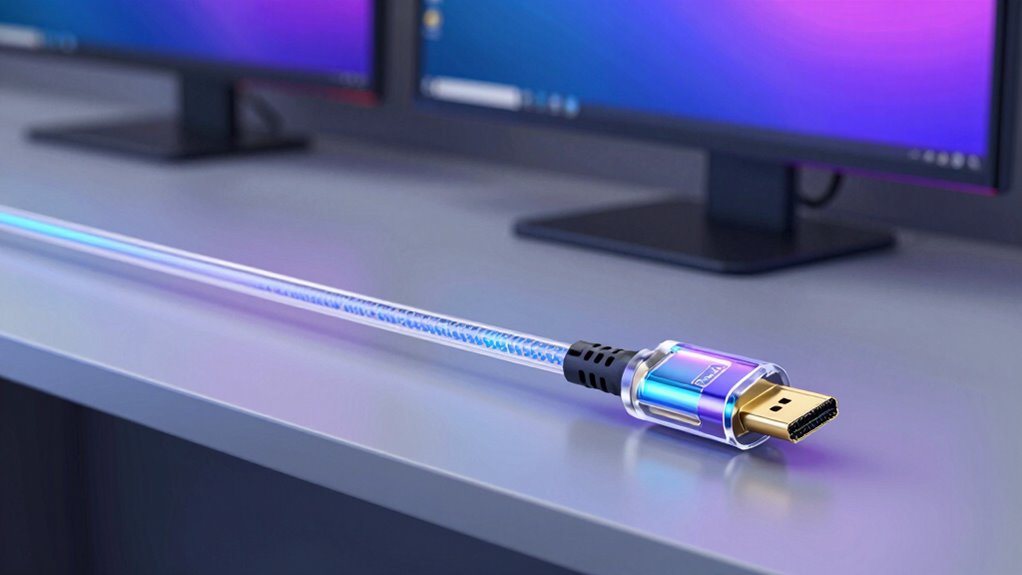
In today’s increasingly connected world, transmitting high-definition audio and video over long distances can be challenging with traditional HDMI cables. Standard cables often struggle to maintain signal quality beyond a certain length, leading to degraded images or audio dropouts. That’s where fiber HDMI cables come into play, offering a reliable solution for high-quality transmission over extended distances. Unlike copper-based cables, fiber optics use light to carry signals, which significantly reduces interference and signal loss. This makes them ideal for situations where maintaining pristine image and sound quality is critical, such as in large conference rooms, home theaters, or broadcast environments.
Fiber HDMI cables ensure high-quality, long-distance signal transmission with minimal interference and loss.
One of the main reasons you might consider a fiber HDMI cable is the need for effective signal amplification. Traditional cables tend to require signal boosters or extenders when you stretch their length, which can complicate installation and increase costs. Fiber optic cables, on the other hand, are naturally capable of transmitting signals over hundreds of meters without additional amplification. This simplifies setup and ensures stable, high-quality output even at great distances. Plus, because fiber optic cables are immune to electromagnetic interference, they deliver a clean, crisp signal without the noise or degradation that can plague copper cables in electrically noisy environments. Additionally, the signal integrity benefits of fiber optics make them especially suitable for professional or high-end residential applications.
However, opting for fiber HDMI cables does come with some installation challenges. These cables are often more delicate than their copper counterparts and may require careful handling during installation. Bending or kinking the fiber can damage the internal fibers, leading to potential signal issues. Also, fiber HDMI cables typically require specialized connectors and equipment, which might mean additional expenses and technical know-how. If you’re installing these cables yourself, you need to be mindful of proper handling and compatibility with existing equipment. To ensure optimal performance, it’s important to understand the fiber optic technology and its specific handling requirements. In some cases, you might need adapters or converters to integrate fiber HDMI cables seamlessly into your setup. Recognizing the cost considerations involved can help you plan your installation more effectively.
Despite these challenges, the benefits of fiber HDMI cables often outweigh the drawbacks, especially when long-distance, high-quality transmission is a priority. They eliminate the need for multiple extenders or boosters, streamline installation, and ensure your signal remains pristine from source to display. When you face the constraints of distance and environmental interference, fiber HDMI cables provide a robust, future-proof solution. They’re particularly suited for professional settings or high-end home entertainment systems where the integrity of audio and video signals is non-negotiable. By understanding both their advantages and installation considerations, you can decide if fiber HDMI cables are the right tool for your high-performance setup.
As an affiliate, we earn on qualifying purchases.
Frequently Asked Questions
What Is the Maximum Transmission Distance for Fiber HDMI Cables?
The maximum transmission distance for fiber HDMI cables typically ranges from 50 meters (164 feet) to over 300 meters (984 feet), depending on the cable quality and signal requirements. You benefit from excellent signal integrity over long distances, as fiber cables resist interference and maintain high-quality video and audio signals. Plus, their durability guarantees reliable performance, making them ideal for extended setups where traditional cables might fail or degrade.
Are Fiber HDMI Cables Compatible With All HDMI Devices?
You’ll find fiber HDMI cables are compatible with most HDMI devices, but it’s not universal. About 95% of modern devices work seamlessly, ensuring excellent signal quality over long distances. However, older equipment might lack the necessary features or ports, so always check your device’s specs. Fiber HDMI cables excel in maintaining high signal quality, especially over extended runs, making them ideal for professional setups but occasionally requiring adapters for legacy devices.
How Do Fiber HDMI Cables Compare in Cost to Traditional Cables?
Fiber HDMI cables tend to be more expensive than traditional copper cables, primarily due to their advanced technology and superior signal transmission. When considering cost comparison, you’ll find fiber options less affordable upfront, but they can save you money long-term by offering better durability and higher performance over long distances. If affordability considerations are key, traditional HDMI cables remain a budget-friendly choice, but fiber cables excel in high-quality, long-distance setups.
What Are the Installation Requirements for Fiber HDMI Cables?
Installing fiber HDMI cables is like wiring a delicate spider’s web; you need careful handling. You’ll require fiber optic connectors and possibly a signal booster to maintain signal integrity. Keep the cable’s bend radius in check, avoiding sharp turns that can damage the delicate fibers. Properly grounding and following manufacturer guidelines guarantee your setup stays intact. With patience and precision, you’ll preserve pristine signals over long distances, ensuring crystal-clear picture quality.
Do Fiber HDMI Cables Support 4K or Higher Resolutions?
Yes, fiber optic HDMI cables support 4K and even higher resolutions, ensuring you get sharp, detailed images. By using fiber optic technology, these cables transmit signals with minimal loss, which means you enjoy superior signal quality even over long distances. This makes them ideal for high-resolution setups, such as gaming, home theaters, or professional displays, where maintaining excellent signal quality is essential for a great viewing experience.
high definition fiber optic HDMI cable
As an affiliate, we earn on qualifying purchases.
As an affiliate, we earn on qualifying purchases.
Conclusion
Think of a fiber HDMI cable like a trusty highway for your signals—fast, reliable, and built to go the distance. When you need pristine picture quality over long runs, it’s your best bet. Just like a well-paved road ensures a smooth ride, a fiber HDMI cable guarantees your entertainment stays clear and uninterrupted. So, next time your setup demands high performance, remember: sometimes, a fiber HDMI cable is exactly what you need, like a bridge over troubled tech waters.
fiber HDMI cable with connectors
As an affiliate, we earn on qualifying purchases.
As an affiliate, we earn on qualifying purchases.
As an affiliate, we earn on qualifying purchases.
Fall Picks
fall essentials
As an affiliate, we earn on qualifying purchases.