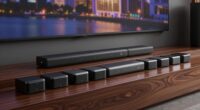
If voices sound muffled, it’s often because your center channel isn’t properly aligned with the screen. To get clear dialogue, the speaker needs to be at ear level and directly centered with the display. Even a slight angle or positioning off to the side can cause voices to seem disconnected or indistinct. Nearly every issue with muffled voices relates to speaker placement and room acoustics—continue exploring to find how precise positioning can make your sound crystal clear.
Key Takeaways
- Properly aligned center channel speakers ensure direct sound delivery, preventing voices from sounding muffled or disconnected.
- Placing the center channel at ear level and directly in line with the screen enhances dialogue clarity.
- Room reflections and hard surfaces can cause sound diffusion, leading to muffled voice perception.
- Incorrect speaker angles or position can cause phase issues, reducing speech intelligibility.
- Using room treatments and adjusting speaker placement optimizes acoustics for natural, crisp dialogue.
Have you ever noticed that voices in your home theater sound muffled or distant when watching movies? That frustrating lack of clarity often comes down to how your speakers are positioned and the room’s acoustics. Specifically, the placement of your center channel speaker plays a vital role in how well you hear dialogue. If it’s not correctly aligned, voices can become muddled, making it hard to follow conversations or appreciate the subtle nuances of speech.
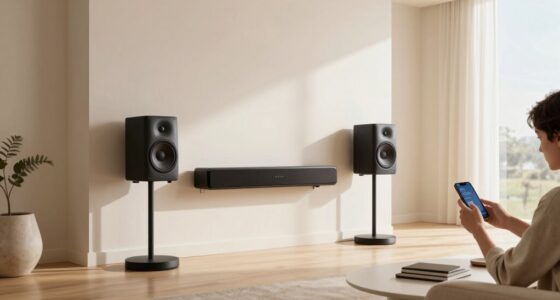
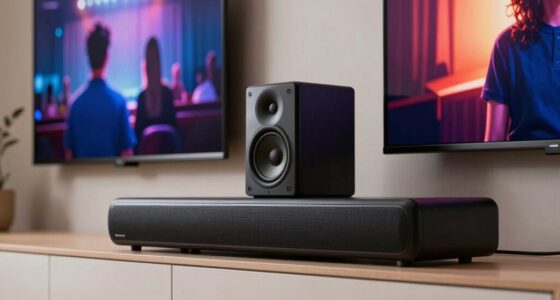
Speaker placement is key. Ideally, your center channel speaker should be directly aligned with your screen, at ear level when you’re seated. This ensures that dialogue sounds as natural and clear as possible, coming straight from the characters on the screen. If the speaker is too high, low, or off to the side, the sound may appear to come from a different location than the actual source, leading to a disjointed audio experience. Proper placement minimizes sound diffusion and phasing issues, which can cause voices to sound muffled or indistinct.
Room acoustics also influence how your center channel’s sound travels. Hard surfaces like tile or glass reflect sound waves, causing echoes and muddiness that diminish speech clarity. Conversely, soft furnishings such as curtains, carpets, and plush furniture absorb excess sound, helping to create a balanced acoustic environment. The goal is to find a sweet spot where sound waves reach your ears directly with minimal reflection or absorption that distorts speech.
A common mistake is placing the center channel too far to the side or too low. When this happens, the sound doesn’t align with the visual source, creating a disconnect that muffles voices. To fix this, experiment with speaker placement by shifting it slightly left or right until dialogue feels natural and focused. Also, consider room treatments that improve acoustics—adding rugs, wall panels, or diffusers can help reduce reflections and enhance clarity.
Additionally, understanding the importance of room acoustics can help you optimize your space for clearer dialogue. Ultimately, you want your home theater to deliver crisp, clear dialogue. Pay attention to how your center channel is placed in relation to the screen, making sure it’s at the right height and directly aligned. Adjust your room’s furnishings and surfaces to optimize acoustics, reducing reflections and absorbing excess sound. When your speaker placement and room acoustics work together, voices will sound vibrant and detailed, transforming your viewing experience from muffled to immersive.
Top picks for "voic sound muffl"
Open Amazon search results for this keyword.
As an affiliate, we earn on qualifying purchases.
Frequently Asked Questions
How Does Room Acoustics Influence Voice Clarity?
Room acoustics greatly influence voice clarity by managing sound absorption and echo reduction. When your room has proper sound absorption, it minimizes reflected sound waves that cause muffling. Additionally, reducing echo helps your voice come through clearer and more intelligible. You can achieve this by adding soft furnishings, curtains, or acoustic panels, which absorb excess sound and create a balanced environment for better voice clarity and overall sound quality.
Can Speaker Placement Improve Muffled Voice Sound?
Like tuning a fine instrument, proper speaker placement can sharpen voice clarity. Position your speakers at ear level to align with the center channel, ensuring voices aren’t muffled. Adjust for sound absorption by avoiding placement near soft furnishings that dampen sound or reflective surfaces that distort it. This simple change enhances vocal intelligibility, making conversations clearer and more natural without needing extra equipment.
What Role Does Speaker Angle Play in Sound Quality?
Your speaker angle considerably impacts sound quality through proper speaker orientation and sound dispersion. By angling your speakers correctly, you guarantee that sound waves are directed toward your ears, enhancing clarity. This improves voice intelligibility and reduces muffling. Properly adjusted angles maximize sound dispersion, creating a more immersive and balanced listening experience, especially for dialogue. So, take time to fine-tune your speaker angles for peak sound quality.
Are There Specific Settings to Enhance Voice Clarity?
To enhance voice clarity, you should adjust your equalizer settings to boost midrange frequencies where vocals sit. Use audio processing features like dialogue enhancement or noise reduction if available. Position your center channel speaker at the ideal angle, typically directly in front of your listening area, to guarantee clear voice projection. Combining these settings with proper speaker placement greatly improves overall voice intelligibility and reduces muffling.
How Do Different Microphone Types Affect Voice Muffling?
Your voice can sound like it’s coming through a foggy window depending on your microphone type. Different microphones, like cardioid or omnidirectional, use various polar patterns that shape how they pick up sound. Their frequency response also plays a role, emphasizing or reducing certain sounds. To avoid muffling, choose mics with a smooth frequency response and polar patterns suited for clear voice capture, making your sound as sharp as a lightning bolt.
Conclusion
So, next time your voice sounds like it’s muffled in the center channel, remember—it’s probably just your angle playing tricks on you. Maybe you should stop obsessing over perfect speaker placement and start blaming your furniture instead. After all, who knew that the secret to crystal-clear voices was just a matter of angling your speakers? Clearly, audio science is just an elaborate game of hide and seek, and you’re always “it.”