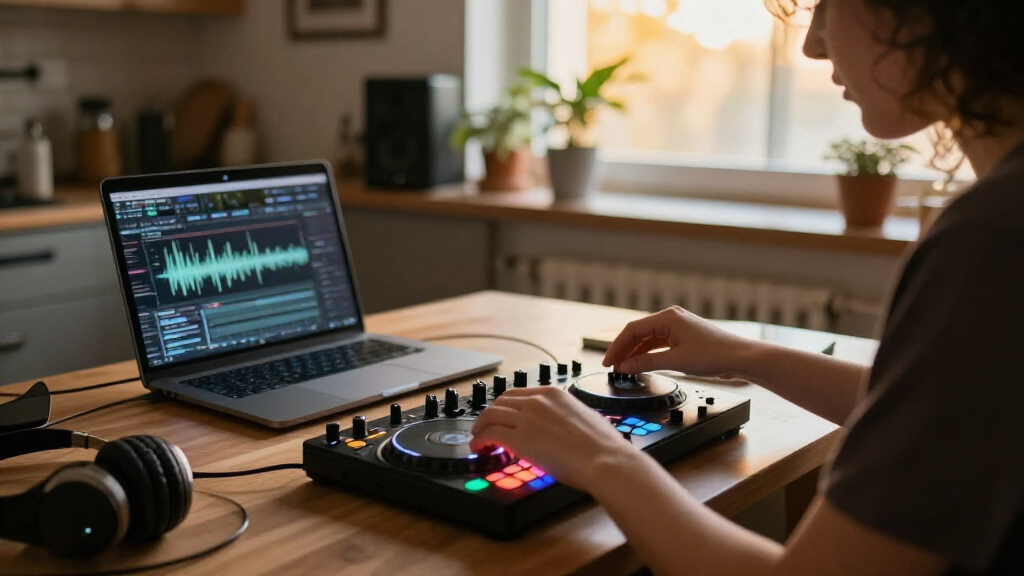
For most new DJs, I’d start with the Pioneer DJ DDJ-FLX4: its approachable two-channel layout and broad software support make it a flexible first controller. The Hercules DJControl Inpulse 500 is a stronger fit if guided learning and room to grow matter more, while the Numark Party Mix Live suits home practice where built-in speakers and lights are appealing. The main tradeoff is between a portable, low-fuss setup and a more capable controller that needs extra gear or learning time. Your software, speakers, and intended practice space can matter as much as the controller itself. Read on for the full breakdown of all 15 options and who each one suits.

Get audio and creator gear delivered free with Prime
- Fast, free delivery on millions of items
- Prime Video, Amazon Music and more included
- Member-only deals all year
Complete the kit


Key Takeaways
- The DDJ-FLX4 is the most balanced starting point in this lineup, with a familiar two-channel format and fewer compromises for someone who may keep DJing as skills grow.
- The Inpulse 500 puts learning support ahead of compactness; its guided approach makes more sense for structured practice than the smaller Inpulse 200 MK3.
- Built-in sound changes the home setup equation. Party Mix Live can reduce the need for separate speakers, while most controllers here call for headphones and an external sound source.
- Wireless and mobile models favor convenience over a conventional desk setup. The DJControl Mix, Mixtrack Go models, and Starlight suit compact practice, but buyers should check their device and software needs first.
- Several choices are near-duplicates rather than distinct controller classes. The white and black Party Mix III variants and the two DDJ-FLX4 finishes make color and bundle details more relevant than performance differences.
| Hercules DJControl Inpulse 500 2-Deck DJ Controller |  | Best for Building Hands-On Skills | Channels: 2 | Connectivity: USB | Audio interface: Built-in | VIEW LATEST PRICE | See Our Full Breakdown |
| Numark Mixtrack Go Mobile DJ Controller, White |  | Best for Mobile Practice | Decks: 2 | Connectivity: Bluetooth MIDI, USB-C | Compatible software: Serato DJ Lite/Pro, Algoriddim djay, VirtualDJ | VIEW LATEST PRICE | See Our Full Breakdown |
| Pioneer DJ DDJ-FLX4 2-Channel DJ Controller with 16 Performance Pads |  | Best All-Round Beginner Pick | Channels: 2 | Performance pads: 16 | Connectivity: USB, Bluetooth | VIEW LATEST PRICE | See Our Full Breakdown |
| Numark Party Mix III Beginner DJ Controller with Bluetooth and Beat-Synced Lights, White |  | Best for Learning with Visual Feedback | Decks: 2 | Connectivity: Bluetooth MIDI, USB-C | Controls: 16 performance pads, 3-band EQ, real-time Stems control | VIEW LATEST PRICE | See Our Full Breakdown |
| Numark Party Mix Live 2-Deck DJ Controller with Built-In Speakers and Lights |  | Best for an All-in-One Starter Setup | Decks: 2 | Built-in speaker output: 10 watts | Software: Serato DJ Lite | VIEW LATEST PRICE | See Our Full Breakdown |
| Numark Mixtrack Go Mobile DJ Controller |  | Best for Portable Setups | Decks: 2 | Connectivity: Bluetooth MIDI, USB-C | Compatible software: Serato DJ Lite/Pro, Algoriddim djay, VirtualDJ | VIEW LATEST PRICE | See Our Full Breakdown |
| Pioneer DJ DDJ-REV1 2-Deck Serato DJ Controller, Black |  | Best for Learning Scratch Mixing | Channels: 2 | Compatible software: Serato DJ Lite | Compatible computers: PC, Mac | VIEW LATEST PRICE | See Our Full Breakdown |
| Hercules DJControl Mix Wireless DJ Controller for Smartphones |  | Best for Smartphone-First Learning | Decks: 2 | Connectivity: Bluetooth | Compatible devices: Android and iOS smartphones and tablets | VIEW LATEST PRICE | See Our Full Breakdown |
| Hercules DJControl Starlight Compact 2-Channel DJ Controller |  | Best for Bare-Bones Portable Practice | Channels: 2 | Connectivity: USB | Power source: Battery powered | VIEW LATEST PRICE | See Our Full Breakdown |
| Pioneer DJ DDJ-FLX4 2-Channel DJ Controller, 16 Performance Pads, White |  | Best for Building Broad Beginner Skills | Channels: 2 | Performance pads: 16 | Connectivity: USB, Bluetooth | VIEW LATEST PRICE | See Our Full Breakdown |
| Numark Party Mix II 2-Deck DJ Controller with Built-In Lights |  | Best for Learning on a Budget | Decks: 2 | Jog wheels: Touch-sensitive | Performance pads: 4 per deck | VIEW LATEST PRICE | See Our Full Breakdown |
| AlphaTheta Pioneer DJ DDJ-FLX2 2-Channel DJ Controller |  | Best for App-Based Mixing | Channels: 2 | Connectivity: USB-C; Bluetooth | Supported software: rekordbox, djay, Serato DJ Lite | VIEW LATEST PRICE | See Our Full Breakdown |
| Numark Party Mix III Beginner Bluetooth DJ Controller with Lights, Black |  | Best for Compact Party Setups | Decks: 2 | Performance pads: 16 | Controls: 3-band EQ; real-time Stems control | VIEW LATEST PRICE | See Our Full Breakdown |
| Hercules DJLearning Kit MK II Beginner DJ Set with Controller, Speakers, and Headphones |  | Best Complete Starter Kit | Included components: DJControl Inpulse 200 MK2 controller, DJMonitor 32 speakers, HDP DJ45 headphones, DJUCED software | Channels: 2 | Supported software: Serato DJ Lite; DJUCED | VIEW LATEST PRICE | See Our Full Breakdown |
| Hercules DJControl Inpulse 200 MK3 2-Deck DJ Controller |  | Best for Guided Skill Building | Model: Inpulse 200 MK3 | Channels: 2 | Controls: 2 jog wheels, 8 performance pads, 2 tempo faders, 1 crossfader | VIEW LATEST PRICE | See Our Full Breakdown |
| DJ controllers for beginner | Weight | Connectivity | Dimensions | Channels |
|---|---|---|---|---|
| Hercules DJControl Inpulse 500 | 11.6 lb | USB | 10.54 × 20.26 × 5.12 in (D × W × H) | 2 |
| Numark Mixtrack Go Mobile DJ C | 1.1 lb | Bluetooth MIDI, USB-C | 12.76 × 1.57 × 3.67 in | — |
| Pioneer DJ DDJ-FLX4 2-Channel | 2.8 kg | USB, Bluetooth | — | 2 |
| Numark Party Mix III Beginner | 2.42 lb | Bluetooth MIDI, USB-C | 13.3 × 8.07 × 1.85 in | — |
| Numark Party Mix Live 2-Deck D | 2.69 lb | USB Type B | 18.9 × 20.51 × 17.91 in | — |
| Numark Mixtrack Go Mobile DJ C | 1.1 pounds | Bluetooth MIDI, USB-C | 3.67 x 12.76 x 1.57 inches | — |
| Pioneer DJ DDJ-REV1 2-Deck Ser | 5 pounds | USB, auxiliary | 10.6 x 20.7 x 2.33 inches | 2 |
| Hercules DJControl Mix Wireles | 2.1 pounds | Bluetooth | — | — |
| Hercules DJControl Starlight C | 1.1 pounds | USB | — | 2 |
| Pioneer DJ DDJ-FLX4 2-Channel | 2.8 kg | USB, Bluetooth | — | 2 |
| Numark Party Mix II 2-Deck DJ | 1.76 pounds | — | — | — |
| AlphaTheta Pioneer DJ DDJ-FLX2 | 2.7 pounds | USB-C; Bluetooth | 18 × 11.7 × 4.4 inches | 2 |
| Numark Party Mix III Beginner | 2.42 pounds | Bluetooth MIDI; USB-C | 8.07 × 13.3 × 1.85 inches | — |
| Hercules DJLearning Kit MK II | 14.3 pounds | — | 20.87 × 14.44 × 10.83 inches | 2 |
| Hercules DJControl Inpulse 200 | 2.2 pounds | — | 15.6 × 10.4 × 3.7 inches | 2 |
More Details on Our Top Picks
Hercules DJControl Inpulse 500 2-Deck DJ Controller
The DJControl Inpulse 500 suits beginners who want a substantial two-deck setup with room to practice more deliberate mixing. Its touch-sensitive jog wheels and 16 RGB pads give learners hands-on tools for scratching, cue points, and loops, while the built-in audio interface and hardware input mixer offer more connection options than the simpler Party Mix III. Fold-out feet and a metal backing plate also make it feel more like a dedicated home setup than an ultra-portable controller. The tradeoff is size: at 11.6 pounds, it is far less convenient to carry than the DDJ-FLX4. It also needs corded power, and the listed software update support date is unknown. I’d choose it for focused home practice, not spontaneous mobile sessions.
Pros:- Built-in audio interface and hardware input mixer expand connection options.
- Touch-sensitive jog wheels support hands-on cueing and scratching practice.
- Sixteen RGB pads provide dedicated controls for loops and performance functions.
- Fold-out feet, metal backing plate, and non-slip supports suit a stable home setup.
Cons:- At 11.6 pounds, it is heavier and less portable than the DDJ-FLX4.
- Requires corded electric power rather than USB-only operation.
- Software update support date is listed as unknown.
Best for: New DJs setting up a home practice space who want hands-on scratching, pad controls, and a built-in audio interface.
Not ideal for: DJs who need a lightweight controller for travel or want a clearly documented software support timeline.
- Channels:2
- Connectivity:USB
- Audio interface:Built-in
- Performance pads:16 backlit RGB pads
- Jog wheels:Touch detection
- Software compatibility:Serato and DJUCED
- Dimensions:10.54 × 20.26 × 5.12 in (D × W × H)
- Weight:11.6 lb
Our verdict“Choose the DJControl Inpulse 500 if your priority is a sturdy home-learning setup with hands-on controls rather than easy portability.”
Numark Mixtrack Go Mobile DJ Controller, White
For a beginner who expects to practice away from a desk, the Mixtrack Go Mobile puts portability first: it weighs just 1.1 pounds and connects over USB-C, with Bluetooth MIDI available for compatible phones and tablets. Eight pads per deck, touch jog wheels, and Stems controls still provide a useful set of hands-on tools, while separate speaker and headphone outputs let you cue privately and send the mix to speakers. Compared with the Numark Party Mix Live, this model is much easier to pack, but it gives up that controller’s built-in speakers and lights. You’ll need external headphones or speakers for audio, and its wireless use is limited to compatible mobile devices. I see it as a portable practice controller, not a self-contained party setup.
Pros:- Very light 1.1-pound design is easy to carry.
- USB-C and Bluetooth MIDI support compatible mobile setups.
- Eight performance pads per deck and hands-on Stems controls offer room to explore.
- Separate speaker and headphone cue outputs support basic monitoring.
Cons:- Requires external speakers or headphones for audio output.
- Bluetooth MIDI operation is limited to compatible smartphones and tablets.
- Does not offer the built-in speakers and lights found on the Party Mix Live.
Best for: Beginners who want a lightweight controller for practice with a compatible smartphone or tablet and can bring their own headphones or speakers.
Not ideal for: Buyers seeking built-in speakers, a light show, or wireless operation with any computer.
- Decks:2
- Connectivity:Bluetooth MIDI, USB-C
- Compatible software:Serato DJ Lite/Pro, Algoriddim djay, VirtualDJ
- Performance pads:Eight per deck
- Audio outputs:1/8-inch main speaker and headphone cue outputs
- Power:USB
- Dimensions:12.76 × 1.57 × 3.67 in
- Weight:1.1 lb
Our verdict“Pick the Mixtrack Go Mobile if portability and mobile-device practice matter more than built-in sound or a party-ready setup.”
Pioneer DJ DDJ-FLX4 2-Channel DJ Controller with 16 Performance Pads
The DDJ-FLX4 is the most balanced choice here for a beginner who wants a familiar two-channel layout without giving up useful learning tools. Its Smart Fader can help smooth basic transitions by adjusting volume, bass, and BPM, while 16 pads make it possible to practice hot cues, effects, beat jumps, and samples. The built-in sound card and support for computers and mobile devices also give it more flexibility than the entry-level Party Mix III. That range comes with limits: it still controls just two channels, and streaming or particular software functions depend on compatible apps and services. The Mixtrack Go Mobile is easier to carry at 1.1 pounds, but the DDJ-FLX4 is the stronger pick for a beginner who wants one controller to learn on across several platforms.
Pros:- User-friendly layout supports learning core mixing skills.
- Smart Fader assists with volume, bass, and BPM adjustments during blends.
- Sixteen pads cover hot cues, Pad FX, Beat Jump, and sampler functions.
- Built-in sound card and broad computer and mobile platform compatibility add flexibility.
Cons:- Two-channel, two-deck control can constrain more complex setups.
- Some streaming and software features depend on compatible apps and services.
- At 2.8 kg, it is heavier than the Mixtrack Go Mobile.
Best for: First-time DJs who want a versatile two-channel controller for learning core mixing and exploring several compatible software platforms.
Not ideal for: DJs planning complex multi-channel sets or buyers who need the lightest possible controller for travel.
- Channels:2
- Performance pads:16
- Connectivity:USB, Bluetooth
- Compatible platforms:Android, Windows, iOS, Mac
- Compatible software:djay, rekordbox, Serato DJ Pro
- Built-in sound card:Yes
- Weight:2.8 kg
- Warranty:1 year manufacturer limited warranty
Our verdict“Choose the DDJ-FLX4 for a versatile first controller that balances guided mixing features with room to develop your skills.”
Numark Party Mix III Beginner DJ Controller with Bluetooth and Beat-Synced Lights, White
The Party Mix III makes beginner practice feel approachable by pairing straightforward two-deck controls with beat-synced LED lights that add a visible rhythm cue and a party effect. Its 16 pads, three-band EQ, and real-time Stems control give learners more to explore than a basic starter layout, while the included beginner video lessons can help structure early practice. Against the DDJ-FLX4, this is the more casual, visually playful option; the Pioneer controller is a better fit for someone focused on broader platform flexibility and skill development. The Party Mix III stays compact and USB-powered, but that means it needs a connected device or power source, and it is aimed more at beginners and informal sets than demanding performance use. Its RCA main output and headphone jack cover basic connections without adding built-in speakers.
Pros:- Beat-synced multicolor lights provide visual feedback and add party atmosphere.
- Sixteen pads, three-band EQ, and real-time Stems offer several controls to learn.
- Compact, lightweight design is easy to carry.
- Includes access to beginner video lessons and supports Serato DJ Lite and Algoriddim djay.
Cons:- Designed primarily for beginner and casual DJ use.
- USB-powered operation requires a connected device or power source.
- Does not have built-in speakers like the Party Mix Live.
Best for: New DJs who learn well with visual beat cues and want a compact controller for casual practice or small gatherings.
Not ideal for: Learners seeking a more skill-focused, flexible controller or a unit with built-in speakers and independent power.
- Decks:2
- Connectivity:Bluetooth MIDI, USB-C
- Controls:16 performance pads, 3-band EQ, real-time Stems control
- Lighting:Integrated beat-synced multicolor LED lights
- Audio outputs:RCA main output, 1/8-inch headphone jack
- Compatible software:Serato DJ Lite, Algoriddim djay
- Dimensions:13.3 × 8.07 × 1.85 in
- Weight:2.42 lb
Our verdict“Pick the Party Mix III if visual feedback and a fun starter layout matter more than built-in audio or a longer-term performance setup.”
Numark Party Mix Live 2-Deck DJ Controller with Built-In Speakers and Lights
The Party Mix Live is the easiest choice in this group for a beginner who wants to start mixing without assembling a separate speaker setup. Its built-in 10-watt stereo speakers handle casual listening, and beat-synced lights add a visual flourish; a switch lets you turn the speakers off when you prefer another output. Two decks, jog wheels, performance pads, EQ, and filter knobs provide the basic controls needed to practice, while headphone monitoring supports private cueing. Compared with the Party Mix III, the Live trades its newer USB-C and Bluetooth MIDI features for integrated speakers. Those speakers are limited in output, and the main connection is 1/8-inch, so it is not the best fit for larger rooms or more elaborate sound systems. It is a convenient first setup, but less flexible than the DDJ-FLX4 as skills grow.
Pros:- Built-in stereo speakers allow practice without external speakers.
- Beat-synced LED lights add a visual element to casual sets.
- Two decks include jog wheels, performance pads, EQ, filter knobs, and pitch sliders.
- Headphone monitoring and a speaker-off switch support quieter practice.
Cons:- Built-in speakers are limited to 10 watts and may not suit larger rooms.
- Main audio output uses a 1/8-inch connection.
- USB Type B connection is less versatile than the Party Mix III’s USB-C and Bluetooth MIDI.
Best for: Beginners who want a compact, self-contained controller for bedroom practice and casual gatherings without separate speakers.
Not ideal for: DJs who need room-filling sound, a more adaptable main audio connection, or broader connectivity options.
- Decks:2
- Built-in speaker output:10 watts
- Software:Serato DJ Lite
- Connectivity:USB Type B
- Outputs:Headphone output and 1/8-inch main output
- Weight:2.69 lb
- Dimensions:18.9 × 20.51 × 17.91 in
- Color:Black
Our verdict“Choose the Party Mix Live if you want an easy first setup with built-in sound, and skip it if you need louder or more flexible audio connections.”
Numark Mixtrack Go Mobile DJ Controller
The Mixtrack Go is the pick for a beginner who wants a fuller set of mixing controls in a travel-friendly package. Its touch jog wheels, eight pads per deck, and dedicated Stems controls offer more hands-on options than the simpler smartphone-focused Hercules DJControl Mix Wireless. Separate speaker and headphone outputs also let a new DJ cue the next track privately before bringing it into the mix. It supports Serato DJ Lite as well as mobile apps, so it can suit different ways of learning. The tradeoff is that it still needs USB-C power; Bluetooth MIDI does not make the whole setup wireless. Its small size also means tighter controls than the larger Pioneer DJ DDJ-FLX4, which is a more comfortable choice for a home desk.
Pros:- Compact 1.1-pound design supports portable practice
- Touch jog wheels and eight backlit pads per deck provide hands-on mixing tools
- Built-in audio interface has separate speaker and headphone outputs
- Works with Serato DJ Lite, djay, and VirtualDJ
Cons:- Requires USB-C power during operation
- Wireless use is limited to compatible phones and tablets
- Compact dimensions leave less room for controls than larger beginner controllers
Best for: Beginners who want a compact controller for practicing with a phone, tablet, or computer and value separate headphone cueing.
Not ideal for: DJs seeking a fully wireless setup or more room between controls for extended practice.
- Decks:2
- Connectivity:Bluetooth MIDI, USB-C
- Compatible software:Serato DJ Lite/Pro, Algoriddim djay, VirtualDJ
- Performance pads:Eight backlit pads per deck
- Audio outputs:1/8-inch speaker and headphone cue outputs
- Power:USB
- Weight:1.1 pounds
- Dimensions:3.67 x 12.76 x 1.57 inches
- Included accessories:USB-C cable, device stand, RCA adapter, quickstart guide, manual
Our verdict“Choose the Mixtrack Go if portability and multiple software options matter more than a roomy, stationary setup.”
Pioneer DJ DDJ-REV1 2-Deck Serato DJ Controller, Black
The DDJ-REV1 makes the most sense for beginners drawn to scratch and open-format mixing, rather than a conventional club-style layout. Its battle-inspired arrangement, tall pitch faders, and quick effect controls put those techniques at the center of the experience. Serato DJ Lite gives new users a straightforward software starting point. Compared with the Pioneer DJ DDJ-FLX4, this controller is more deliberately shaped around scratching, while the FLX4 offers more general-purpose assistance through Smart Fader and Smart CFX. That focus is also the main limitation: the REV1 has two channels and is designed for PC or Mac, so it is less flexible for mobile practice or more complex setups. Choose it for its layout, not as an all-purpose controller.
Pros:- Battle-style layout is tailored to scratch and open-format techniques
- Tall pitch faders provide room for deliberate pitch adjustments
- Quick effect controls and one-motion scratch routines support hands-on practice
- Serato DJ Lite provides an entry-level software option
Cons:- Two-channel design limits more complex setups
- Designed primarily for PC and Mac rather than mobile devices
- Scratch-focused layout is less general-purpose than the Pioneer DJ DDJ-FLX4
Best for: New DJs who want to learn scratch routines and open-format mixing on a PC or Mac.
Not ideal for: Beginners who want mobile-device support, more than two channels, or an all-purpose layout for varied mixing styles.
- Channels:2
- Compatible software:Serato DJ Lite
- Compatible computers:PC, Mac
- Connectivity:USB, auxiliary
- USB ports:1
- Dimensions:10.6 x 20.7 x 2.33 inches
- Weight:5 pounds
- Warranty:1 year manufacturer
Our verdict“Pick the DDJ-REV1 if scratching is your main goal; choose the DDJ-FLX4 for a broader beginner skill set.”
Hercules DJControl Mix Wireless DJ Controller for Smartphones
The DJControl Mix Wireless is aimed at beginners who want to learn using a compatible phone or tablet, with Bluetooth connectivity and the djay app by Algoriddim at the center of the setup. Jog wheels, faders, knobs, and pads provide familiar controls without requiring a computer-based rig, and the included foldable stand helps keep a phone positioned for practice. Compared with the Numark Mixtrack Go, this is the more focused mobile choice; the Mixtrack Go also supports computer software and has separate speaker and headphone outputs. The Hercules is better suited to casual, phone-based sessions than to a desk setup with broader software flexibility. Its smartphone-and-tablet focus narrows its role, and the plastic-and-metal construction may not appeal to buyers seeking a more substantial controller.
Pros:- Bluetooth connection supports a smartphone- or tablet-based setup
- Works with compatible iOS and Android devices
- Jog wheels, faders, knobs, and pads give beginners physical mixing controls
- Foldable smartphone stand is included
Cons:- Designed around smartphones and tablets rather than a computer-first setup
- Software choice is more limited than on the Numark Mixtrack Go
- Construction combines plastic and metal
Best for: Beginners who already plan to mix on a compatible iOS or Android phone or tablet using the djay app.
Not ideal for: Learners who want a computer-first controller, a wider choice of desktop software, or a more substantial build.
- Decks:2
- Connectivity:Bluetooth
- Compatible devices:Android and iOS smartphones and tablets
- Supported software:djay by Algoriddim, DJUCED
- Controls:Jog wheels, faders, knobs, pads, buttons, dial
- Weight:2.1 pounds
- Materials:Plastic and metal
- Included components:DJ deck, USB cable, user manual
Our verdict“Choose the DJControl Mix Wireless if you want to learn with a phone or tablet and do not need computer-focused flexibility.”
Hercules DJControl Starlight Compact 2-Channel DJ Controller
The DJControl Starlight keeps the beginner setup simple: it includes Serato DJ Lite, a built-in sound card for headphone cueing, and the core controls needed to practice two-deck mixing. Its pressure-sensitive jog wheels add tactile control, while the synced RGB and strobe lighting give the compact unit a more playful feel. At 1.1 pounds, it is easy to pack compared with the larger Pioneer DJ DDJ-REV1. That portability comes with fewer ways to grow: both are two-channel controllers, but the REV1 has a more specialized scratch layout, while the Starlight prioritizes a small footprint and essential mixing controls. It also uses battery power, so buyers should check their preferred power setup before choosing it. This is a focused practice tool, not the most expansive option here.
Pros:- Lightweight 1.1-pound design is easy to carry
- Built-in sound card supports headphone cueing and speaker output
- Pressure-sensitive jog wheels provide tactile control
- Serato DJ Lite and synced lighting make it approachable for practice
Cons:- Two-channel layout limits more complex mixing
- Essential controls offer less room to grow than the Pioneer DJ DDJ-REV1
- Battery-powered operation may not suit every setup
Best for: Beginners who want a very small controller for basic Serato DJ Lite practice and headphone cueing.
Not ideal for: DJs who want a broader control surface, more than two channels, or a more feature-rich layout for developing advanced techniques.
- Channels:2
- Connectivity:USB
- Power source:Battery powered
- Output connector:RCA
- Software:Serato DJ Lite
- Weight:1.1 pounds
- Lighting:RGB and strobe effects
- Included components:DJ deck, cables, owner’s manual
Our verdict“Pick the Starlight for portable, basic Serato practice with cueing; skip it if you want a larger controller to grow into.”
Pioneer DJ DDJ-FLX4 2-Channel DJ Controller, 16 Performance Pads, White
The DDJ-FLX4 is the most versatile learning platform in this group for someone who wants to practice more than basic fades. Smart Fader and Smart CFX can help newcomers shape transitions and effects, while 16 performance pads open up Hot Cues, Beat Jump, and sampling. Its computer and mobile-device compatibility also gives it a broader setup range than the PC-and-Mac-focused DDJ-REV1 or the phone-first Hercules DJControl Mix Wireless. A built-in sound card and microphone mixing add practical flexibility for home practice or small hosted sessions. The tradeoff is a two-channel, two-deck limit, which may feel restrictive as a learner’s setups grow. Its many functions also offer more to learn than the Starlight’s pared-back controls.
Pros:- Smart Fader and Smart CFX help beginners work with transitions and effects
- Sixteen pads support Hot Cues, Pad FX, Beat Jump, and Sampler modes
- USB and Bluetooth connectivity support computers and mobile devices
- Built-in sound card and microphone mixing add monitoring and MC flexibility
Cons:- Two-channel, two-deck control can limit more complex setups
- The range of pad functions may be more than a learner needs for basic practice
- Streaming compatibility depends on supported software
Best for: Beginners who want one controller for learning transitions, effects, cueing, and sampling across computer and mobile setups.
Not ideal for: DJs planning to control more than two decks or seeking the smallest, simplest controller for occasional practice.
- Channels:2
- Performance pads:16
- Connectivity:USB, Bluetooth
- Compatible devices:PC, Mac, iPhone, iPad, Android
- Supported software:Serato DJ Pro, rekordbox
- Weight:2.8 kg
- Material:Stainless steel
- Included components:USB cable
- Color:White
Our verdict“Choose the DDJ-FLX4 if you want a flexible controller with guided mixing tools and room to explore several beginner techniques.”
Numark Party Mix II 2-Deck DJ Controller with Built-In Lights
The Party Mix II keeps the beginner setup approachable: two decks, touch-sensitive jog wheels, four performance pads per deck, and filter knobs cover the basics without crowding the controls. Its built-in audio interface provides separate headphone and main outputs, so a new DJ can cue the next track before bringing it into the mix. The beat-synced lights add a party-friendly touch, while Serato DJ Lite gives beginners a clear software starting point. Compared with the Hercules DJControl Inpulse 200 MK3, this Numark puts more emphasis on playful lighting than on guided beatmatching tutorials. The tradeoff is its plastic construction and a 1/8-inch main output, which is less convenient for connecting to some speaker setups than standard RCA outputs.
Pros:- Familiar two-deck layout with jog wheels, performance pads, and filter knobs
- Built-in audio interface supports separate headphone cueing and main output
- Beat-synced RGB lights add visual effects without extra equipment
- Serato DJ Lite support offers a straightforward software entry point
Cons:- Plastic construction may feel less substantial than a larger beginner controller
- The 1/8-inch main output can limit convenient speaker connections
- Does not provide the dedicated beatmatching guidance found on the Inpulse 200 MK3
Best for: First-time DJs who want a straightforward two-deck Serato setup with built-in lights for casual home sessions or small gatherings.
Not ideal for: Learners who want visual beatmatching lessons, sturdier construction, or a standard RCA main output for connecting speakers.
- Decks:2
- Jog wheels:Touch-sensitive
- Performance pads:4 per deck
- Lighting:Beat-synced RGB LED lights
- Audio interface:Built-in
- Outputs:Headphone output; 1/8-inch main output
- Software:Serato DJ Lite
- Weight:1.76 pounds
Our verdict“Choose the Party Mix II for an accessible first controller with playful lighting, but pick the Inpulse 200 MK3 if guided beatmatching matters more.”
AlphaTheta Pioneer DJ DDJ-FLX2 2-Channel DJ Controller
The DDJ-FLX2 suits beginners who want to mix across a phone, tablet, or computer rather than build around one specific setup. Its USB-C connection and support for rekordbox, djay, and Serato DJ Lite offer flexibility, while Smart Fader helps match volume, BPM, and bass during transitions. That assistance can make early blends less intimidating, though it does not replace learning how to control a transition yourself. Compared with the Numark Party Mix II, the FLX2 focuses more on app compatibility and assisted mixing than on built-in party lighting. Its 3.5 mm output supports speaker playback and headphone monitoring, but the two-channel layout limits room to grow into more complex mixes, and streaming access depends on the chosen app and service.
Pros:- Works with rekordbox, djay, and Serato DJ Lite across supported platforms
- Smart Fader assists with volume, BPM, and bass matching during transitions
- USB-C connection and bus power support portable setups
- Allows speaker output while monitoring through headphones
Cons:- Two-channel design limits more advanced mixing setups
- Streaming availability depends on compatibility between the DJ app and service
- 3.5 mm audio output offers fewer connection choices than standard RCA outputs
Best for: New DJs who plan to practice with a phone, tablet, or computer and want flexibility across supported DJ apps and streaming services.
Not ideal for: Buyers who need more than two channels, full-size connection options, or a controller centered on onboard visual effects.
- Channels:2
- Connectivity:USB-C; Bluetooth
- Supported software:rekordbox, djay, Serato DJ Lite
- Compatible platforms:Android, iOS, Windows, PC/Mac
- Audio output:3.5 mm
- Power:USB-C bus powered
- Weight:2.7 pounds
- Dimensions:18 × 11.7 × 4.4 inches
Our verdict“Pick the DDJ-FLX2 if app choice and assisted transitions matter most; choose the Party Mix II for built-in lights or the Inpulse 200 MK3 for beatmatching guidance.”
Numark Party Mix III Beginner Bluetooth DJ Controller with Lights, Black
The Party Mix III brings a lot of beginner-friendly activity into a compact, USB-powered two-deck controller. Its 16 performance pads, three-band EQ, and real-time Stems controls offer more ways to shape a mix than the Party Mix II’s four pads per deck, while beat-synced LEDs give casual sessions a built-in visual accent. Bluetooth MIDI and USB-C add connection options, and the included stand can help position a phone or tablet during practice. The main RCA output is also a more useful speaker connection than the Party Mix II’s 1/8-inch main output. On the other hand, its Stems and software features still depend on a compatible device and DJ application; this is not a standalone player. Its compact, casual focus is a weaker fit for larger or more demanding event setups.
Pros:- Sixteen performance pads and three-band EQ provide varied hands-on controls
- Real-time Stems controls let beginners experiment with vocal and instrumental parts
- USB-C, Bluetooth MIDI, and USB power support flexible compact setups
- Main RCA output and headphone jack provide distinct connections for speakers and monitoring
Cons:- Requires a compatible phone, tablet, or laptop running DJ software
- Designed for casual use and small events rather than demanding setups
- Some software and streaming features depend on app compatibility
Best for: Beginners who want a portable, light-equipped controller for home practice and small gatherings, with extra pad and Stems controls to explore.
Not ideal for: DJs who need a standalone setup, a larger event-ready controller, or a system that works without a compatible computer or mobile device.
- Decks:2
- Performance pads:16
- Controls:3-band EQ; real-time Stems control
- Connectivity:Bluetooth MIDI; USB-C
- Audio outputs:Main RCA output; 1/8-inch headphone jack
- Power source:USB
- Weight:2.42 pounds
- Dimensions:8.07 × 13.3 × 1.85 inches
Our verdict“Choose the Party Mix III for a portable party-focused controller with more pad and Stems options than the Party Mix II, provided you already have a compatible device.”
Hercules DJLearning Kit MK II Beginner DJ Set with Controller, Speakers, and Headphones
The DJLearning Kit MK II removes a common beginner hurdle: assembling the rest of the setup. It includes the DJControl Inpulse 200 MK2 controller, DJMonitor 32 speakers, HDP DJ45 headphones, and DJUCED software, so a laptop or PC is the main extra item needed to start learning. Beatmatch Guide LEDs offer visual help with tempo and beatmatching, making this a more lesson-oriented choice than the light-focused Numark Party Mix II. The package also includes Serato DJ Lite, giving beginners another software option alongside DJUCED. The tradeoff is that this is a larger bundle rather than a compact controller-only purchase: the complete set weighs 14.3 pounds and occupies more space than the portable Inpulse 200 MK3. Its two-channel format is aimed at learning the fundamentals, not advanced setups.
Pros:- Includes a controller, speakers, and headphones in one beginner set
- Beatmatch Guide LEDs provide visual support for tempo and beatmatching practice
- DJUCED and Serato DJ Lite offer two software options
- Provides a ready-to-start hardware setup for laptop or PC users
Cons:- Requires a laptop or PC to run the DJ software
- The complete kit is bulkier and heavier to move than a controller alone
- Two-channel beginner layout may not suit users seeking a more advanced setup
Best for: New DJs who have a laptop or PC but still need a controller, speakers, headphones, and beginner-focused beatmatching guidance.
Not ideal for: Buyers who already own speakers and headphones, need a portable controller-only setup, or want more than two channels.
- Included components:DJControl Inpulse 200 MK2 controller, DJMonitor 32 speakers, HDP DJ45 headphones, DJUCED software
- Channels:2
- Supported software:Serato DJ Lite; DJUCED
- Compatible devices:Laptop, PC
- Hardware platform:PC/Mac
- Connection:USB
- Weight:14.3 pounds
- Dimensions:20.87 × 14.44 × 10.83 inches
Our verdict“Choose the DJLearning Kit MK II if you need the core hardware and guided lessons together; choose the Inpulse 200 MK3 if you already own speakers and headphones.”
Hercules DJControl Inpulse 200 MK3 2-Deck DJ Controller
The Inpulse 200 MK3 is a controller for beginners who want help learning, not just an easy way to start a mix. Its light guides assist with beat and tempo alignment, while DJ Academy tutorials and included DJUCED and Serato DJ Lite software give new DJs multiple routes into practice. Dedicated controls for vocal and instrumental Stems also let users experiment with separating parts of a track. Compared with the Party Mix II, the MK3 puts less emphasis on built-in party lighting and more on instruction and developing technique. It is also more portable than the complete DJLearning Kit MK II, but that bundle includes speakers and headphones the MK3 does not. Its two-deck layout and compact control surface leave less room for more advanced mixing.
Pros:- Beatmatch light guides help learners work on tempo and beat alignment
- DJUCED, Serato DJ Lite, and DJ Academy tutorials support learning
- Dedicated controls enable vocal and instrumental Stems mixing
- Lightweight design is easier to carry than the complete DJLearning Kit
Cons:- Two-channel layout limits more complex mixing
- Compact surface offers fewer controls than larger beginner controllers
- Does not include speakers or headphones
Best for: Beginners who want a compact controller with beatmatching guidance, tutorials, and Stems controls for structured practice.
Not ideal for: Buyers who need speakers and headphones included, want a larger control surface, or need more than two decks.
- Model:Inpulse 200 MK3
- Channels:2
- Controls:2 jog wheels, 8 performance pads, 2 tempo faders, 1 crossfader
- Audio outputs:Master speakers; headphone monitoring
- Hardware interface:3.5 mm audio; USB
- Weight:2.2 pounds
- Dimensions:15.6 × 10.4 × 3.7 inches
- Color:Black
Our verdict“Pick the Inpulse 200 MK3 for guided, portable practice; choose the DJLearning Kit MK II if you also need speakers and headphones.”
How We Picked
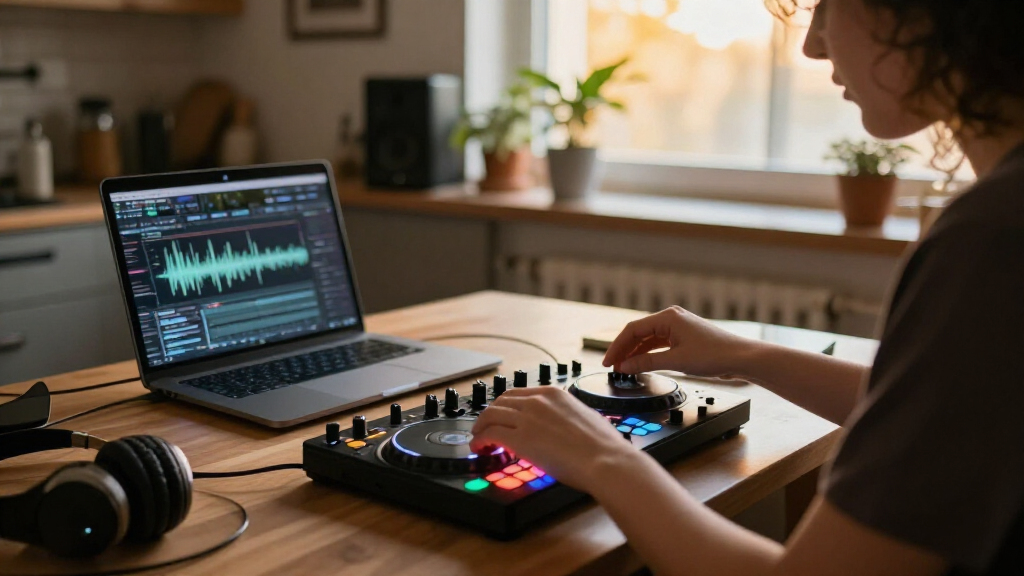
I ranked these controllers around the needs of a first-time DJ: how quickly a beginner can learn the controls, how clearly the layout supports basic mixing, what software or device setup is required, and whether the package includes useful extras. I also weighed portability, connection options, built-in audio features, and room to develop beyond the first few practice sessions. A controller with fewer setup hurdles can be a better first choice than one with more features, while a compact or highly guided model can earn its place for a specific learning style.
The ranking favors balanced usability and future flexibility over novelty features alone. That puts the DDJ-FLX4 near the top as a versatile all-rounder, with the Inpulse 500 close behind for guided learning and hands-on controls. Party Mix models rank well for casual home use, but their built-in lights and speakers do not replace a more adaptable setup for every learner. Duplicate color versions are treated as practical alternatives, not as separate performance upgrades.
Factors to Consider When Choosing DJ Controllers For Beginners
Before choosing a first controller, I’d plan the whole practice setup rather than compare control layouts alone. Software, sound, space, and learning style determine whether a controller feels straightforward or creates extra hurdles.
Match the software and device you already own
A controller is only useful if it works with the computer or mobile device and DJ software you plan to use. Before buying, check the current compatibility details for your operating system, connection type, and preferred application; support can differ by model and software version. Beginners often focus on pad count and overlook whether they need a laptop, phone, or tablet to run the setup. Mobile controllers can be convenient, but a phone-centered workflow may feel different from learning on a laptop. If you want to follow online lessons, check which software they use before committing. A familiar device and clear software path can save more setup frustration than extra performance features.
Budget for the complete sound setup
Many entry-level controllers control software but do not function as a complete listening system. You may need headphones for cueing and speakers for room playback, and those needs depend on whether you practice alone or play for others. A model with built-in speakers can make bedroom practice simpler, though it may not replace larger speakers when you want fuller sound or a group to listen. Check how the controller routes headphone and master audio before assuming you can monitor one track privately while another plays aloud. Leave room in your setup plan for the necessary cables and audio gear. A controller that appears self-contained may still need accessories for the way you intend to practice.
Choose a layout that supports learning, not just convenience
A beginner benefits from controls that make the relationship between two decks, the mixer, and tempo easy to understand. Guided features can help with early practice, but they should support learning the underlying actions rather than become the only way you mix. Compact controllers save desk space, yet smaller controls can make precise adjustments less comfortable for some people. Before choosing a tiny model for portability, think about how often you will practice at a fixed desk and whether you expect to play on shared equipment later. A more conventional layout may take longer to learn on day one but can make later upgrades less confusing. Prioritize clarity and control spacing over a long feature list.
Decide how much portability you will actually use
Wireless or mobile-friendly designs can make spontaneous practice easier, but portability is useful only if the rest of your setup travels too. A controller may still depend on a charged phone, an app, headphones, or a separate speaker. For home use, a wired model with a more familiar layout can be the simpler choice even if it takes more desk space. Think through where you will practice, how you will carry the gear, and whether you have a stable surface and power nearby. Wireless convenience can also add device-pairing steps that are absent from a simple cable connection. Pick portability for a real use case, not just because a product description calls it mobile.
Pay for growth only when it matches your plans
A more capable controller can offer a smoother path as your mixes become more complex, but extra controls may distract a beginner who only needs to learn beatmatching and transitions. If you expect to keep practicing, play small gatherings, or explore performance features, a flexible two-channel layout may be a sensible step up from a basic starter device. If you are still deciding whether DJing is a lasting hobby, a simpler controller or a bundled learning set can reduce the number of separate purchases. Compare what the added features let you do with the extra setup and learning they ask of you. Avoid paying for a feature you cannot explain how you would use. The right upgrade is one that removes a real limit in your practice.
Frequently Asked Questions
Is the DDJ-FLX4 a better first controller than the Inpulse 500?
I’d choose the DDJ-FLX4 if you want an adaptable first controller with a familiar two-channel format and a broad path into DJ software. The Inpulse 500 makes more sense if guided learning and a larger hands-on control surface are higher priorities. Neither is automatically easier for every learner: the best fit depends on whether you prefer software flexibility or more explicit support while practicing. Check the software and device requirements that matter to you before deciding. If you expect to move between different DJ environments later, compare their supported workflows as part of the choice.
Do I need separate speakers if my controller has built-in speakers?
Not necessarily for basic home practice, but built-in speakers may not meet every listening need. They can simplify casual playback, while separate speakers may be preferable when you want fuller room sound or are playing for other people. Headphones remain useful for cueing tracks without sending them to the main output. Before buying, check how the controller handles headphone monitoring and external audio connections. If you already own speakers, a controller without built-in ones may be a better use of your setup space.
Should I choose a wireless controller or a wired model as my first one?
Choose wireless if you have a clear mobile practice routine and are comfortable managing the required phone, app, and connection steps. A wired controller can be less fiddly at a desk and may be easier to integrate into a conventional laptop-and-headphones setup. Wireless does not always mean the entire rig is cable-free, since charging, headphones, or external speakers may still be part of the setup. Check device compatibility and connection requirements before treating wireless operation as a shortcut. For many beginners, the simplest setup is the one that matches the device they already use.
Are the black and white versions of the same controller meaningfully different?
For the DDJ-FLX4 and Party Mix III entries in this roundup, the listed differences are primarily finish rather than a distinct beginner skill level. I’d compare the exact listing for included software, cables, or other package details instead of assuming the color changes how the controller performs. Similar names can still refer to different product generations, so verify the model designation before ordering. Choose the finish you prefer once the underlying model and bundle match your needs. Color should be a deciding detail only after compatibility and setup are settled.
Is a beginner bundle with speakers and headphones a smarter first purchase?
A bundle such as the Hercules DJLearning Kit MK II can simplify shopping if you need several parts of a practice setup at once. That convenience does not guarantee every included component will suit you long term, so check what the package contains and whether it meets your sound and comfort needs. Buying a controller separately gives you more control over speaker and headphone choices, especially if you already own audio gear. Compare the bundle’s learning support and included equipment against the setup you actually need. A complete kit is most useful when it removes missing essentials rather than adding items you will not use.
Conclusion
For the broadest mix of beginner-friendly layout and room to develop, my best overall pick is the Pioneer DJ DDJ-FLX4. The best value for guided practice is the Hercules DJControl Inpulse 200 MK3 for learners who want an approachable entry point, while the larger Inpulse 500 is my best premium learning-focused choice in this group. For someone who wants a particularly welcoming first setup, I’d compare the Inpulse models with the Hercules DJLearning Kit MK II, especially if speakers and headphones are still missing. Choose the Numark Party Mix Live for casual home sessions with built-in speakers and lights, or a compact Mixtrack Go, DJControl Mix, or Starlight when portability matters most. Match the controller to your software, sound setup, and practice habits, and the right first step becomes much clearer.