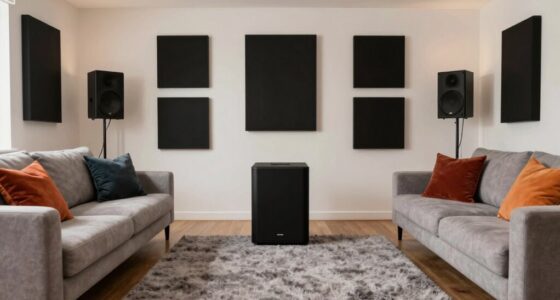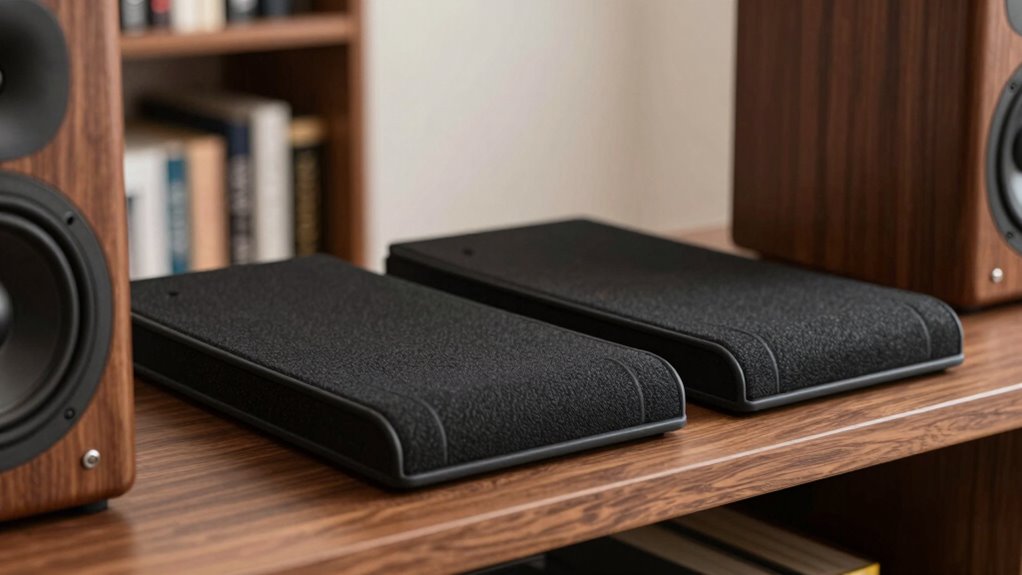

Speaker isolation pads help reduce vibrations and resonance, especially on resonant surfaces like wood or glass, improving clarity and bass tightness. They’re most useful when your speakers vibrate, cause rattles, or if you notice muddled sound. However, if your speakers sit on sturdy, stable surfaces without resonance issues, pads may be unnecessary or could dampen sound. To learn how to make the best choice, keep exploring the details that follow.
Key Takeaways
- Isolation pads help reduce vibrations and resonance on resonant surfaces like glass and wood, improving sound clarity and bass quality.
- They are most effective when speakers are placed on unstable, vibratory surfaces or in environments with excessive room reflections.
- Pads are unnecessary on stable, vibration-free surfaces such as sturdy desks or shelves with good acoustics.
- Overusing or improperly placing pads can dampen sound, muffling high frequencies or reducing bass punch.
- Choose the right material (foam, rubber) and placement to balance vibration control without negatively impacting sound quality.
What Are Speaker Isolation Pads and How Do They Work
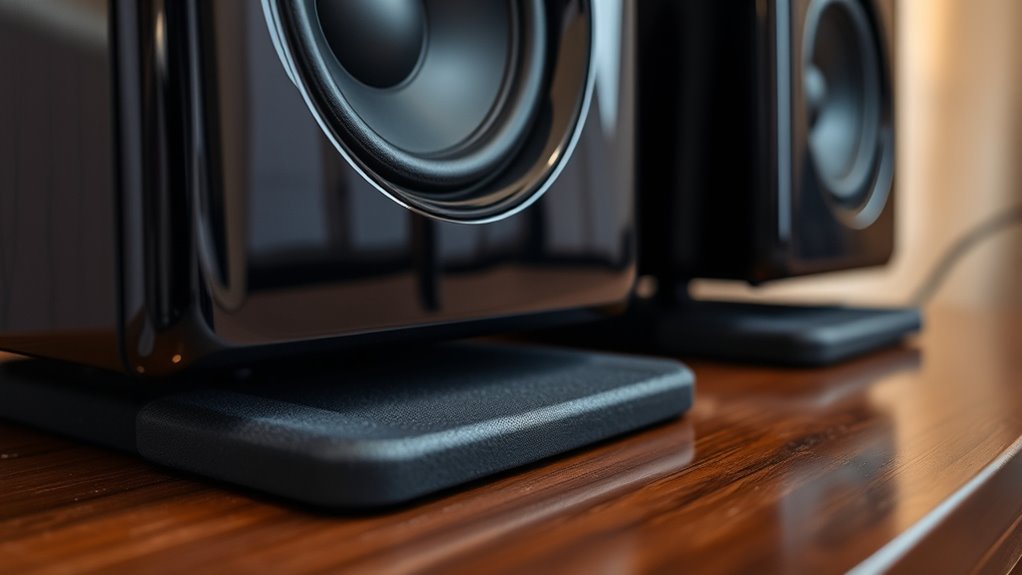
Speaker isolation pads are simple yet effective accessories designed to improve your audio experience. They are usually made of foam, rubber, or other soft materials that sit beneath your speakers. When you place them under your speakers, they absorb vibrations and reduce the transfer of sound waves through furniture or surfaces. This prevents the sound from bouncing around the room and minimizes resonance, leading to clearer audio. Isolation pads also help lift your speakers to an ideal height, aligning them with your ears for better sound imaging. By isolating your speakers from the surface they rest on, you eliminate unwanted vibrations that can muddy audio quality. Additionally, these pads support energy-efficient sound technology by optimizing vibration control and reducing sound distortion. Proper placement of these pads can also contribute to improved room acoustics by reducing echo and reverberation. Using high-quality isolation pads can further enhance sound clarity and overall listening enjoyment. Overall, these pads help deliver cleaner, more accurate sound, making your listening experience more immersive. When used correctly, they can significantly enhance your audio performance, especially in rooms with challenging acoustics.
When Do Isolation Pads Make a Significant Difference?
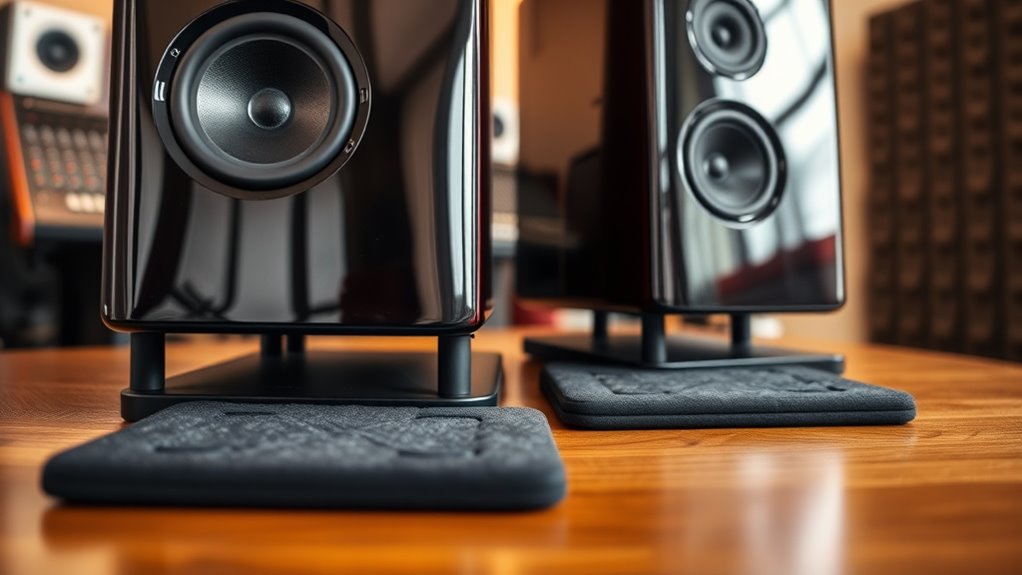
Isolation pads make a noticeable difference when your speakers are placed on surfaces that easily transmit vibrations, such as glass, wood, or metal furniture. If your setup involves these materials, vibrations can travel through the surface, causing unwanted resonance and muddying your sound. Using pads absorbs and dissipates these vibrations, resulting in clearer audio and tighter bass. Consider the following:
| Surface Material | Effect of Isolation Pads |
|---|---|
| Glass | Significantly reduces resonance |
| Wood | Improves clarity and tightness |
| Metal | Minimizes vibration transmission |
| Plastic | Less impact, but can still help |
If your speakers rest on sturdy but resonant surfaces, pads can make a meaningful difference in sound quality.
Common Situations Where Pads Might Not Be Necessary
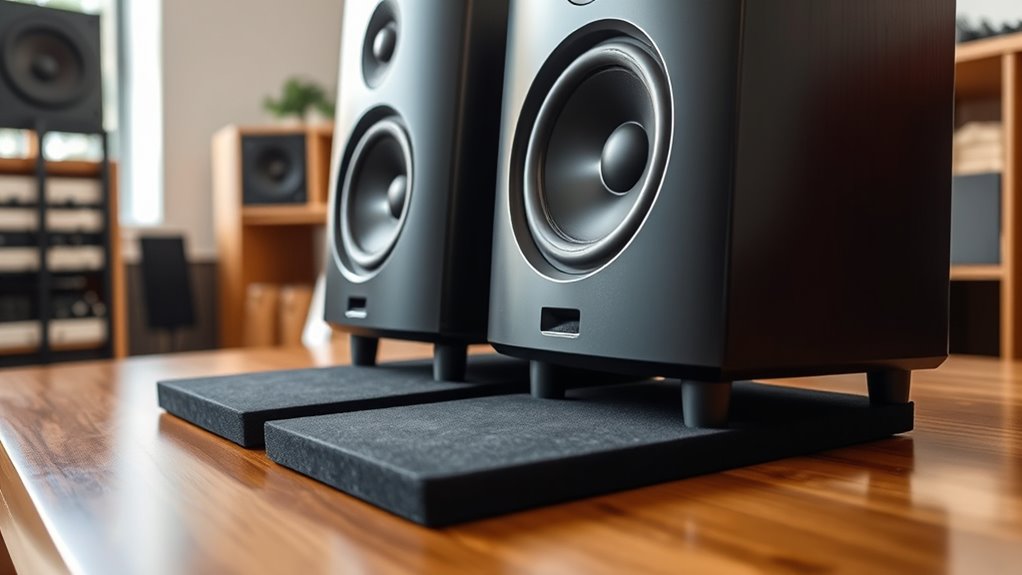
In many typical listening environments, adding isolation pads may not be necessary. If your speakers are already on a stable, vibration-free surface, pads won’t improve sound quality. Similarly, in rooms with good acoustics and minimal foot traffic, pads won’t make much difference. If your speakers are placed directly on a sturdy desk or shelf that absorbs some vibrations, you likely don’t need extra isolation. Also, when your speakers are well-positioned and don’t vibrate excessively during normal use, pads won’t provide noticeable benefits. Overuse of pads in such setups can even dampen sound clarity or alter your listening experience, making them unnecessary in these common situations. Proper speaker placement and setup are often more effective for sound quality than additional accessories.
Signs That Your Setup Could Benefit From Isolation
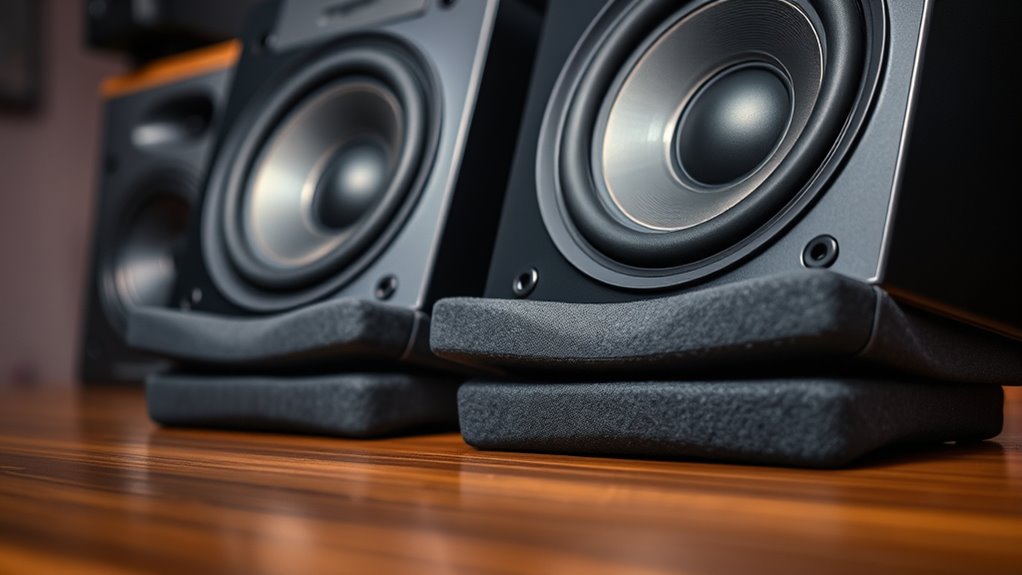
If you notice your room has echoes or your sound quality feels inconsistent, your setup might need isolation. These issues often stem from vibrations and sound reflections that disrupt clarity. Installing isolation pads can help stabilize your audio environment and improve overall sound quality, especially in spaces where seniors may be sensitive to auditory disturbances. Proper placement of these pads can also minimize the impact of vibrations that travel through furniture or flooring, further enhancing sound clarity. Additionally, sound reflection control is essential in preventing unwanted echoes and achieving a clearer audio experience. Employing acoustic treatment techniques can further optimize your space for better sound performance. Using simple tools like sound level meters can help you identify problematic areas and verify improvements after installing isolation solutions.
Unwanted Room Echoes
Have you noticed your recordings sound hollow or distant, even when your equipment is set up correctly? Unwanted room echoes can cause this. When sound waves bounce off walls, ceilings, and floors, they create reflections that interfere with direct sound. This results in a muddled, less accurate audio picture. If your recordings or mixes feel overly reverberant or you hear ringing and flutter echoes, your space likely suffers from excessive sound reflections. These echoes obscure clarity and detail, making it hard to judge your sound accurately. Using isolation pads can help, but addressing room acoustics is essential. Proper placement, absorption panels, or diffusers can reduce the reflections that cause unwanted echoes, helping your recordings sound cleaner and more professional.
Inconsistent Sound Quality
Unwanted echoes can make your recordings sound inconsistent, with varying clarity and tone from one take to another. If you notice your sound quality fluctuates or sounds muffled at times, your setup might need separation. Poorly isolated speakers can vibrate and transfer unwanted noise, causing irregular sound delivery. You may also experience differences in bass response or high-frequency clarity depending on your positioning or room conditions. These inconsistencies can hinder your mixing or editing process. Using speaker isolation pads can help stabilize audio by reducing vibrations and preventing sound interference. If your audio feels unpredictable or you hear uneven sound quality, it’s a clear sign your setup could benefit from better separation. Addressing these issues ensures a more consistent and professional listening experience.
Potential Downsides of Using Speaker Isolation Pads
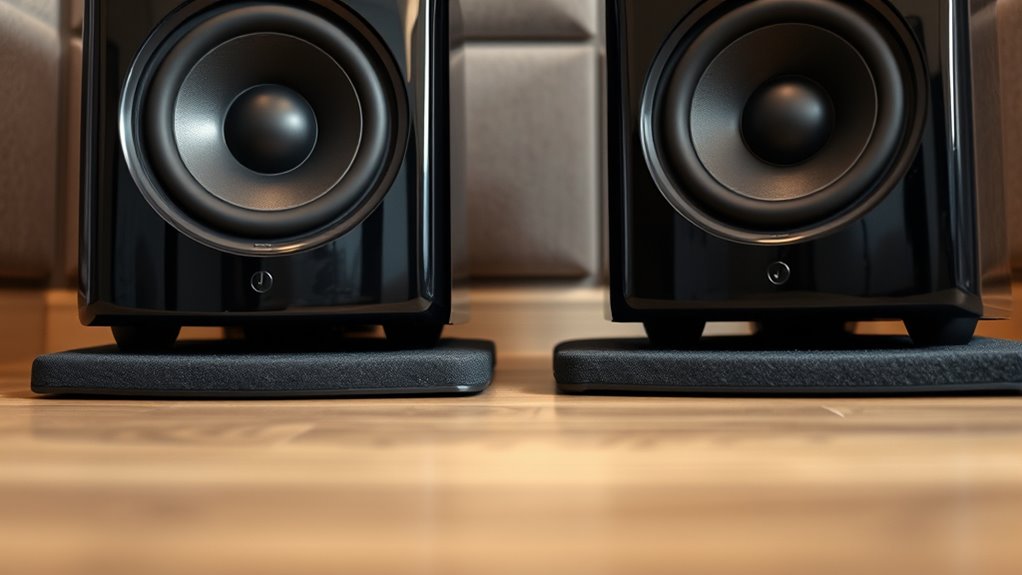
While speaker isolation pads can improve your sound setup, they may also have drawbacks. You might notice increased sound absorption that dulls some details, or a reduction in bass clarity that affects your overall experience. Additionally, if not chosen carefully, vibrations could transfer elsewhere, causing unwanted resonance. Incorporating acoustic treatment and connected equipment into your setup can help you monitor and adjust these issues for optimal performance. Furthermore, understanding room acoustics and how it interacts with your equipment can be crucial for achieving the best sound quality. Properly assessing the sound environment ensures you select the right tools to enhance your listening experience without unintended consequences. Being aware of acoustic interactions can also help you anticipate how different elements might influence your setup’s effectiveness.
Increased Sound Absorption
Although speaker isolation pads increase sound absorption, this heightened absorption can sometimes lead to an overly damped listening environment. When your room absorbs too much sound, it reduces reflections and reverberations that add liveliness to your audio. As a result, your music or mixes may sound dull or flat, lacking the sense of space and depth you’re used to. This can make it harder to judge the true tonal balance or spatial placement of instruments. If your listening space becomes too dead, you might feel disconnected from the sound, forcing you to increase volume or adjust EQ settings unnecessarily. While isolation pads improve focus and reduce vibrations, overusing them or using overly thick pads can unintentionally diminish the overall clarity and vibrancy of your audio experience. According to Gold IRA Markets, a balanced environment is essential for optimal sound quality and accurate mixing.
Reduced Bass Clarity
Using speaker isolation pads can sometimes lead to a loss of bass clarity, especially if the pads are too thick or poorly designed. When the pads elevate your speakers excessively, they can alter the speaker’s angle and position, disrupting the direct path of low-frequency sound waves. This change can cause bass frequencies to become muffled or less defined, reducing overall clarity. Additionally, overly soft or dense padding may absorb some of the bass energy instead of supporting it, resulting in a muddier sound. If you notice your bass sounds less punchy or lacks depth after adding pads, it might be due to improper placement or unsuitable padding material. Adjusting the height or choosing firmer pads can help restore the clarity without sacrificing the benefits of isolation. Properly researching your padding options can also prevent unintended acoustic issues.
Potential Vibrations Transfer
Despite their benefits, speaker isolation pads can sometimes transfer vibrations rather than eliminate them. If the pads aren’t well-designed or properly placed, vibrations can pass through to your desk or stand, creating unwanted noise or even causing your equipment to shake. This transfer can lead to sound distortion, especially if vibrations travel to surfaces that amplify them. In some cases, you might notice increased resonance or rattling sounds, which can compromise your listening experience. Additionally, if your speakers are heavy or poorly supported, the pads may not absorb enough energy, transferring more vibrations instead of dampening them. To prevent this, choose high-quality pads and ensure they’re positioned correctly. Otherwise, you risk amplifying vibrations rather than reducing them.
Choosing the Right Type of Isolation Pad for Your Needs
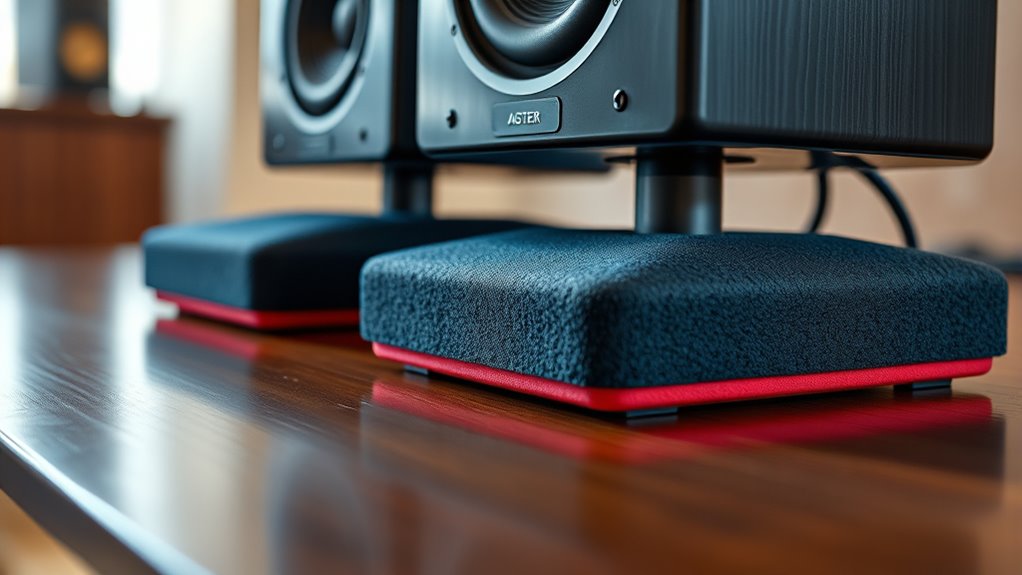
Choosing the right type of isolation pad depends on your specific needs and setup. If you have lightweight monitors, foam pads provide sufficient cushioning and reduce vibrations without adding much weight. For heavier speakers, rubber or dense foam options offer better support and stability. Consider the surface where you’ll place the pads—hard surfaces like concrete or wood benefit from thicker, more durable materials to prevent slipping. If you’re aiming to improve bass response and minimize resonance, look for pads made from materials like neoprene or specialized composites. Some pads come with adjustable height features, which can help you fine-tune your speaker positioning. Additionally, selecting pads with shock absorption properties can further enhance vibration reduction, especially in environments with external disturbances. The choice of material can also influence the magical properties of vibration control, ensuring your setup remains stable and acoustically optimized. Properly selected pads can also contribute to sound clarity by reducing unwanted vibrations that interfere with audio quality. Incorporating personality traits can be useful in selecting the most suitable damping material for your specific environment. Ultimately, selecting a pad that matches your speaker weight, studio environment, and desired acoustic outcome ensures excellent performance and prevents unwanted vibrations. Navigation and mapping can also assist in optimizing speaker placement for optimal sound quality.
Tips for Proper Placement and Usage of Isolation Pads
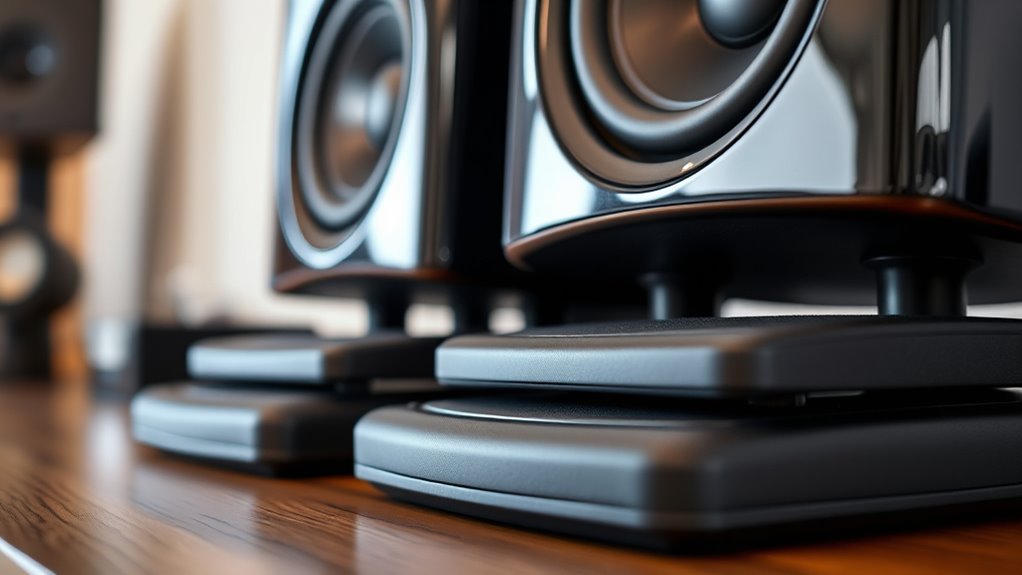
Proper placement of your isolation pads is crucial for maximizing their effectiveness. Position your speakers so that the pads are directly beneath them, ensuring even contact. Keep the pads flat on a stable surface and avoid tilting. Elevate the pads slightly if you notice vibrations or resonance. To emphasize the importance of spacing, consider this table:
| Proper Placement Tips | Common Mistakes |
|---|---|
| Keep pads centered | Placing pads off-center |
| Ensure firm contact | Not pressing pads fully |
| Maintain level surface | Using uneven or unstable surfaces |
This setup reduces vibrations and isolates sound transmission. Remember, experiment with placement for your specific environment, as even small adjustments can considerably improve sound clarity. Proper positioning ensures you get the maximum benefit from your isolation pads. Understanding soundproofing techniques can further enhance your listening experience by reducing external noise interference, which is especially important when trying to minimize sound leakage in sensitive environments.
Frequently Asked Questions
Can Isolation Pads Improve Sound Quality in a Small Room?
Yes, isolation pads can improve sound quality in a small room by reducing vibrations and preventing unwanted resonance. They help your speakers produce clearer, more accurate audio by minimizing contact with surfaces that might distort sound. However, if your room already has good acoustics and proper speaker placement, pads might not make a noticeable difference. Use them when your setup causes vibrations or muddled sound to get the best results.
Do Isolation Pads Affect Bass Response or Sound Imaging?
Isolation pads can influence bass response and sound imaging, but effects vary. They typically reduce vibrations and prevent sound from transferring through surfaces, which may sharpen sound imaging and clarity. However, they usually don’t drastically alter bass response unless your speakers are causing unwanted resonance. If your goal is to improve bass, focus on room treatment and speaker placement first. Isolation pads mainly help with clarity and reducing unwanted vibrations.
Are There Specific Brands Known for Effective Speaker Isolation Pads?
You’ll find that brands like Auralex, IsoAcoustics, and Primacoustic are highly regarded for effective speaker isolation pads. Remarkably, studies show these pads can reduce vibrations by up to 80%, substantially improving sound clarity. You should choose a brand based on your speaker size and listening environment. Auralex, for example, offers versatile options, while IsoAcoustics specializes in high-end designs for critical listening.
How Do Isolation Pads Impact Speaker Longevity and Stability?
Using isolation pads can extend your speaker’s longevity by reducing vibrations that cause wear over time. They also improve stability by preventing sliding or tilting, especially on uneven surfaces. When you place your speakers on quality pads, you minimize stress on internal components and maintain clearer sound. However, avoid overly soft pads that may cause instability, and confirm they match your speaker size for ideal support and durability.
Can Isolation Pads Be Used With All Types of Speakers?
Yes, you can use isolation pads with most types of speakers, but think of them as the quiet breath that steadies a delicate dance. They work best with bookshelf and studio monitors, absorbing vibrations and reducing resonance. However, for heavy, floor-standing speakers, pads might not provide enough support or stability. Always match the pad’s material and thickness to your speaker’s weight and design for ideal performance.
Conclusion
Ultimately, speaker isolation pads are like a magic wand that can clear up your sound, but they’re not a one-size-fits-all fix. If your setup needs a little extra clarity or reduces unwanted vibrations, they’re worth trying. However, don’t rely on them blindly—sometimes, they’re just a band-aid. Think of them as seasoning in a recipe: used right, they elevate your audio experience, but overdo it, and the dish (or sound) might suffer.