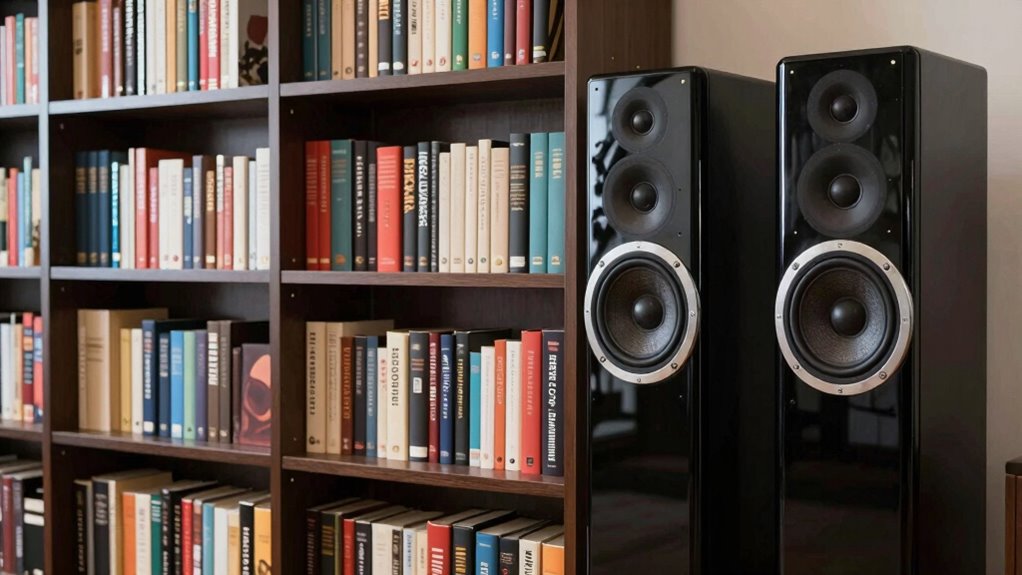
When choosing between bookshelf and floorstanding front speakers, you’ll notice that placement and room setup differ. Bookshelf speakers need to be positioned close to walls and at ear level, requiring careful adjustments for clarity and bass response. Floorstanding models are larger, often filling more space, and can be placed further from walls for ideal sound. Your room size and acoustics influence your choice. Keep exploring to discover how to maximize each type for your space and sound preferences.

Get audio and creator gear delivered free — and shop member deals
- Fast, free delivery on millions of items
- Access to Prime Big Deal Days deals on October 6–7
- Prime Video, Amazon Music and more included
Key Takeaways
- Placement precision is more critical for bookshelf speakers to avoid muddiness and optimize sound clarity.
- Floorstanding speakers generally require less exact positioning due to their larger size and room-filling design.
- Bass response is deeper and more prominent in floorstanding models, influencing room acoustics and placement.
- Room size and acoustics impact each type differently; soft furnishings benefit both but are especially important for bookshelf speakers.
- Practice involves experimenting with positioning to maximize soundstage, clarity, and overall performance for each speaker type.
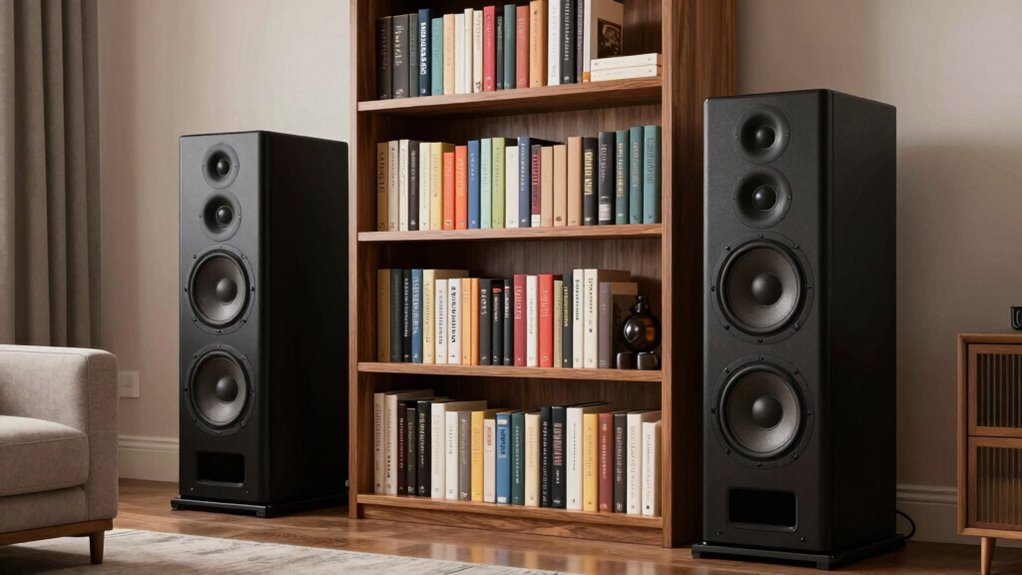
Have you ever wondered whether bookshelf or floorstanding front speakers are the better choice for your home audio setup? The answer depends on a few key factors, especially when it comes to speaker placement and room acoustics. These elements greatly influence how your speakers perform and how your space sounds overall. When choosing between the two, consider how much space you have and how you want your sound to fill the room.
Bookshelf speakers are compact, so they fit easily onto shelves, stands, or even wall mounts. Because of their size, you’ll need to pay close attention to speaker placement to get the best sound. Positioning them too close to walls or corners can cause bass to boom or sound to become muddy, so it’s essential to experiment with their placement. Ideally, you want to place them at ear level when seated and keep some space between the speakers and the back wall. This helps improve clarity and soundstage, making your listening experience more immersive. Proper speaker placement can make a significant difference in sound quality, especially in smaller rooms.
Place bookshelf speakers at ear level with space from walls for optimal clarity and soundstage.
Floorstanding speakers, on the other hand, are larger and designed to stand freely on the floor. They often feature multiple drivers, which deliver deeper bass and a broader soundstage. Since they’re bigger, they can fill a room more easily without needing as much precise placement. However, their size means you should consider room acoustics carefully. They might overpower a small space or create unwanted echoes if placed too close to walls or in a cluttered room. To optimize their performance, you’ll want to position them a few feet away from walls and at an appropriate distance from each other, usually forming an equilateral triangle with your listening position. Additionally, understanding room acoustics can help you make better adjustments to achieve clearer sound.
Room acoustics play a *significant* role regardless of which type of speaker you choose. Hard surfaces like windows and floors can reflect sound waves, causing echoes or harshness, while soft furnishings absorb some frequencies, making the sound more balanced. For bookshelf speakers, adjusting their placement and adding rugs or curtains can help tame reflections. For floorstanding models, considering their size and how they interact with the room’s shape and furnishings is *essential*. Both types benefit from proper speaker placement, but floorstanding speakers often require more space and strategic positioning to maximize their full potential. Evaluating your room’s layout and furnishings can help you decide which speaker type will produce the best overall sound.
Ultimately, your choice hinges on your room’s size and layout, as well as how much effort you’re willing to put into speaker placement and managing acoustics. Both bookshelf and floorstanding speakers can deliver excellent sound if set up thoughtfully, but understanding how room acoustics and placement impact performance will guide you to the right decision.
As an affiliate, we earn on qualifying purchases.
Frequently Asked Questions
How Do Speaker Sizes Affect Room Acoustics?
Smaller speakers like bookshelves tend to reduce room reverberation and echo, creating a clearer sound. Larger floorstanding speakers produce more sound energy, which can increase reverberation and make the room feel livelier. Their size also influences sound absorption, as bigger speakers fill the space more, affecting how sound interacts with the room’s surfaces. Overall, speaker size considerably impacts acoustics by altering reverberation and absorption, shaping your listening experience.
Can Bookshelf Speakers Replace Floorstanding Models Entirely?
You can replace floorstanding models with bookshelf speakers if you prioritize aesthetic compatibility and need a space-saving option. While bookshelf speakers often have good speaker durability, they may not deliver the same bass response or volume as larger floorstanders. Consider your room size and listening preferences, and make sure your setup offers enough power and quality to match your audio expectations, especially if you want immersive sound.
What Are the Best Placement Tips for Each Type?
You should position bookshelf speakers at ear level for ideal sound, guaranteeing their speaker height aligns with your sitting position. Place them symmetrically in relation to your listening area to create balanced soundstage and avoid acoustic issues. For floorstanding speakers, guarantee they’re a few inches from the wall to prevent bass muddiness, and maintain symmetry across the room for consistent audio performance. Proper placement enhances clarity and immersion.
How Do Cost Differences Impact Sound Quality?
Think of your sound system like a garden—spending more often yields richer blooms. Cost differences impact sound quality because higher-priced speakers usually have better components, resulting in clearer, more detailed audio. With budget constraints, you might sacrifice some nuance, but you can still get decent sound. Choosing cost-efficient options means balancing your desire for quality with what you can afford, ensuring you enjoy satisfying sound without overspending.
Are There Specific Genres That Favor One Over the Other?
If you’re into genres like classical or jazz, bookshelf speakers might suit you better because they excel in detailed, nuanced sound in smaller listening environments. For action movies or rock, floorstanding speakers can deliver powerful bass and full-range sound, especially in larger rooms. Your genre preferences and listening environment should guide your choice, as each speaker type complements different audio needs and space constraints.
floorstanding speakers for living room
As an affiliate, we earn on qualifying purchases.
As an affiliate, we earn on qualifying purchases.
Conclusion
Choosing between bookshelf and floorstanding speakers is like selecting a vessel for your musical voyage. Your space, listening habits, and aesthetic preferences shape your journey’s course. Think of bookshelf speakers as a sleek canoe—compact and nimble—while floorstanders are a sturdy ship, capable of commanding a grander soundscape. Whichever you pick, remember it’s your voyage, and the right vessel will carry your audio adventures across the seas of sound with grace and precision.
As an affiliate, we earn on qualifying purchases.
room acoustic treatment for speakers
As an affiliate, we earn on qualifying purchases.
As an affiliate, we earn on qualifying purchases.
Evergreen bestsellers Picks
bestsellers
As an affiliate, we earn on qualifying purchases.