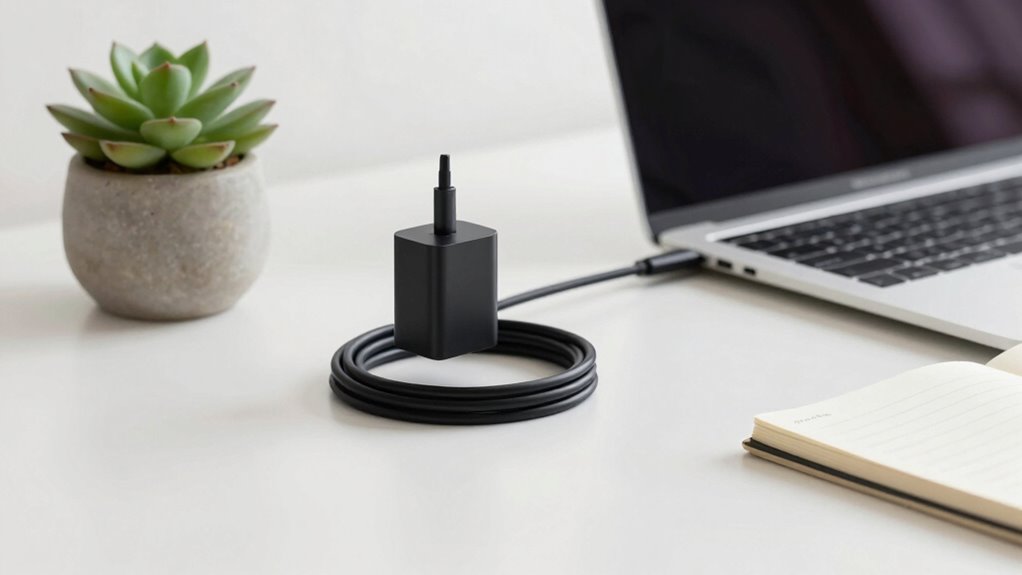

The ‘one cable’ dream is still a work in progress, with current tech offering partial solutions. You can use USB-C for charging, data transfer, and video connections on many devices, making it a versatile option. Wireless charging makes powering your phone more convenient, but data sharing still relies on cables. Although a fully universal cable hasn’t arrived, exploring the latest advancements shows how close we are. Keep going for a closer look at where this technology stands today.

Get audio and creator gear delivered free with Prime
- Fast, free delivery on millions of items
- Prime Video, Amazon Music and more included
- Member-only deals all year
Key Takeaways
- Universal cables aim to combine charging, data, audio, and video, but compatibility issues prevent full realization.
- USB-C supports high-speed data, power, and video, making it a practical partial solution.
- Wireless charging simplifies power delivery but does not handle data or multimedia transfer.
- Currently, a single cable for all functions remains unachieved due to technological and standardization barriers.
- Combining USB-C with wireless charging offers a practical, partial approach to reducing cable clutter.

Have you ever wondered if a single cable could truly simplify your tech setup? The idea of a universal cable that handles everything—charging, data transfer, and even audio or video—sounds appealing. It promises to cut down on clutter, reduce the number of cables you carry, and streamline your daily routine. However, in reality, the technology isn’t quite there yet. While it’s tempting to envision a single cable that powers your devices and transfers all data seamlessly, the current state of tech shows limitations that prevent this from becoming an everyday reality. Compatibility issues still pose a challenge, preventing a truly universal solution.
When it comes to wireless charging, it’s a convenient feature that many devices now support. You simply place your phone on a compatible pad, and it charges without plugging in. This eliminates the need for traditional cables for power, but it doesn’t replace data transfer altogether. Wireless charging is great for convenience but doesn’t handle data, which still requires a cable or wireless connection like Wi-Fi or Bluetooth. So, even with wireless charging, your setup isn’t entirely cable-free; you still need cables or wireless solutions for transferring data.
Data transfer, on the other hand, has advanced significantly. USB-C has become a popular standard because it can carry high-speed data, power, and even video signals. This means that, technically, a single USB-C cable can replace multiple older cables. You can connect your smartphone to a laptop, external monitor, or charger with one type of cable. But while this reduces the number of cables, it doesn’t address the need for multiple accessories or the different types of ports required for various devices. Plus, not all devices support the same standards, so compatibility issues can arise. As technology evolves, manufacturers are working towards more universal standards, but widespread adoption still takes time. It’s also worth noting that the development of interoperable devices remains a key factor in making this vision a reality.
The dream of a single cable that handles everything is partly achievable with current technology, especially with USB-C. Still, it’s not a universal solution for every device or scenario. Wireless charging is excellent for convenience, but it’s limited to power delivery and doesn’t replace data transfer. Meanwhile, data transfer has improved with versatile cables, but these still require physical connections and aren’t always compatible across all devices. To truly simplify your setup, you might need a combination of wireless and wired solutions, rather than relying on one magic cable. The ‘one cable’ dream remains appealing, but in practice, it’s more about finding the right balance between convenience and functionality.
As an affiliate, we earn on qualifying purchases.
Frequently Asked Questions
What Are the Main Limitations of a Single-Cable Solution?
The main limitations of a single-cable solution include concerns about cable durability and aesthetic appeal. You might worry that a single cable could wear out faster if not built robustly, leading to frequent replacements. Additionally, it could compromise your space’s look, as a single visible cable may be less sleek and more obtrusive. Balancing durability with aesthetics becomes challenging, especially when trying to keep your setup clean and functional.
How Does a Universal Cable Impact Device Performance?
Imagine you’re living in the 90s, but your universal cable makes device performance smoother. It streamlines wireless charging and data transfer, minimizing lag and compatibility issues. While it simplifies connections, it can sometimes limit speed or power delivery compared to specialized cables. You’ll enjoy convenience, but for peak performance, certain devices might still need dedicated cables. Overall, a universal cable balances flexibility with some trade-offs in device efficiency.
Are There Compatibility Issues With Different Brands?
Yes, there can be compatibility issues with different brands. Brand compatibility matters because some manufacturers use proprietary connectors or standards that may not work seamlessly with other brands. Accessory integration can be limited if a device isn’t designed for universal cables, leading to potential performance issues or connection failures. To avoid frustration, check compatibility details before purchasing, ensuring your devices and accessories work smoothly together regardless of brand.
What Is the Cost Difference Compared to Multiple Cables?
You’ll notice a cost difference that can surprise you — investing in one versatile cable might seem pricey upfront, but it pays off. Imagine a cable that boasts impressive longevity and power efficiency, reducing the need for replacements and saving money over time. While multiple cables might seem cheaper initially, the durability and efficiency of a single, high-quality cable make it a smarter, more economical choice in the long run.
How Future-Proof Is the ‘One Cable’ Approach?
The ‘one cable’ approach isn’t completely future-proof, but it’s pretty close. Wireless charging is improving, making it more convenient, but it still isn’t as fast or reliable as traditional cables. Battery longevity can be affected by wireless charging, so keep that in mind. Overall, you’ll benefit from fewer cables now, but stay adaptable as technology evolves, especially with advances in wireless tech and faster charging options.
wireless charging pad for smartphones
As an affiliate, we earn on qualifying purchases.
As an affiliate, we earn on qualifying purchases.
Conclusion
So, imagine a world where your single cable rules them all—no more tangled messes, no more endless plugging and unplugging. It’s like wielding the ultimate power of simplicity and efficiency, transforming your daily tech chaos into pure harmony. While the dream isn’t perfect everywhere, where it works, it’s nothing short of revolutionary—like having a magic wand that finally makes your gadgets behave. Embrace it, and watch your tech life become a smooth, unstoppable force.
As an affiliate, we earn on qualifying purchases.
As an affiliate, we earn on qualifying purchases.
Fall Picks
fall essentials
As an affiliate, we earn on qualifying purchases.