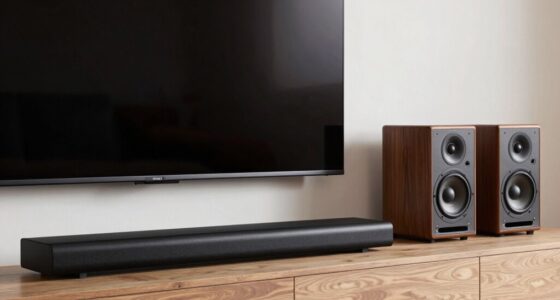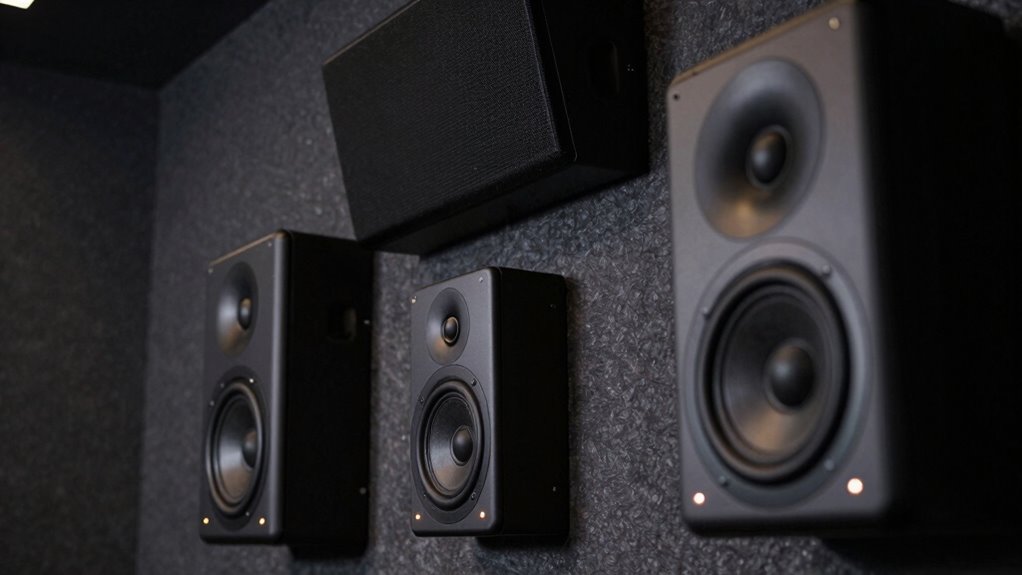

Rear speakers often impress more than bigger front speakers because they add depth and realism to your soundscape. They reproduce ambient noises like whispers, footsteps, and echoes, making you feel truly immersed in the scene. While front speakers deliver impact and clarity, rear speakers focus on spatial accuracy and subtle cues that enhance authenticity. If you want to understand how proper placement and technology can amplify these effects, keep exploring this fascinating topic.

Get audio and creator gear delivered free — and shop member deals
- Fast, free delivery on millions of items
- Access to Prime Big Deal Days deals on October 6–7
- Prime Video, Amazon Music and more included
Key Takeaways
- Rear speakers enhance spatial accuracy, creating a more immersive and realistic sound environment than front speakers alone.
- They reproduce subtle ambient sounds and directional cues that bigger front speakers may overlook.
- Proper calibration and placement of rear speakers amplify their impact on the overall listening experience.
- Rear speakers contribute to emotional engagement by enveloping listeners in a convincing three-dimensional soundscape.
- Advances in audio technology improve the realism and precision of rear channel effects, often surpassing the influence of larger front speakers.
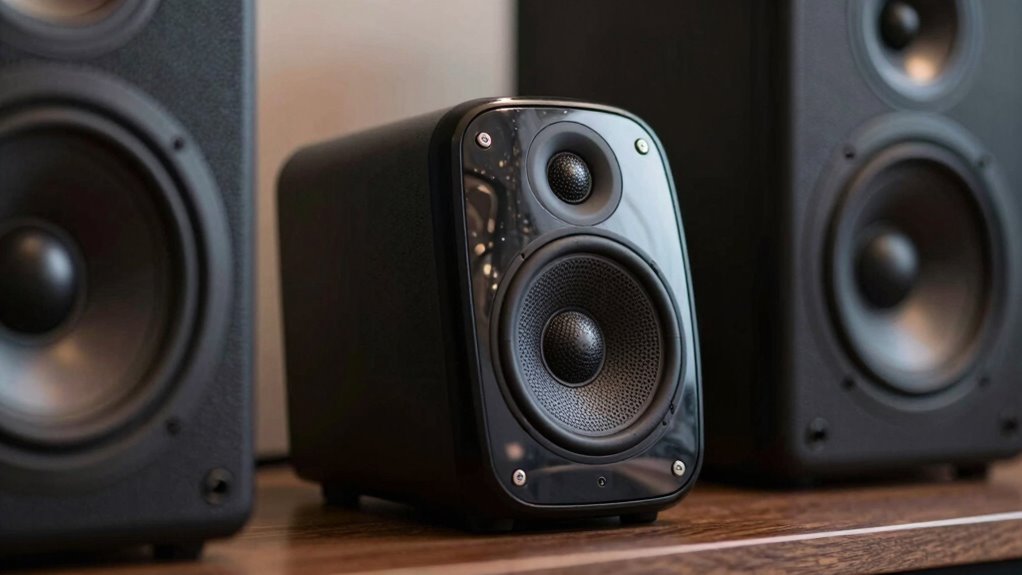
While larger front speakers, with their powerful drivers and enhanced bass response, often steal the spotlight in home theater setups, rear speakers can sometimes deliver a more immersive audio experience that leaves you impressed. The secret lies in how they contribute to surround sound and deepen your acoustic immersion. When you sit down to watch a movie or listen to music, your ears crave a sense of space—an environment that makes you feel like you’re right there in the scene. This is where rear speakers excel, filling in the soundscape from behind and around you, creating a layered and dynamic audio environment.
You might assume that bigger front speakers, with their powerful drivers and enhanced bass response, automatically provide superior sound. While they do deliver impactful audio at the forefront, they often focus on clarity and volume rather than spatial accuracy. Rear speakers, on the other hand, are designed to complement this by adding directionality and depth. Their placement behind you enables them to produce subtle, nuanced sounds—such as footsteps, whispers, or distant echoes—that contribute to a richer sense of space and realism. This creates a more convincing surround sound experience, making you feel like you’re inside the action rather than just observing it.
Acoustic immersion is all about how well your sound system transports you into the environment. Rear speakers play a crucial role here, because they help establish a seamless sound field that envelops you from multiple angles. When sound effects originate from behind, it tricks your brain into perceiving a true three-dimensional space. This heightened sense of acoustic immersion amplifies the emotional impact of a scene, whether it’s the rustling leaves in a forest or the faint hum of distant city life. The more effectively your rear speakers reproduce these ambient sounds, the more convincing your entire audio experience becomes. Additionally, proper calibration and speaker placement are essential to maximize their effectiveness in creating a realistic sound stage. Achieving precise timing and synchronization between all speakers is also vital for a cohesive listening experience. Properly calibrated audio channels can significantly enhance the sense of realism and immersion. Furthermore, advancements in audio processing technology have made it easier to optimize speaker performance and spatial accuracy, further elevating the overall experience.
A well-designed sound field can also help compensate for less-than-ideal room acoustics, making the placement of rear speakers even more critical for optimal performance. In many cases, the difference isn’t about how loud or powerful the rear speakers are, but how precisely they reproduce spatial cues. They add a layer of realism that bigger front speakers often can’t match alone. When set up correctly, rear speakers help you perceive sound as a natural extension of the environment, not just a collection of isolated channels. This makes your home theater feel more alive, more detailed, and ultimately more immersive. So, even if your front speakers are impressive, don’t overlook the power of well-placed rear speakers—they might just elevate your entire listening experience beyond expectations.
As an affiliate, we earn on qualifying purchases.
Frequently Asked Questions
How Do Rear Speakers Enhance Surround Sound Experiences?
Rear speakers enhance your surround sound experience by creating surround immersion and improving spatial accuracy. When you set up rear speakers correctly, you feel more enveloped in sound, making movies and music more realistic. They accurately position sounds behind you, adding depth and dimension. This setup tricks your brain into perceiving a three-dimensional soundstage, making your entertainment feel more lifelike and engaging, especially during action scenes or immersive audio experiences.
Can Smaller Rear Speakers Outperform Larger Front Speakers?
Smaller rear speakers can outperform larger front speakers in creating an immersive sound experience because they focus on delivering precise, directional sound effects and ambient noises that enhance surround sound. While speaker size influences bass depth, rear speakers often prioritize clarity and spatial cues over deep bass. Their strategic placement around your listening area amplifies the sense of space, making them more impressive in certain setups despite their smaller size.
What Is the Ideal Placement for Rear Speakers?
Think of your room as a concert hall where rear speakers are the echoing drums that fill the space. Place rear speakers slightly behind your listening position, at ear level, and equidistant from each other. Proper speaker calibration and acoustic treatment ensure sound clarity, making the experience immersive. This setup transforms your space into a symphony, where well-placed rear speakers deliver a balanced, enthralling surround sound that impresses every time.
Do Rear Speakers Require More Power Than Front Speakers?
No, rear speakers don’t necessarily require more power than front speakers. It depends on their speaker wattage and power efficiency. If your rear speakers have higher wattage or lower power efficiency, they might need more power to perform well, especially at high volumes. However, generally, both front and rear speakers are designed to operate effectively within their wattage ratings, so matching their power needs ensures balanced sound without overloading your amplifier.
How Do Room Acoustics Affect Rear Speaker Performance?
Room acoustics are like a dance partner, guiding your rear speakers’ performance. Reflections from walls and furniture can muddy sound, making rear channels less clear. To improve, you need acoustic treatment—adding panels or diffusers reduces unwanted reflections, allowing rear speakers to shine. Properly managed acoustics guarantee your surround sound feels immersive, with rear speakers delivering crisp, precise effects that captivate you, even more than the larger front speakers.
best rear speakers for home theater
As an affiliate, we earn on qualifying purchases.
As an affiliate, we earn on qualifying purchases.
Conclusion
So, next time you’re setting up your home theater, don’t overlook those rear speakers. They might just surprise you, delivering a richness and depth that even larger front speakers can’t match. As you fine-tune your system, ask yourself—could the secret to immersive sound be hiding behind you? Sometimes, the most unassuming speakers hold the key to the ultimate listening experience. Ready to discover what’s been missing all along?
ambient sound speakers for immersive audio
As an affiliate, we earn on qualifying purchases.
As an affiliate, we earn on qualifying purchases.
rear channel speaker calibration kit
As an affiliate, we earn on qualifying purchases.
As an affiliate, we earn on qualifying purchases.
Fall Picks
fall essentials
As an affiliate, we earn on qualifying purchases.