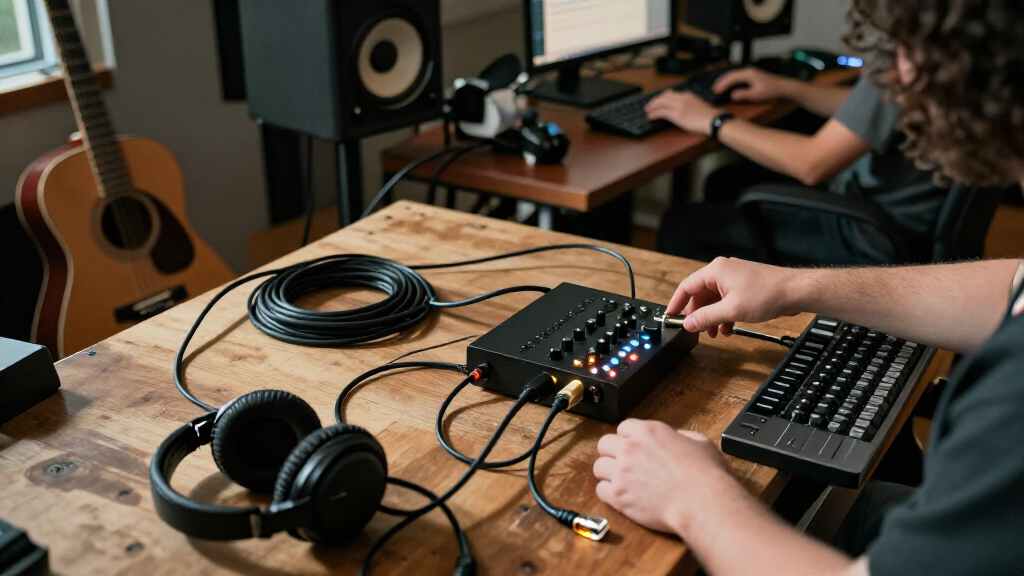

For Ethernet audio, the right interface depends on what you need to put onto or take off the network. I’d start with the Focusrite RedNet X2P for a compact recording and monitoring station with two microphone preamps, choose the MAXSQUARE MSQ-3900D when four existing analog sources need Dante or AES67 connectivity, and pick the RedNet AM2 when the job is listening and line-level monitoring rather than recording microphones. Those are different roles, not interchangeable versions of the same product.

Get audio and creator gear delivered free with Prime
- Fast, free delivery on millions of items
- Prime Video, Amazon Music and more included
- Member-only deals all year
The main tradeoff is channel direction and purpose: the MAXSQUARE converts four XLR inputs for network transport, the X2P adds microphone preamps and local outputs in a 2×2 interface, and the AM2 is an output-focused Dante endpoint. All three depend on a compatible network-audio setup, so Ethernet alone does not make them plug-and-play USB interfaces. I rank them by how broadly each can serve a practical studio workflow, while weighing channel count, monitoring, and setup requirements.
Complete the kit


Key Takeaways
- RedNet X2P is my most flexible recording pick: its two Red Evolution preamps, headphone amplifier, and stereo line output combine input and monitoring in one Dante endpoint.
- MAXSQUARE MSQ-3900D takes four analog inputs: it suits installations that need more XLR channels than the X2P, and it supports both Dante and AES67.
- RedNet AM2 is for network-fed monitoring: headphone and XLR line outputs make it useful at a listening position, but it does not provide microphone inputs.
- PoE simplifies placement: the MSQ-3900D and AM2 can receive power over Ethernet; the X2P is also built for Dante network use, but its listed specifications do not state a power method.
- Choose around your network workflow: Dante or AES67 routing requires compatible network-audio configuration; none of these should be treated as a conventional USB interface.
| Focusrite RedNet X2P 2×2 Dante Ethernet Audio Interface with Mic Preamps | 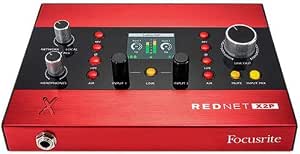 | Best Overall for a Compact Recording Point | Audio network: Dante over Ethernet | Channels: 2×2 | Microphone preamps: Two Red Evolution preamps | VIEW LATEST PRICE | See Our Full Breakdown |
| MAXSQUARE MSQ-3900D 4-Channel Dante Analog Audio Network Interface |  | Best for Four Analog Inputs and AES67 | Inputs: Four 3-pin XLR | Audio formats: Dante and AES67 RTP | Supported sample rates: 44.1 kHz, 48 kHz, and 96 kHz | VIEW LATEST PRICE | See Our Full Breakdown |
| Focusrite RedNet AM2 Stereo Dante Headphone Amplifier and Line Output Interface with PoE |  | Best for Dante Headphone and Line Monitoring | Network connectivity: Dante | Headphone output: 1/4-inch TRS | Line outputs: XLR | VIEW LATEST PRICE | See Our Full Breakdown |
| Ethernet audio interface | Power | Warranty |
|---|---|---|
| Focusrite RedNet X2P 2×2 Dante | — | — |
| MAXSQUARE MSQ-3900D 4-Channel | PoE class 0 or USB Type-C | One-year limited warranty |
| Focusrite RedNet AM2 Stereo Da | PoE or included external power supply | Three years |
More Details on Our Top Picks
Focusrite RedNet X2P 2×2 Dante Ethernet Audio Interface with Mic Preamps
I rank the RedNet X2P first because it covers the most jobs in one remote Dante device: two microphone inputs with Red Evolution preamps, stereo headphone monitoring, and stereo line output. That combination suits a booth, rehearsal room, or secondary recording position where a performer needs to connect microphones and monitor locally without placing a larger interface at the source.
Its advantage over the MAXSQUARE MSQ-3900D is not raw input count. The MAXSQUARE accepts four analog XLR inputs and supports AES67 as well as Dante, making it stronger for multi-channel line-input transport or mixed network environments. The X2P instead provides two specifically described microphone preamps plus local listening outputs, so it makes more sense when the signals are microphones and the performer needs a complete capture-and-monitoring point. Its stated maximum sample rate of 96 kHz also aligns with the MSQ-3900D, while the AM2 is presented chiefly as an output device.
The compromise is its focused 2×2 format. Buyers needing four separate analog inputs should look to the MSQ-3900D, and buyers who only need to feed headphones and line monitors from Dante may not need to pay for preamps they will not use. The supplied details also specify Windows compatibility but do not spell out power options, so I would verify operating-system and power requirements for the intended installation before choosing it. This is my best all-around pick only when its two-input layout matches the recording task.
Pros:- Two Red Evolution microphone preamps in a compact 2×2 network interface
- Built-in stereo headphone amplifier for local performer monitoring
- Stereo line output adds a feed for external monitors or equipment
- Supports sample rates up to 96 kHz
Cons:- Only two input channels, fewer than the MSQ-3900D’s four XLR inputs
- Uses Dante rather than the stated Dante-and-AES67 flexibility of the MAXSQUARE
- Listed information does not specify a power method, so installation requirements need checking
Best for: Small studios, remote recording positions, and performers who need two microphone preamps with headphone and stereo line monitoring on a Dante network.
Not ideal for: Installations needing four analog input channels, AES67 support, or a dedicated Dante headphone endpoint without microphone preamps.
- Audio network:Dante over Ethernet
- Channels:2×2
- Microphone preamps:Two Red Evolution preamps
- Audio input:XLR
- Outputs:Stereo headphone amplifier and stereo line output
- Maximum sample rate:96 kHz
- Operating system listed:Windows
Our verdict“I’d choose the RedNet X2P for the broadest compact recording workflow, provided two microphone inputs are enough and the Dante setup is compatible.”
MAXSQUARE MSQ-3900D 4-Channel Dante Analog Audio Network Interface
The MAXSQUARE MSQ-3900D is the clearest choice when the priority is moving several existing analog signals onto an audio network. Four 3-pin XLR inputs give it twice the stated input count of the RedNet X2P, and support for Dante and AES67 RTP makes it the most adaptable option here for systems that need one of those network formats. Its uncompressed, low-latency transmission is aimed at routing audio across a compatible IP network rather than replacing a conventional desktop USB interface.
Compared with the X2P, the MSQ-3900D emphasizes channel capacity and protocol flexibility over a built-in recording-point experience. The X2P has two microphone preamps and local headphone and line outputs; the MAXSQUARE’s supplied specifications identify four XLR inputs but do not describe microphone preamps or local monitoring outputs. That distinction matters: if the sources already arrive at appropriate analog levels and the goal is network transport, four channels may be more useful than the X2P’s integrated monitoring. If you need microphone gain or a performer’s headphone feed, I would favor the X2P instead.
Power is a practical strength. PoE or USB Type-C offers two ways to place the aluminum-bodied unit, which weighs 10.56 ounces. It supports 44.1, 48, and 96 kHz, so the maximum matches the X2P’s stated ceiling. The tradeoff is network dependence: Dante or AES67 needs compatible equipment and routing, and a four-input converter is less useful if your setup has no matching endpoint or network plan. The listed one-year limited warranty is also shorter than the three-year warranty stated for the RedNet AM2.
Pros:- Four 3-pin XLR inputs provide more analog input channels than either Focusrite option
- Supports both Dante and AES67 RTP network audio
- PoE and USB Type-C power options support flexible placement
- Aluminum housing and sample-rate support up to 96 kHz
Cons:- Requires compatible Dante or AES67 equipment and network routing
- The supplied specifications do not describe microphone preamps or headphone monitoring
- One-year limited warranty is shorter than the RedNet AM2’s stated three years
Best for: Installers and studios that need four XLR analog inputs on a Dante or AES67 network and value PoE or USB Type-C power choices.
Not ideal for: Solo recording users who need described microphone preamps and built-in headphone monitoring, or anyone looking for a simple USB interface.
- Inputs:Four 3-pin XLR
- Audio formats:Dante and AES67 RTP
- Supported sample rates:44.1 kHz, 48 kHz, and 96 kHz
- Power:PoE class 0 or USB Type-C
- Housing:Aluminum
- Weight:10.56 ounces
- Warranty:One-year limited warranty
Our verdict“I’d pick the MSQ-3900D when four analog feeds and Dante-or-AES67 flexibility matter more than integrated preamps and performer monitoring.”
Focusrite RedNet AM2 Stereo Dante Headphone Amplifier and Line Output Interface with PoE
The RedNet AM2 is the most specialized option in this group: it brings a Dante audio feed to a listening position and provides a headphone output plus XLR line outputs. Independent level controls for headphones and line output let a listener adjust personal headphone volume without changing the feed to connected monitors or other equipment. A mute switch adds a straightforward way to silence output when a monitoring point needs to go quiet.
That role separates it from the RedNet X2P. The X2P can capture two microphone inputs and provide local monitoring, while the AM2 is presented as a headphone amplifier and line-output endpoint, not a microphone recording interface. If your goal is to place a Dante headphone station near a performer, editor, or engineer, the AM2 avoids selecting a device for preamp features you will not use. But if microphones need to enter the network at that same location, the X2P is the better match. The MSQ-3900D goes the other direction by accepting four analog inputs for network transport rather than concentrating on headphone listening.
Power over Ethernet helps reduce the need for a separate supply at the listening position, and an included external power supply gives another option. The listed three-year warranty is longer than the MAXSQUARE’s one-year limited warranty. Its limitation is equally clear: it requires a Dante-compatible setup, and its described output-focused layout does not replace an interface with microphone inputs. The published details do not state a sample-rate ceiling, so I would check compatibility with the network system rather than infer one from the other RedNet products.
Pros:- Headphone amplifier is designed to drive high-impedance headphones
- Independent level controls for headphone and XLR line outputs
- Mute switch supports quick control at a monitoring position
- PoE or the included external power supply can power the unit
Cons:- Requires a Dante-compatible network-audio setup
- No microphone inputs or preamps are described, unlike the RedNet X2P
- No maximum sample rate is stated in the supplied specifications
Best for: Dante installations that need a dedicated headphone listening point with separate headphone and XLR line level controls.
Not ideal for: Recording directly from microphones, converting four analog inputs to network audio, or working without a Dante-compatible system.
- Network connectivity:Dante
- Headphone output:1/4-inch TRS
- Line outputs:XLR
- Output controls:Independent headphone and line level controls
- Additional control:Mute switch
- Power:PoE or included external power supply
- Warranty:Three years
Our verdict“I’d choose the AM2 for Dante-fed headphone and line monitoring, but not as a microphone-recording interface.”
How We Picked
I ranked these three products by the job their Ethernet connection actually performs. Network audio is not a single feature set: an interface may send analog inputs to a Dante system, provide microphone preamps and monitoring at a remote workstation, or receive network audio for headphones and line outputs. I gave more weight to workflow breadth and clearly stated capabilities than to a long feature list.
My top placement goes to the RedNet X2P because its two microphone preamps, headphone output, and stereo line output make it the most self-contained choice for a small recording point. The MSQ-3900D ranks close behind for installations that need four analog XLR inputs or AES67 support; it has more input channels but less stated local monitoring functionality. The RedNet AM2 has a narrower output role, so it ranks third overall despite being the clearest fit for Dante headphone and line monitoring.
I also weighed practical setup details: PoE options, supported sample rates where specified, output controls, and the available warranty information. I did not assume unlisted features such as USB connectivity, bundled network software, exact preamp specifications, or power support. Each pick has a real limitation: these devices require network-audio compatibility and configuration, and their channel layouts are designed for distinct use cases. A buyer should confirm that the intended Dante or AES67 system, routing plan, and power arrangement match the selected unit.
| Ethernet audio interface | Power | Warranty |
|---|---|---|
| Focusrite RedNet X2P 2×2 Dante | — | — |
| MAXSQUARE MSQ-3900D 4-Channel | PoE class 0 or USB Type-C | One-year limited warranty |
| Focusrite RedNet AM2 Stereo Da | PoE or included external power supply | Three years |
Factors to Consider When Choosing Best Ethernet Audio Interfaces
I’d choose an Ethernet audio interface by tracing the signal path first: what needs to enter the network, what needs to come out, and where someone needs to listen. These three products answer different parts of that problem, so the channel count alone does not tell the whole story.
Decide whether you need network inputs or outputs
Start by identifying the direction of the audio. The MSQ-3900D has four XLR inputs for sending analog sources into Dante or AES67. The RedNet X2P also serves an input role, but its two channels are paired with Red Evolution microphone preamps and local listening outputs. The RedNet AM2 is the output-oriented choice: it receives Dante audio for headphones and XLR line outputs. Buying the AM2 when you need microphone inputs, or choosing the MAXSQUARE when you need a dedicated headphone station, creates a mismatch that extra network features cannot fix.
Match input count to real sources
Four XLR connections make the MSQ-3900D the straightforward pick for multiple analog feeds, while the X2P’s two-input design is a better fit for a compact stereo recording point or two-microphone setup. The stated X2P inputs include Red Evolution preamps; the MAXSQUARE specifications do not describe preamp gain, so I would not assume it provides the same microphone-input function. Count the sources that must be captured at one location, then confirm that the chosen unit supports their signal levels and the required gain staging.
Check the network format and routing plan
Dante and AES67 are network-audio standards, not synonyms for an ordinary Ethernet connection. The MSQ-3900D lists both Dante and AES67 RTP, while both Focusrite options are described as Dante devices. Confirm what formats the rest of the system supports and how channels will be routed between endpoints. A compatible switch, software configuration, and destination device may be part of the installation. If you only need a simple interface attached directly to a computer, these network devices may add setup steps without solving a problem you have.
Treat monitoring as a separate requirement
Local headphone and line outputs change how useful an interface is at a performer’s position. The X2P combines input with a stereo headphone amplifier and line output; the AM2 focuses on listening, with independent headphone and line controls plus a mute switch. The MAXSQUARE listing describes four networked XLR inputs, but does not list comparable local headphone outputs. Plan whether monitoring happens at the interface, at a separate Dante endpoint, or elsewhere in your system before deciding which box belongs near the source.
Plan power and placement
PoE can make a remote network endpoint easier to place by carrying power over the Ethernet cable, provided the network installation can supply it. The MSQ-3900D also accepts USB Type-C power; the AM2 can use PoE or its included external power supply. The X2P’s supplied specifications do not state a power method, so check the manufacturer’s installation documentation before relying on a particular mounting or cabling plan. Also account for weight, access to controls, and the location of headphone or line connections.
Compare sample-rate needs and warranty details
The MSQ-3900D supports 44.1, 48, and 96 kHz, and the X2P states a maximum of 96 kHz. The AM2’s supplied details do not list a maximum sample rate; that omission is not a basis for assuming incompatibility, but it is a reason to confirm the specification for a system with a fixed rate requirement. Warranty information also differs: the MAXSQUARE lists a one-year limited warranty, while the AM2 lists three years. Choose based on the published coverage and your deployment needs rather than treating one spec as a substitute for checking service terms.
Keep the full system cost and complexity in view
An Ethernet interface is one component of a networked audio chain. I would map the source, interface, switch or network connection, routing software, destination, monitoring method, and power before ordering. A feature such as four XLR inputs matters only if four signals need to cross the network from that point; a headphone amplifier matters only if someone monitors there. This avoids choosing a capable device whose channel direction or control layout does not fit the room.
Frequently Asked Questions
What is an Ethernet audio interface?
An Ethernet audio interface connects analog audio inputs or outputs to an audio network, often using Dante or AES67, so audio can travel between compatible network devices. Unlike a typical USB interface, it relies on network-audio routing and compatible endpoints. The three products here illustrate distinct functions: the MSQ-3900D sends four analog inputs to a network, the RedNet X2P combines two microphone inputs with monitoring, and the RedNet AM2 provides headphone and line outputs from Dante.
Can I connect these directly to a computer and use them like USB interfaces?
I would not buy any of these expecting ordinary USB-interface behavior. Their defining connection is Ethernet audio, and the Focusrite models require Dante-compatible workflows while the MAXSQUARE supports Dante and AES67. The X2P lists DAW compatibility with Dante and Focusrite drivers, but a computer and DAW still need a supported network-audio configuration. Check the device and software requirements for your operating system before planning a session around direct computer use.
Which of these is best for recording microphones?
The RedNet X2P is the clearest microphone-recording choice in this group because it includes two Red Evolution microphone preamps, plus headphone and stereo line outputs. The MSQ-3900D has four XLR inputs, but its supplied specifications do not identify microphone preamps, so confirm its intended input levels and gain requirements before connecting microphones. The AM2 is an output and monitoring device rather than a microphone-input interface.
Which model should I choose for a Dante headphone station?
I would choose the RedNet AM2 when the main task is listening to Dante audio on headphones and sending a separate line-level feed to XLR-connected equipment. Its independent headphone and line controls let the two output levels be adjusted separately, and its mute switch provides a quick output control. The X2P can also provide headphone monitoring, but its added role is capturing two microphone inputs, making it a better match when recording and local listening happen together.
When does AES67 support make a difference?
AES67 support matters when the intended audio network uses AES67-compatible RTP streams or needs interoperability with equipment configured for that standard. Of the three products here, the MAXSQUARE MSQ-3900D explicitly lists both AES67 and Dante; the Focusrite models are specified as Dante devices. Support on one interface does not guarantee that every network device will connect or route automatically, so verify compatibility and routing requirements across the whole system.
Conclusion
For a compact recording position that needs microphone preamps and local monitoring, I’d choose the RedNet X2P. For an installation sending four analog XLR sources over Dante or AES67, the MAXSQUARE MSQ-3900D is the better fit. If the requirement is a Dante-fed headphone and line-monitoring point, I’d select the RedNet AM2. The deciding question is not simply which interface has the most features: it is whether your network needs more inputs, a self-contained recording station, or a dedicated output endpoint.
Halloween Picks
halloween
As an affiliate, we earn on qualifying purchases.