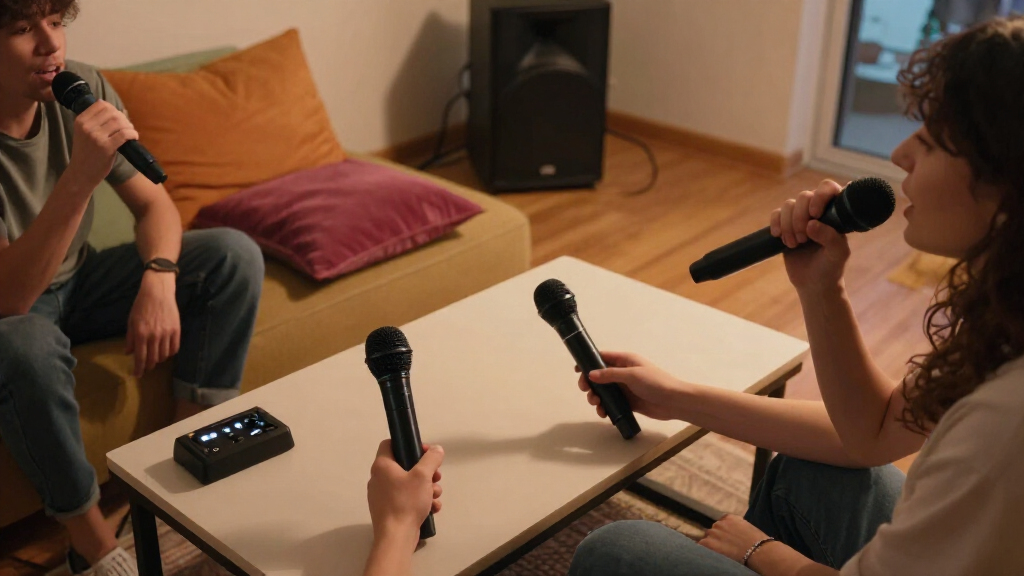
The best wireless karaoke microphones depend on whether you want a simple home singalong, a two-singer party setup, or a system that can connect to a larger sound system. I rank the HUACAM W58 as the best overall for its dual-microphone, receiver-based approach, while the JBL PartyBox Wireless Microphones stand out for compatible PartyBox owners and the BONAOK Q78 for a portable, all-in-one-style karaoke experience. The main tradeoffs are speaker compatibility, microphone count, portability, and setup complexity: a handheld Bluetooth karaoke mic is not interchangeable with a receiver-based pair. Read on for the full ranking, the features that separate these options, and advice for matching a microphone to your karaoke setup.

Get audio and creator gear delivered free with Prime
- Fast, free delivery on millions of items
- Prime Video, Amazon Music and more included
- Member-only deals all year
Complete the kit


Key Takeaways
- Receiver-based pairs lead this roundup for shared singing: The HUACAM W58, WONATU G26-S, and several other dual-mic systems are built around two handheld microphones and a receiver, unlike the single-unit BONAOK karaoke mics.
- Compatibility matters more than wireless branding: Bluetooth microphone products and receiver-based UHF or 2.4GHz systems connect in different ways, so buyers should check their speaker or karaoke machine before choosing.
- JBL’s two options serve different setups: The PartyBox Wireless Microphones are aimed at compatible PartyBox speakers, while JBL’s dual-channel receiver system is a separate style of wireless microphone setup.
- Portability comes with a different experience: The BONAOK Q78 and Q37 combine a handheld microphone with Bluetooth-oriented karaoke features, while most other picks need an external speaker or sound system.
- More microphones are useful only when the setup supports them: Aveek’s four-microphone system suits group hosting, but a two-mic pair is simpler for most households and smaller gatherings.
| HUACAM W58 2.4GHz Dual Wireless Microphone System |  | Best for Plug-and-Play Dual-Mic Use | Wireless technology: 2.4GHz | Microphones: 2 handheld | Receiver runtime: 5–6 hours | VIEW LATEST PRICE | See Our Full Breakdown |
| WONATU G26-S Dual Wireless Karaoke Microphones |  | Best for Long Sessions and Flexible Connections | Wireless technology: 2.4GHz dual-signal system | Microphones: 2 handheld | Wireless range: Up to 260 ft | VIEW LATEST PRICE | See Our Full Breakdown |
| TONOR TW360 UHF Wireless Microphone System, Gray | 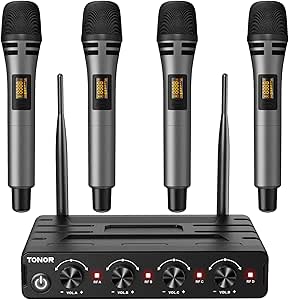 | Best UHF Pick for PA and Karaoke Gear | Wireless technology: UHF | Microphones: Handheld system | Wireless range: Up to 200 ft (60 m) | VIEW LATEST PRICE | See Our Full Breakdown |
| BONAOK Q78 Portable Bluetooth Karaoke Microphone with LED Lights |  | Best Compact All-in-One Karaoke Mic | Connectivity: Bluetooth 5.0 | Playback: Bluetooth and TF card | Microphone form: Handheld, unidirectional | VIEW LATEST PRICE | See Our Full Breakdown |
| JBL PartyBox Wireless Microphones |  | Best for JBL PartyBox Owners | Microphones: 2 handheld | Wireless connection: 2.4GHz dongle | Compatibility: JBL PartyBox speakers | VIEW LATEST PRICE | See Our Full Breakdown |
| Phenyx Pro PTU-71-2H Dual UHF Wireless Handheld Microphone System |  | Best for Long-Range UHF Use | Channels: 2 | Selectable frequencies: 100 per channel | Frequency ranges: Channel 1: 536.57–561.32 MHz; Channel 2: 562.37–587.12 MHz | VIEW LATEST PRICE | See Our Full Breakdown |
| JBL Wireless Two-Microphone System with Dual-Channel Receiver, Black |  | Best for JBL PartyBox Owners | Channels: 2 | Connectivity: Wireless receiver with USB connection | Compatible devices: Listed JBL PartyBox Encore, 100/110, Encore Essential, 200, 300, 310/310 MC, 710, Ultimate, 1000, and On-The-Go models | VIEW LATEST PRICE | See Our Full Breakdown |
| BONAOK Q37 Wireless Bluetooth Karaoke Microphone, Rose Gold |  | Best All-in-One Bluetooth Pick | Model: Q37 | Connectivity: Bluetooth and wired | Bluetooth range: 10 m | VIEW LATEST PRICE | See Our Full Breakdown |
| SINWE Wireless Handheld Microphones with LED Lights – Karaoke Set |  | Best for Long Battery Life and Stage Flair | Number of channels: 1 | Transmission range: Up to 200 ft (60 m) | Battery life: Over 40 hours | VIEW LATEST PRICE | See Our Full Breakdown |
| Dual Rechargeable All-Metal Wireless Karaoke Microphones |  | Best for Adjustable Two-Singer Setups | Wireless connectivity: 2.4 GHz | Microphones: 2 handheld all-metal microphones | Connectors: 3.5 mm and 6.35 mm | VIEW LATEST PRICE | See Our Full Breakdown |
| Wireless Dual Handheld Dynamic Microphone Set |  | Best for Simple, Long-Range Duets | Microphones: 2 handheld dynamic microphones | Wireless range: Up to 200 feet, line of sight | Receiver connector: 6.35 mm plug; 3.5 mm adapter included | VIEW LATEST PRICE | See Our Full Breakdown |
| ALPOWL Wireless Handheld Microphone System with Rechargeable Receiver |  | Best for Rechargeable Receiver Convenience | Channels: 2 | Wireless range: Up to 200 feet (60 m) | Receiver connector: 6.35 mm jack | VIEW LATEST PRICE | See Our Full Breakdown |
| Talomen K60-2 Dual Handheld Wireless Microphone System |  | Best Rechargeable Pick for Regular Duets | Microphones: 2 handheld dynamic microphones | Wireless technology: 2.4 GHz | Wireless range: Up to 160 feet (50 m) | VIEW LATEST PRICE | See Our Full Breakdown |
| ELIRIRA Dual Handheld Wireless Microphone System |  | Best for Travel and Long Receiver Runtime | Model: HVM-001 | Microphones: 2 handheld | Wireless technology: 2.4 GHz | VIEW LATEST PRICE | See Our Full Breakdown |
| Aveek 4-Pack Wireless Microphone System |  | Best for Group Karaoke | Microphones: 4 handheld dynamic microphones | Channels: 4 | Wireless technology: UHF | VIEW LATEST PRICE | See Our Full Breakdown |
| wireless karaoke microphone | Microphones | Wireless range |
|---|---|---|
| HUACAM W58 2.4GHz Dual Wireles | 2 handheld | — |
| WONATU G26-S Dual Wireless Kar | 2 handheld | Up to 260 ft |
| TONOR TW360 UHF Wireless Micro | Handheld system | Up to 200 ft (60 m) |
| BONAOK Q78 Portable Bluetooth | — | — |
| JBL PartyBox Wireless Micropho | 2 handheld | Up to 30 meters |
| Phenyx Pro PTU-71-2H Dual UHF | — | — |
| JBL Wireless Two-Microphone Sy | — | — |
| BONAOK Q37 Wireless Bluetooth | — | — |
| SINWE Wireless Handheld Microp | — | — |
| Dual Rechargeable All-Metal Wi | 2 handheld all-metal microphones | Up to 200 ft (60 m) in open, unobstructed areas |
| Wireless Dual Handheld Dynamic | 2 handheld dynamic microphones | Up to 200 feet, line of sight |
| ALPOWL Wireless Handheld Micro | — | Up to 200 feet (60 m) |
| Talomen K60-2 Dual Handheld Wi | 2 handheld dynamic microphones | Up to 160 feet (50 m) |
| ELIRIRA Dual Handheld Wireless | 2 handheld | Up to 200 feet (60 m) |
| Aveek 4-Pack Wireless Micropho | 4 handheld dynamic microphones | Up to 262 feet |
More Details on Our Top Picks
HUACAM W58 2.4GHz Dual Wireless Microphone System
The HUACAM W58 is a straightforward choice when two people need handheld microphones for karaoke, announcements, or a small PA setup. Its two-mic package and plug-and-play receiver avoid the need to assemble a separate wireless kit, while 2.4GHz transmission suits casual home and event use. Compared with the WONATU G26-S, it offers a simpler feature set and shorter stated receiver runtime, but the WONATU adds selectable channels and rechargeable microphones. The HUACAM receiver runs for 5–6 hours after a 2–3 hour charge; the microphones themselves use replaceable batteries, so buyers should plan for spares. Its included 3.5mm adapter broadens connection options, though the listed auxiliary and Lightning details make it important to check the intended device input before buying.
Pros:- Includes two handheld microphones and a wireless receiver
- Plug-and-play setup suits casual karaoke and speech use
- Rechargeable receiver is rated for 5–6 hours of operation
- Includes a 3.5mm adapter and anti-slip rings
Cons:- Microphones use replaceable batteries rather than built-in rechargeable batteries
- Receiver needs 2–3 hours to recharge
- Listed auxiliary and Lightning connection details may require buyers to verify device compatibility
Best for: Households and event hosts who want two handheld mics for casual karaoke or speeches and prefer a simple receiver setup.
Not ideal for: Singers who need long rechargeable microphone runtime, frequent channel changes, or a system with clearly documented compatibility for their audio equipment.
- Wireless technology:2.4GHz
- Microphones:2 handheld
- Receiver runtime:5–6 hours
- Receiver charging time:2–3 hours
- Receiver battery:1500 mAh rechargeable
- Microphone pickup pattern:Unidirectional
- Connectivity:Auxiliary; includes 3.5mm adapter
- Included power items:3 batteries and USB charging cable
Our verdict“Choose the HUACAM W58 for a simple two-microphone setup, but pick the WONATU G26-S if rechargeable mic batteries and channel selection matter more.”
WONATU G26-S Dual Wireless Karaoke Microphones
The WONATU G26-S is the most feature-rich dual-mic option here for buyers who want long sessions without frequent battery changes. Its microphones are rated for over 40 hours, and the receiver offers both 6.35mm and 3.5mm plugs, making it more adaptable than the TONOR TW360, which connects through a 6.35mm jack and relies on AA batteries. The WONATU also provides 99 selectable channels and DSP feedback suppression, useful when a room or nearby wireless equipment makes clean audio harder to maintain. Its stated range reaches 260 feet, though that figure is most relevant to open spaces rather than typical living rooms. Buyers still need compatible audio gear, and the product information gives conflicting warranty durations, so I would not treat the warranty term as settled.
Pros:- Microphone battery life is rated for over 40 hours
- 99 selectable channels provide options for managing wireless interference
- Receiver includes both 6.35mm and 3.5mm plugs
- DSP feedback suppression and noise filtering are included
Cons:- Requires compatible karaoke, PA, amplifier, or speaker input
- Warranty duration is inconsistent across the supplied product details
- The stated 260-foot range may be unnecessary for typical home karaoke
Best for: Karaoke hosts and presenters who want rechargeable microphones, multiple connection plug options, and room to move around a larger space.
Not ideal for: Buyers who need a microphone that works by itself or who want clear, consistent warranty information before purchasing.
- Wireless technology:2.4GHz dual-signal system
- Microphones:2 handheld
- Wireless range:Up to 260 ft
- Selectable channels:99
- Microphone battery life:Over 40 hours
- Charging port:USB Type-C
- Receiver connectors:6.35mm and 3.5mm
- Pickup pattern:Unidirectional
Our verdict“Pick the WONATU G26-S for long rechargeable sessions and flexible inputs, especially if you need more options than the simpler HUACAM W58 provides.”
TONOR TW360 UHF Wireless Microphone System, Gray
The TONOR TW360 suits buyers who already own a mixer, amplifier, karaoke machine, or powered speaker with a 6.35mm microphone input. Its UHF link, automatic receiver syncing, and stated 200-foot range make it a more equipment-focused choice than the all-in-one BONAOK Q78, which connects to a phone over Bluetooth and has its own speaker. The TW360’s 40 selectable channels give users a way to switch frequencies if a connection is unreliable, while the cardioid pickup is intended to favor the singer’s voice over surrounding sound. This is a single handheld microphone system rather than a two-mic set, and each mic needs two AA batteries that are not included. Buyers without the right audio input should choose a Bluetooth karaoke mic or a receiver with broader connections instead.
Pros:- UHF transmission with a stated range of up to 200 ft
- 40 selectable channels allow frequency changes
- Receiver syncs automatically with the microphone
- Cardioid pickup is designed to reduce background sound
Cons:- Requires a 6.35mm microphone input
- Two AA batteries per microphone are not included
- Includes one handheld microphone rather than a dual-mic set
Best for: Singers, presenters, and karaoke hosts with a 6.35mm-equipped PA, mixer, amplifier, or powered speaker who want UHF operation and channel choices.
Not ideal for: Phone-only karaoke users, buyers seeking two microphones in one kit, or anyone whose audio equipment lacks a 6.35mm microphone input.
- Wireless technology:UHF
- Microphones:Handheld system
- Wireless range:Up to 200 ft (60 m)
- Selectable channels:40 (4 × 10)
- Audio connector:6.35mm jack
- Pickup pattern:Unidirectional cardioid
- Microphone power:2 AA batteries per microphone
- Compatible equipment:Mixers, karaoke machines, amplifiers, and powered speakers
Our verdict“Choose the TONOR TW360 if you have PA or karaoke equipment with a 6.35mm input and want UHF channel selection rather than the phone-focused BONAOK Q78.”
BONAOK Q78 Portable Bluetooth Karaoke Microphone with LED Lights
The BONAOK Q78 is aimed at casual singers who want a self-contained karaoke gadget, not a conventional wireless microphone system. It combines a handheld mic, Bluetooth speaker, MP3 playback, and echo effect, so there is no separate receiver or PA speaker required for basic phone-based singalongs. The 27 LED lights can be switched off, which gives it a more restrained mode than its appearance suggests. Compared with the receiver-based HUACAM W58, the Q78 is easier to carry and set up for one singer, but it does not provide two microphones or the same kind of connection to audio equipment. TF-card playback adds a phone-free option, although the card is not included. The battery is built in and non-removable, so long-term use depends on its rechargeable cell remaining serviceable.
Pros:- Combines a microphone, Bluetooth speaker, and MP3 player
- Bluetooth 5.0 and TF-card playback provide two music sources
- Built-in echo effect adds a karaoke-style vocal option
- LED lights can be switched off
Cons:- Built-in rechargeable battery is not user-replaceable
- TF card is not included
- Single-device format is less suited to duets or connecting to PA equipment
Best for: Families and casual solo singers who want a portable, phone-paired karaoke mic with built-in playback and visual effects.
Not ideal for: Duet singers, PA users, or buyers who need replaceable batteries or a separate receiver-based wireless connection.
- Connectivity:Bluetooth 5.0
- Playback:Bluetooth and TF card
- Microphone form:Handheld, unidirectional
- Vocal effect:Echo
- LED lights:27 colorful lights; can be turned on or off
- Battery:Built-in rechargeable, non-removable
- Material:Aluminum
- Dimensions:4.25 × 3.86 × 11.02 inches
Our verdict“Choose the BONAOK Q78 for portable solo singalongs, but select the HUACAM W58 if you need two microphones for a karaoke setup.”
JBL PartyBox Wireless Microphones
For owners of compatible JBL PartyBox speakers, this two-microphone set is the most purpose-built match in the group. The cardioid pickup, built-in pop filter, and shock mounts target common vocal nuisances such as breath noise and handling sounds, while the included 2.4GHz dongle connects the microphones to the speaker. It is a more focused choice than the WONATU G26-S, which offers broader 3.5mm and 6.35mm receiver connections and a longer stated microphone runtime. JBL lists up to 20 hours of playtime, falling to up to 12 hours with the digital wireless dongle; the ability to use the mics while charging helps when a session runs longer. The main limitation is compatibility: these are designed for JBL PartyBox speakers, not a general-purpose wireless mic setup.
Pros:- Includes two handheld wireless microphones
- Cardioid pickup, pop filters, and shock mounts help control unwanted vocal and handling noise
- Can be used while charging
- Wireless range is stated as up to 30 meters
Cons:- Designed for compatibility with JBL PartyBox speakers
- Playtime is rated for up to 12 hours when using the digital wireless dongle
- Less connection flexibility than the WONATU G26-S receiver with 3.5mm and 6.35mm plugs
Best for: JBL PartyBox owners who want two wireless handheld microphones with features aimed at reducing pop and handling noise.
Not ideal for: Buyers using other speaker brands or those who need broadly compatible receiver plugs and the longest stated battery life.
- Microphones:2 handheld
- Wireless connection:2.4GHz dongle
- Compatibility:JBL PartyBox speakers
- Pickup pattern:Cardioid, unidirectional
- Wireless range:Up to 30 meters
- Playtime:Up to 20 hours; up to 12 hours with digital wireless dongle
- Charging:Rechargeable; usable while charging
- Frequency range:50–15,000 Hz
Our verdict“Choose the JBL set if you own a compatible PartyBox and value vocal-noise controls; the WONATU G26-S is a better fit for broader equipment compatibility.”
Phenyx Pro PTU-71-2H Dual UHF Wireless Handheld Microphone System
The Phenyx Pro PTU-71-2H suits karaoke hosts who want two conventional handheld mics and room to move. Its receiver offers 100 selectable frequencies per channel and auto scan, giving it more control over interference than the simpler plug-and-play SINWE set. The stated line-of-sight range reaches 328 feet, though walls and other obstructions can reduce that distance. Cardioid pickup focuses on the singer in front of each mic, while the metal construction is a sturdier choice for repeated event use than the plastic JBL system. The tradeoff is a separate receiver setup and AA-powered microphones rather than USB-C recharging. I’d choose this for a venue or larger gathering, not for someone who wants a compact, self-contained Bluetooth karaoke mic.
Pros:- Two microphones support duets and shared singing
- Auto scan and 100 selectable frequencies per channel help manage interference
- Long stated line-of-sight operating range of up to 328 feet
- Metal construction and replaceable microphone heads suit frequent use
Cons:- Microphones require AA batteries rather than USB-C charging
- The stated range depends on clear line of sight
- A separate receiver and antennas take more setup space than an all-in-one karaoke mic
Best for: Karaoke hosts and event organizers who need two handheld microphones, selectable UHF channels, and extended movement in open spaces
Not ideal for: Casual singers seeking a self-contained Bluetooth mic or rechargeable handhelds; this system uses a receiver and AA batteries
- Channels:2
- Selectable frequencies:100 per channel
- Frequency ranges:Channel 1: 536.57–561.32 MHz; Channel 2: 562.37–587.12 MHz
- Operating range:290–328 ft line of sight
- Microphone type:Dynamic handheld, cardioid (unidirectional)
- Connectivity:UHF wireless, XLR, and 6.35 mm jack
- Power:AA batteries; up to 16 hours; 4 AA batteries included
- Included components:Receiver, 2 microphones, audio cable, adapter, power adapter, 2 antennas, anti-rolling rings, rubber feet, and manual
Our verdict“Choose the Phenyx Pro for two-mic karaoke across a large, relatively open space; skip it if rechargeable simplicity matters more than UHF range and tuning options.”
JBL Wireless Two-Microphone System with Dual-Channel Receiver, Black
For singers who already own a compatible PartyBox, the JBL Wireless Two-Microphone System makes the path from setup to duet straightforward: connect its receiver, switch on the microphones, and both voices can run together. That convenience gives it a clearer role than the Phenyx Pro, whose selectable UHF frequencies and long stated range better suit users managing a larger space or potential interference. JBL lists compatibility with specific PartyBox models, so this is not a universal receiver for any karaoke speaker. The receiver is rechargeable for up to 6 hours, while the microphones use replaceable AA batteries; that mix of power systems may require keeping spare batteries on hand. Its plastic construction also feels less geared to rough event handling than the Phenyx’s metal build.
Pros:- Two microphones and a dual-channel receiver allow simultaneous singing
- Simple plug-and-play setup with compatible PartyBox models
- Rechargeable receiver provides up to 6 hours of playback
- Compact, lightweight system at 1.2 pounds
Cons:- Compatibility is listed for JBL PartyBox models rather than general-purpose speakers
- Microphones use replaceable AA batteries
- Receiver playback time is limited to up to 6 hours per charge
Best for: PartyBox owners who want an easy two-microphone setup for home karaoke and gatherings
Not ideal for: Buyers with non-JBL speakers, mixers, or karaoke machines, and anyone needing a long-running rechargeable receiver
- Channels:2
- Connectivity:Wireless receiver with USB connection
- Compatible devices:Listed JBL PartyBox Encore, 100/110, Encore Essential, 200, 300, 310/310 MC, 710, Ultimate, 1000, and On-The-Go models
- Microphone pickup:Unidirectional
- Frequency range:65–15,000 Hz
- Receiver playback:Up to 6 hours
- Included components:USB-C cable, wireless receiver, 2 wireless microphones, quick start guide, safety sheet, and warranty card
- Material and weight:Plastic; 1.2 pounds
Our verdict“Pick this for straightforward duets on a compatible JBL PartyBox, but choose a more general-purpose system if your speaker is from another brand.”
BONAOK Q37 Wireless Bluetooth Karaoke Microphone, Rose Gold
The BONAOK Q37 is the most self-contained option here: it combines a handheld microphone with a speaker, MP3 playback, and recording, so a singer can pair a compatible device without setting up a separate receiver and speaker system. That makes it a different kind of karaoke pick from the two-mic Phenyx Pro or JBL systems, which are better suited to duets through an external speaker. The Q37’s separate microphone, echo, and music controls let users adjust the vocal and backing track independently. It supports Bluetooth and wired connections, plus microSD cards up to 32 GB, but the card is not included. Its single handheld format also means it is less suited to group singing or filling a large room than a dedicated dual-mic kit.
Pros:- Combines microphone, speaker, MP3 player, and recorder in one handheld unit
- Bluetooth and wired connections offer more than one way to connect
- Independent microphone, echo, and music volume controls
- Supports microSD cards up to 32 GB for stored tracks
Cons:- MicroSD card is not included
- Single-microphone design is not built for duets
- Its handheld speaker format is less suited to large spaces than a receiver-based system
Best for: Solo singers and families who want a portable, self-contained karaoke mic for casual use with compatible phones or stored music
Not ideal for: Duet-focused households or hosts who need strong room coverage through a separate PA or karaoke speaker
- Model:Q37
- Connectivity:Bluetooth and wired
- Bluetooth range:10 m
- Microphone type:Handheld, unidirectional
- MicroSD support:Up to 32 GB; card not included
- Controls:Separate microphone, echo, and music volume
- Power:Battery-powered; 1 lithium polymer battery required
- Included items:Microphone, audio cable, charging cable, user manual, and box
Our verdict“Choose the Q37 for portable solo karaoke with built-in playback, not for two singers or performances that need a separate speaker system.”
SINWE Wireless Handheld Microphones with LED Lights – Karaoke Set
The SINWE set brings a more performance-focused look to a two-microphone setup, pairing built-in multicolor RGB lights with rechargeable mics rated for over 40 hours of use. Auto-pairing keeps setup simpler than the frequency selection on the Phenyx Pro, while USB-C charging avoids that system’s AA-battery routine. Its stated 200-foot range is ample for many open-room gatherings, but it is shorter than the Phenyx’s listed maximum and still depends on the environment. The key limitation is compatibility: SINWE connects through a dedicated MIC input, not AUX, phones, tablets, or laptops. That makes it a better fit for a karaoke machine or PA than the BONAOK Q37, which can connect to compatible devices over Bluetooth or wire.
Pros:- Two rechargeable microphones support duets
- Battery life is listed at over 40 hours per microphone
- USB-C charging takes under 3 hours for a full charge
- Auto-pairing and built-in RGB lighting simplify setup and add visual effects
Cons:- Works only with a MIC input, not AUX or direct phone, tablet, or laptop connections
- Some 3.5 mm or 6.35 mm connections require an adapter
- The listed 200-foot range depends on the operating environment
Best for: Karaoke-machine and PA owners who want two rechargeable microphones, long battery life, and colorful lighting
Not ideal for: People who want to sing through a phone, tablet, laptop, AUX port, or Bluetooth-only speaker; this set requires a MIC input
- Number of channels:1
- Transmission range:Up to 200 ft (60 m)
- Battery life:Over 40 hours
- Charging:USB-C; full charge in under 3 hours
- Battery capacity:1200 mAh
- Connectivity:Wireless MIC-IN; 3.5 mm and 6.35 mm jack connections
- Signal-to-noise ratio:60 dB
- Included components:2 microphones, receiver, cables, and adapters
Our verdict“Choose SINWE for long-running karaoke on a machine or PA with a MIC input; skip it if you need direct phone or Bluetooth-speaker compatibility.”
Dual Rechargeable All-Metal Wireless Karaoke Microphones
This dual rechargeable set gives each singer independent volume control, with LCD displays for battery and frequency status—a helpful distinction when two voices need different levels. Its cardioid capsules and DSP noise reduction are aimed at focused vocals, while the all-metal microphones make it a sturdier-feeling alternative to the ABS SINWE set. Both systems offer USB-C charging and a stated range of up to 200 feet; SINWE adds RGB lighting, while this model adds visible status information and independent controls. Compatibility is the deciding factor: this receiver needs a dedicated 3.5 mm or 6.35 mm MIC input. It will not replace a Bluetooth karaoke mic like the BONAOK Q37 or connect through AUX and headphone ports.
Pros:- Two microphones support duets and shared performances
- Independent volume controls help balance singers separately
- LCDs show battery and frequency information
- Rechargeable USB-C power, cardioid pickup, and DSP noise reduction
Cons:- Requires a dedicated 3.5 mm or 6.35 mm MIC input
- Does not work with AUX or headphone ports and listed consumer devices such as phones and TVs
- The stated 200-foot range applies to open, unobstructed areas
Best for: Duets and small karaoke groups using a karaoke machine, mixer, amplifier, PA, or powered speaker with a dedicated MIC input
Not ideal for: Phone, tablet, laptop, TV, Bluetooth-only speaker, or AUX users who lack a dedicated microphone input
- Wireless connectivity:2.4 GHz
- Microphones:2 handheld all-metal microphones
- Connectors:3.5 mm and 6.35 mm
- Wireless range:Up to 200 ft (60 m) in open, unobstructed areas
- Battery life:Up to 40 hours
- Charging:USB-C
- Microphone features:Cardioid capsules, DSP noise reduction, independent volume controls, and LCD battery and frequency displays
- Compatibility:Karaoke machines, PA systems, amplifiers, mixers, and powered speakers with a dedicated 3.5 mm or 6.35 mm MIC input
Our verdict“Choose this set for adjustable duets on gear with a dedicated MIC input; pick the BONAOK Q37 instead for a self-contained Bluetooth karaoke option.”
Wireless Dual Handheld Dynamic Microphone Set
I’d shortlist this set for karaoke nights where two people need microphones and the sound system already has a microphone input. Its two handheld mics and stated 200-foot line-of-sight range suit larger rooms better than a compact Bluetooth karaoke mic such as the BONAOK Q78, but this is a receiver-based system, not a self-contained speaker. The metal enclosures and plug-and-play pairing favor straightforward use with compatible karaoke machines, PA systems, or amplifiers. Noise reduction and anti-interference features are useful additions, though the listed 70 dB signal-to-noise ratio is less compelling on paper than the 85 dB listed for the ELIRIRA system. The main limitation is compatibility: it won’t connect directly to phones, tablets, or computers, and its receiver needs a 3.5 mm or 6.35 mm microphone input.
Pros:- Includes two handheld dynamic microphones and a receiver
- Stated wireless range reaches up to 200 feet in line of sight
- Plug-and-play pairing and noise-reduction features simplify setup
- Metal microphone enclosures
Cons:- Does not work with phones, computers, or tablets
- Requires a compatible microphone input on the connected equipment
- Listed 70 dB signal-to-noise ratio trails the ELIRIRA system’s stated 85 dB
Best for: Duets and family karaoke using a speaker, amplifier, or karaoke machine with a 3.5 mm or 6.35 mm microphone input.
Not ideal for: Buyers who want to sing along with a phone or laptop directly, or who need microphones for a Bluetooth-only speaker without a microphone input.
- Microphones:2 handheld dynamic microphones
- Wireless range:Up to 200 feet, line of sight
- Receiver connector:6.35 mm plug; 3.5 mm adapter included
- Compatibility:Amplifiers, audio interfaces, karaoke machines, PA systems, and speakers with microphone inputs
- Polar pattern:Unidirectional
- Signal-to-noise ratio:70 dB
- Power:Battery powered; 3 lithium polymer batteries included
- Enclosure:Metal; grey
Our verdict“Choose this for two singers and a compatible sound system when a long stated range matters more than direct phone connectivity.”
ALPOWL Wireless Handheld Microphone System with Rechargeable Receiver
The ALPOWL’s clearest point of difference is its USB-C rechargeable receiver, which can reduce the need to keep replacing receiver batteries. It pairs two microphone channels with a stated up-to-200-foot range, DSP noise reduction, and a claimed microphone runtime of up to 10 hours. Compared with the Talomen K60-2, which also charges over USB-C and lists more than 10 hours per charge, ALPOWL’s advantage is the receiver-focused charging detail; Talomen gives a longer battery-life claim for its microphones. Setup is described as plug-and-play, although initial pairing may take one to three minutes. This is still a system for equipment with a microphone jack, not a direct phone accessory, despite the broad device list. Check the actual input before buying: the receiver connects through a 6.35 mm jack.
Pros:- USB-C rechargeable receiver
- Two-channel system for duet use
- DSP noise reduction and plug-and-play setup
- Stated wireless range of up to 200 feet
Cons:- Receiver must connect to a microphone jack
- Initial pairing may take one to three minutes
- Microphone battery life is stated as up to 10 hours, shorter than Talomen’s more-than-10-hour claim
Best for: Karaoke hosts who want a two-channel mic set with a USB-C rechargeable receiver for use with a mixer, amplifier, speaker, or karaoke machine.
Not ideal for: Phone and tablet singers, or buyers whose speaker only has AUX or Bluetooth and lacks a microphone input.
- Channels:2
- Wireless range:Up to 200 feet (60 m)
- Receiver connector:6.35 mm jack
- Microphone battery life:Up to 10 hours
- Charging time:3–4 hours
- Charging:USB-C rechargeable receiver
- Frequency range:0.05–18 kHz
- Signal-to-noise ratio:60 dB
Our verdict“Pick ALPOWL if a rechargeable receiver and two-channel setup suit your equipment, but skip it if you need direct phone playback or a simpler connection.”
Talomen K60-2 Dual Handheld Wireless Microphone System
For buyers who want to avoid disposable microphone batteries, the K60-2 makes a strong case with USB-C charging and a stated runtime of more than 10 hours per full charge. It includes two unidirectional dynamic microphones, automatic connection, and noise reduction, making it a practical fit for repeat karaoke sessions with compatible equipment. Its stated range of up to 160 feet is shorter than the 200-foot claims for the ALPOWL and ELIRIRA systems, so I’d favor those for a larger performance area. Talomen’s sharper boundary is compatibility: it needs a microphone input and won’t work with phones, computers, tablets, AUX, or line inputs. The included 3.5 mm adapter helps with some microphone jacks, but it doesn’t turn an AUX port into a supported input.
Pros:- Two handheld microphones support duet use
- USB-C charging with more than 10 hours of stated battery life
- Automatic connection and noise reduction
- Includes a 3.5 mm adapter alongside the 6.35 mm receiver plug
Cons:- Does not support phones, computers, tablets, AUX inputs, or line inputs
- Stated 160-foot range is shorter than the ALPOWL and ELIRIRA claims
- First charge may take 3–5 hours
Best for: Regular duet singers who want rechargeable microphones and a receiver for a karaoke machine, PA system, amplifier, or speaker with a microphone input.
Not ideal for: People who plan to connect through a phone, tablet, AUX port, or line input, or who need the longest stated range in this group.
- Microphones:2 handheld dynamic microphones
- Wireless technology:2.4 GHz
- Wireless range:Up to 160 feet (50 m)
- Battery life:More than 10 hours per full charge
- Charging:USB-C; 2–3 hours, with first charge listed as 3–5 hours
- Receiver connector:6.35 mm plug; 3.5 mm adapter included
- Frequency range:2402–2480 MHz
- Compatibility:Equipment with a microphone input; not compatible with phones, computers, tablets, AUX, or line inputs
Our verdict“Choose the K60-2 for rechargeable duet use on compatible gear; choose ALPOWL or ELIRIRA if a longer stated range is your priority.”
ELIRIRA Dual Handheld Wireless Microphone System
The ELIRIRA stands out for a combination that suits mobile karaoke hosts: a foldable receiver, two microphones, and up to 30 hours of stated receiver runtime. Its 2.4 GHz system claims a range of up to 200 feet, matching the ALPOWL’s stated reach and exceeding the Talomen K60-2’s 160-foot figure. The foldable design also gives it a storage advantage over a conventional fixed receiver, though it does not solve the bigger compatibility restriction. This set only connects to equipment with a microphone input; AUX and line-in ports, Bluetooth-only devices, phones, tablets, and laptops are excluded. Buyers should also distinguish receiver runtime from microphone runtime: the provided data lists the former, not a separate mic battery-life figure. That makes the long receiver claim helpful, but not a complete picture of charging intervals.
Pros:- Foldable receiver is designed for easier storage and transport
- Includes two microphones for shared singing
- Stated wireless range reaches up to 200 feet
- Receiver runtime is listed at up to 30 hours
Cons:- Requires a compatible microphone input
- Does not work with AUX, line-in, Bluetooth-only devices, phones, tablets, or laptops
- No separate microphone runtime is provided in the listed specifications
Best for: Hosts who carry a two-mic system between compatible karaoke machines, mixers, or PA setups and value a foldable receiver with long stated runtime.
Not ideal for: Singers using a phone, laptop, Bluetooth-only speaker, or equipment that offers only AUX or line-in connections.
- Model:HVM-001
- Microphones:2 handheld
- Wireless technology:2.4 GHz
- Wireless range:Up to 200 feet (60 m)
- Receiver runtime:Up to 30 hours
- Receiver battery:1200 mAh
- Connectors:3.5 mm and 6.35 mm jacks
- Signal-to-noise ratio:85 dB
Our verdict“Choose ELIRIRA for a portable receiver and long stated receiver runtime, provided your sound system has a microphone input.”
Aveek 4-Pack Wireless Microphone System
When four people need their own microphones, the Aveek is the group-oriented pick in this lineup: its four-channel receiver avoids the two-mic limit of the ELIRIRA and Talomen sets. The UHF system also lists a 262-foot range and up to 40 hours of rechargeable battery life, giving it the most expansive stated range and runtime among these five options. Cardioid pickup is intended to focus on each singer’s voice, while individual volume controls let a host balance louder and quieter performers. The tradeoffs are practical rather than subtle: the receiver connects through a 1/4-inch output, and this system is not compatible with laptops, tablets, phones, or AV receivers. Its receiver also randomly assigns a channel when paired, which can reduce control over channel selection compared with a setup where frequencies are chosen deliberately.
Pros:- Four microphones and four channels support group performances
- Longest stated range in this batch at up to 262 feet
- Rechargeable battery life is listed at up to 40 hours
- Individual volume controls and battery indicators help manage multiple singers
Cons:- Not compatible with laptops, tablets, phones, or AV receivers
- Receiver randomly assigns a channel when paired
- Requires equipment that can accept its 1/4-inch output
Best for: Families, party hosts, and small group performers who need four handheld microphones for a PA system, mixer, karaoke machine, or powered speaker.
Not ideal for: Buyers who need phone or laptop compatibility, use an AV receiver, or want to select each microphone’s channel manually.
- Microphones:4 handheld dynamic microphones
- Channels:4
- Wireless technology:UHF
- Wireless range:Up to 262 feet
- Battery life:Up to 40 hours
- Charging:USB Type-C
- Output:6.35 mm (1/4-inch)
- Polar pattern:Unidirectional cardioid
- Signal-to-noise ratio:85 dB
Our verdict“Choose Aveek when four singers need wireless microphones on compatible PA or karaoke gear; choose a dual-mic set for a smaller, simpler setup.”
How We Picked
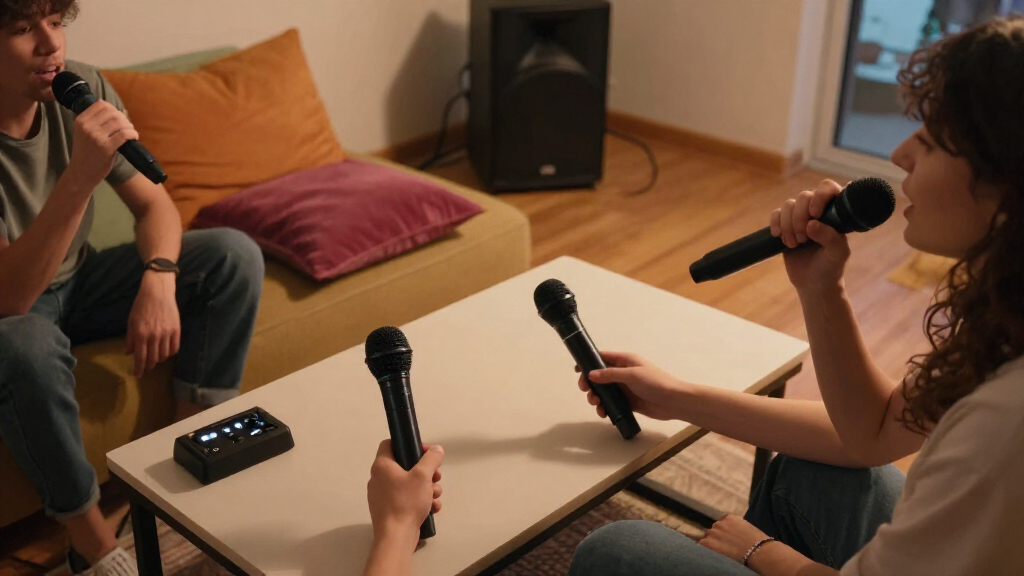
I compared these 15 wireless karaoke microphones by how clearly each product’s design suits a real singing setup: solo or group use, portable singalongs, or connection to a separate speaker or sound system. I gave weight to the number of microphones, connection style, receiver or speaker requirements, stated power approach, and features such as rechargeable components or LED effects when those details were provided. I also looked at how much setup and compatibility checking a buyer may need to do before singing.
The ranking favors versatility and clear use cases over feature count alone. Dual-microphone receiver systems place well for households and parties that need two singers, while Bluetooth handheld models earn their place for buyers who value portability and an integrated karaoke format. Specialized picks rank higher for the people they fit and lower for buyers who need a broader setup; where the supplied product information does not establish compatibility or performance details, I avoid treating those as proven advantages.
Factors to Consider When Choosing Wireless Karaoke Microphones
Before choosing a model, match the microphone’s wireless method to the equipment you already own. The biggest buying mistake is assuming that every wireless karaoke microphone pairs directly with any Bluetooth speaker; some systems rely on a dedicated receiver instead. These factors can help you avoid a setup that looks convenient on paper but does not fit your room, audience, or audio gear.
Match the Connection to Your Speaker
Start by checking how the microphone sends audio, not just whether the listing says wireless. A Bluetooth karaoke microphone, such as the BONAOK-style handheld format, has a different connection path from a system that uses its own receiver. Look at the speaker’s available inputs and the microphone system’s included receiver or pairing requirements before buying. A Bluetooth speaker may play backing tracks while still lacking a suitable input for a separate wireless microphone receiver. Avoid assuming that two products with Bluetooth features will pass microphone audio between them. If the connection details are unclear, choose only after confirming the exact setup the seller supports.
Choose One, Two, or Four Microphones for Your Group
For solo practice, a single handheld can be easier to store and manage than a dual system. Two microphones make sense when people sing duets or take turns without passing one around, which is why pairs such as the HUACAM W58 and WONATU G26-S suit family gatherings. A four-microphone system such as the Aveek is more relevant for hosts who expect several singers to participate at once. More microphones do not automatically mean a better group experience: the receiver, speaker inputs, and room layout still shape how well everyone can use the system. Think about your usual number of singers rather than buying for an occasional crowd. For most homes, two is a practical middle ground.
Decide Between a Portable Karaoke Mic and a Receiver System
Portable handheld karaoke microphones appeal to buyers who want a compact device for casual singalongs, while receiver-based systems are designed to work as part of a larger audio setup. The BONAOK Q78 and Q37 take the portable route; the dual handheld systems in this roundup typically add a separate receiver to the setup. That receiver can make the system more suitable for a compatible speaker or karaoke machine, but it also adds another component to connect and keep track of. Do not choose based on portability alone if you need microphone audio routed through an existing sound system. Conversely, a full receiver setup may be unnecessary if your priority is a compact personal karaoke device. Let your actual use space decide which format is less awkward.
Check Power, Charging, and Replacement Needs
Power details affect how readily a microphone can be used, especially when a gathering lasts longer than a short singalong. Some products in this lineup identify rechargeable microphones or receivers, while others may require buyers to check the included power arrangement and battery requirements. Confirm which components need charging or batteries: the handhelds, receiver, or both. A rechargeable receiver does not by itself mean the microphones are rechargeable. Consider how easy it will be to keep the system ready between uses and whether you have a convenient charging spot. If you cannot find clear information about charging or replacement batteries, treat that as a question to resolve before choosing.
Prioritize Controls and Effects Only If They Fit Your Use
Features such as LED lights can make a portable karaoke microphone feel more playful, particularly for informal home singing, but they do not establish that the microphone will work with your speaker. For a party setup, straightforward controls and a compatible signal path may matter more than visual effects. Think about who will use the controls: beginners may prefer a simple handheld format, while a host connecting a receiver to an existing sound system may be comfortable with extra setup steps. Decide whether you want an all-in-one-feeling device or a microphone pair that becomes part of a larger arrangement. Avoid letting decorative extras distract from the number of microphones, connection method, and power requirements. The best feature set is the one that supports how your group actually sings.
Frequently Asked Questions
Can I use a wireless karaoke microphone with any Bluetooth speaker?
No. A Bluetooth karaoke microphone and a receiver-based wireless system may connect to audio equipment in different ways, and a speaker that plays music over Bluetooth may not accept microphone audio through that same connection. Check the microphone’s connection instructions and the speaker’s available inputs before buying. For a receiver system, confirm that the speaker or karaoke machine can accept the receiver’s output. For a portable Bluetooth microphone, verify how it handles backing tracks and microphone sound together. If the connection path is not clear, do not assume that the word “wireless” guarantees compatibility.
Should I choose a two-microphone system or a single portable karaoke mic?
Choose a two-microphone system if duets, shared singing, or quick handoffs are part of your usual gatherings. A single portable karaoke mic, such as the BONAOK-style format, can suit casual solo use and buyers who want a compact device. The tradeoff is that portable convenience may not match the connection options of a receiver-based pair. Consider who will sing and what speaker will play the sound before deciding. If you regularly host two singers, the extra microphone is likely more useful than a compact form. If you mostly sing alone, a pair may add equipment you rarely use.
Are JBL PartyBox Wireless Microphones the right pick for a non-PartyBox speaker?
The PartyBox model is most clearly suited to buyers who already use a compatible JBL PartyBox setup. Do not assume it will connect to another speaker simply because both products are wireless. Check the microphone system’s supported connections and the speaker’s inputs, then compare those details with the general JBL dual-channel receiver system in this roundup. A broader receiver-style setup may be a better match when you want to connect to different compatible audio equipment. If you do not own a PartyBox, confirm compatibility before making this your pick. That check can prevent buying a microphone that does not fit your current system.
Is a four-microphone system worth choosing over a dual set?
A four-microphone system is useful when you regularly host larger groups and want several people to have microphones available. For a family or a couple of singers, a dual set is usually easier to place, manage, and match to the way people take turns. Before choosing a four-pack such as the Aveek, check how the system handles its microphones and whether your audio setup suits group use. More handhelds can mean more power and storage to manage. If larger gatherings are occasional, a two-microphone system may be the simpler everyday choice. Pick the larger set for recurring group use, not just because it includes more microphones.
What should I check before buying a rechargeable wireless microphone system?
Confirm which parts recharge: the microphones, the receiver, or both. Product names that mention a rechargeable receiver do not prove that the handhelds use rechargeable batteries. Check what charging accessories are included, how the system is powered during use, and whether replacement batteries are needed. Also make sure the receiver can connect to your speaker or karaoke machine. These details matter more than the rechargeable label alone because they determine how much setup and upkeep the system needs. If the listing leaves any of them unclear, resolve that before choosing.
Conclusion
For most buyers seeking a pair for home singing and parties, I recommend the HUACAM W58 as the best overall, with the WONATU G26-S another dual-microphone option to compare. For best value, focus on a straightforward two-mic receiver system that matches your existing speaker rather than paying for features you will not use. For best premium fit, JBL’s PartyBox Wireless Microphones make the most sense for someone already building around a compatible PartyBox; they are a specialized choice, not a universal one. Beginners who want a portable, casual format can start with the BONAOK Q78, while buyers who want more microphone effects can compare it with the Q37 and the LED-equipped SINWE set. For larger groups, consider the Aveek four-pack; for a less complicated household setup, stick with two microphones. Before choosing any of them, confirm the connection method and power requirements for your speaker and the specific system.
Halloween Picks

9 ft Halloween Inflatable Haunted Castle with Dragon and Ghost

27FT Giant Inflatable Pumpkin Lighted Outdoor Halloween Decor

Kalolary 11 ft Halloween Inflatable Archway Ghost House Tunnel
As an affiliate, we earn on qualifying purchases.