Get audio and creator gear delivered free — and shop member deals
- Fast, free delivery on millions of items
- Access to Prime Big Deal Days deals on October 6–7
- Prime Video, Amazon Music and more included
Key Takeaways
- Top-tier models like the Akai MPK Mini MK3 balance portability with a broad control set, making them ideal for versatile use.
- Budget options such as the Korg NanoKontrol Studio excel with basic features but may lack advanced controls for complex productions.
- Size and layout are critical; smaller controllers are more portable but often have fewer knobs and pads, limiting workflow.
- Build quality varies; premium controllers tend to last longer and feel more durable, especially for frequent use.
- Compatibility with DAWs and software integration is a key factor, influencing ease of use and setup.
| Korg NanoKontrol Studio Bluetooth/USB MIDI Control Surface with 8 Faders |  | Best for Mobile Flexibility and Compact Control | Connectivity: Wireless Bluetooth and USB | Faders: 8 | Design: Compact and portable | VIEW LATEST PRICE | See Our Full Breakdown |
| Akai Professional APC40 MKII USB MIDI Pad Controller |  | Best for Ableton Live Integration and Live Performance | Pads: 40 RGB | Knobs: 8 | Faders: 9 | VIEW LATEST PRICE | See Our Full Breakdown |
| Akai Professional LPD8 USB MIDI Pad Controller |  | Best for Portable Beat Making and Customization | Pads: 8 RGB | Assignable Knobs: 8 | Preset Slots: 4 | VIEW LATEST PRICE | See Our Full Breakdown |
| Akai Professional LPK25 25-Key USB MIDI Keyboard Controller |  | Best for Songwriting and Expressive Playing | Keys: 25 velocity-sensitive | Connectivity: USB MIDI | Features: Arpeggiator, presets | VIEW LATEST PRICE | See Our Full Breakdown |
| Akai Professional APC Mini MK2 USB MIDI Pad Controller |  | Best for Clip Launching and Live Performance with Ableton | Pads: 64 RGB | Faders: 9 (8 assignable + 1 master) | Modes: Drum and Note modes | VIEW LATEST PRICE | See Our Full Breakdown |
| PreSonus ATOM Production & Performance MIDI Pad Controller with Software |  | Best Overall for Versatility and Software Integration | Pads: 16 velocity- and pressure-sensitive RGB pads | Assignable buttons: 20 | Rotary encoders: 4 | VIEW LATEST PRICE | See Our Full Breakdown |
| Akai Professional MPK Mini MK3 25-Key USB MIDI Keyboard Controller |  | Best for Portable Control and Beat Making | Number of Keys: 25 | Pad Type: MPC-style velocity-sensitive pads | Knobs: 8 | VIEW LATEST PRICE | See Our Full Breakdown |
| Akai Professional MPK Mini Play MK3 25-Key USB MIDI Keyboard Controller |  | Best for All-in-One Portable Performance | Number of Keys: 25 | Built-in Speaker: Yes | MIDI Controller Capabilities: Yes | VIEW LATEST PRICE | See Our Full Breakdown |
| M-AUDIO Keystation Mini 32 MK3 USB MIDI Controller |  | Best for Basic Portability and Simplicity | Number of Keys: 32 | Key Type: Velocity-sensitive | Connectivity: USB | VIEW LATEST PRICE | See Our Full Breakdown |
| M-AUDIO Oxygen Pro Mini 32 USB MIDI Keyboard Controller |  | Best for Seamless DAW Integration and Live Performance | Number of Keys: 32 | Pads: 8 RGB backlit drum pads | Controls: 4 assignable knobs, 4 faders | VIEW LATEST PRICE | See Our Full Breakdown |
| Akai Professional MPK Mini Plus 37-Key USB MIDI Keyboard Controller |  | Best for Versatile Music Production and Modular Setups | Number of Keys: 37 | Pads: 8 RGB MPC Pads | Sequencer: 64-step | VIEW LATEST PRICE | See Our Full Breakdown |
| Samson Carbon 49 USB MIDI Controller |  | Best for Expressive Playing and Traditional MIDI Integration | Number of Keys: 49 | Key Type: Semi-weighted | Velocity Sensitive: Yes | VIEW LATEST PRICE | See Our Full Breakdown |
| Arturia MiniLab 3 Universal MIDI Controller, White |  | Best for Compact, Portable Control with Software Integration | Keys: 25 | Pads: 8 multi-color | Faders: 4 | VIEW LATEST PRICE | See Our Full Breakdown |
| music production MIDI controller | Connectivity | Pads |
|---|---|---|
| Korg NanoKontrol Studio Blueto | Wireless Bluetooth and USB | — |
| Akai Professional APC40 MKII U | — | 40 RGB |
| Akai Professional LPD8 USB MID | USB | 8 RGB |
| Akai Professional LPK25 25-Key | USB MIDI | — |
| Akai Professional APC Mini MK2 | — | 64 RGB |
| PreSonus ATOM Production & Per | — | 16 velocity- and pressure-sensitive RGB pads |
| Akai Professional MPK Mini MK3 | USB | — |
| Akai Professional MPK Mini Pla | — | 8 MPC pads |
| M-AUDIO Keystation Mini 32 MK3 | USB | — |
| M-AUDIO Oxygen Pro Mini 32 USB | USB, 1/8" MIDI Out | 8 RGB backlit drum pads |
| Akai Professional MPK Mini Plu | USB, MIDI, CV/Gate I/O | 8 RGB MPC Pads |
| Samson Carbon 49 USB MIDI Cont | USB, MIDI Out, Sustain pedal | — |
| Arturia MiniLab 3 Universal MI | — | 8 multi-color |
More Details on Our Top Picks
Korg NanoKontrol Studio Bluetooth/USB MIDI Control Surface with 8 Faders
The Korg NanoKontrol Studio excels in portability, offering both wireless and USB connectivity, making it ideal for musicians who need a versatile controller on the go. Compared to the Akai APC Mini MK2, it lacks dedicated pads but makes up for it with a sleek, lightweight design and wireless option, perfect for performers who prefer mobility. Its 8 faders provide precise control, yet setup can be tricky without detailed instructions—users should be prepared to consult the manual. This controller is best suited for mobile producers or live performers who prioritize convenience over extensive control features, but it may not satisfy those needing complex pad layouts or extensive DAW integration.
Pros:- Wireless and USB connectivity for flexible use
- Compact, portable design ideal for mobile setups
- Includes 8 faders for precise control
Cons:- Lacks detailed setup instructions, requiring manual reference
- Missing dedicated pads or knobs for more complex control
Best for: Musicians or producers who require a portable, wireless MIDI controller for live performances or mobile setups.
Not ideal for: Studio producers needing a full-featured DAW control surface with extensive pad and knob options, like the APC40 MKII.
- Connectivity:Wireless Bluetooth and USB
- Faders:8
- Design:Compact and portable
Our verdict“This pick is perfect for mobile musicians valuing portability and wireless flexibility, but less suited for studio-heavy workflows.”
Akai Professional APC40 MKII USB MIDI Pad Controller
The Akai APC40 MKII stands out for its deep integration with Ableton Live, making it a top choice for electronic musicians who rely heavily on clip launching and live remixing. Its 40 RGB pads provide clear visual feedback, which is superior to the simpler layout of the Akai LPD8. While it offers extensive control with 8 knobs and 9 faders, setup can be complex for beginners and it’s primarily optimized for Ableton, limiting its functionality with other DAWs. This controller is best for producers and performers who want a dedicated Ableton workflow, but those using other software might find it less versatile.
Pros:- Seamless Ableton Live integration for full control
- RGB pads with visual feedback for clip status
- Includes Ableton software and sample packs
Cons:- Designed mainly for Ableton Live, limiting cross-DAW use
- Setup complexity can challenge beginners
Best for: Ableton Live users seeking comprehensive clip, mixer, and effect control in live or studio settings.
Not ideal for: Producers using DAWs other than Ableton Live, due to limited compatibility and full feature access.
- Pads:40 RGB
- Knobs:8
- Faders:9
- Compatibility:Ableton Live V9.1.3+
Our verdict“Ideal for Ableton users wanting a dedicated controller with visual feedback, but not suited for multi-DAW workflows.”
Akai Professional LPD8 USB MIDI Pad Controller
The Akai LPD8 offers a compact, lightweight design with 8 RGB-backlit MPC pads and 8 assignable knobs, making it an excellent choice for beat makers and producers on the move. Its universal DAW compatibility surpasses the more specialized APC40 MKII, offering flexibility across platforms. However, it relies solely on USB power, which can limit portability in some setups, and its limited 8 pads and knobs might restrict complex live arrangements. This controller makes the most sense for mobile producers or beginners who need straightforward control without advanced features.
Pros:- Portable and lightweight for mobile music creation
- Customizable presets for quick setup
- Universal DAW compatibility
Cons:- No built-in power source; relies on USB
- Limited to 8 pads and knobs, less suited for complex setups
Best for: Beat makers and producers requiring a portable, easy-to-use MIDI pad controller that works across all major DAWs.
Not ideal for: Producers needing extensive control or a larger pad layout for complex sequences or live performances.
- Pads:8 RGB
- Assignable Knobs:8
- Preset Slots:4
- Connectivity:USB
Our verdict“This controller is perfect for mobile beat making and quick setups, but less ideal for complex live performances or studio rigs.”
Akai Professional LPK25 25-Key USB MIDI Keyboard Controller
The Akai LPK25 combines portability with expressive control through velocity-sensitive keys, making it a solid choice for songwriters and performers who need a compact keyboard. Its simple design includes an arpeggiator and programmable presets, providing versatile functionality. Compared with the Akai MPK Mini MK3, the LPK25 emphasizes pure keyboard control over additional pads or knobs, which benefits those focused on melodic and harmonic work. Its 25 keys are perfect for sketching ideas quickly but may feel cramped for complex performance routines or live sets.
Pros:- Compact and portable design
- Velocity-sensitive keys for expressive playing
- Built-in arpeggiator and preset customization
Cons:- Limited to 25 keys, restricting performance complexity
- No built-in sounds or speakers
- Requires external software for full functionality
Best for: Songwriters and producers who want a portable, expressive MIDI keyboard for melody and harmony creation.
Not ideal for: Performers or producers needing a full-sized keyboard or extensive control surface for complex arrangements.
- Keys:25 velocity-sensitive
- Connectivity:USB MIDI
- Features:Arpeggiator, presets
- Compatibility:Mac and PC
Our verdict“Ideal for songwriters and mobile producers seeking expressive MIDI control in a small package, but not suited for full-range live performance.”
Akai Professional APC Mini MK2 USB MIDI Pad Controller
The Akai APC Mini MK2 excels in live performance environments, offering 64 RGB pads that enable quick clip launching and beat switching. Its 9 faders, including an assignable master, give basic mixer control, but its full potential shines when paired with Ableton Live, where its dedicated modes facilitate seamless workflow. Compared to the Akai APC40 MKII, the Mini MK2 is more portable but has fewer faders and no dedicated knobs, which might limit detailed control in studio settings. It’s best for Ableton users who need a compact controller, but less suited for those requiring extensive parameter control or multi-DAW support.
Pros:- Compact and portable, ideal for live and studio use
- Bright RGB pads for visual feedback during clips
- Includes Ableton Live Lite and virtual instrument software
Cons:- Limited to Ableton Live for full features
- No standalone mode—requires a computer
- Fewer faders than larger controllers like the APC40
Best for: Ableton Live users seeking a portable clip-launcher and performance controller for studio or stage.
Not ideal for: Producers working outside Ableton Live who need a more versatile or comprehensive control surface.
- Pads:64 RGB
- Faders:9 (8 assignable + 1 master)
- Modes:Drum and Note modes
- Compatibility:Ableton Live 11+
Our verdict“Best for Ableton Live performers needing a compact, visually intuitive clip launcher, but not suited for multi-DAW setups or extensive control needs.”
PreSonus ATOM Production & Performance MIDI Pad Controller with Software
The PreSonus ATOM stands out for its highly expressive 16 RGB velocity- and pressure-sensitive pads, making it a top choice for beat makers and performers who need tactile control. Its inclusion of popular software like Studio One Artist and Ableton Live Lite, along with over $1000 in plug-ins, makes it a powerful all-in-one solution. Compared with the Akai MPK Mini MK3, ATOM offers more dedicated pads and customizable feel, but its complexity can be daunting for beginners. Its reliance on USB-only connectivity limits flexibility in live setups. This pick makes the most sense for producers who value expressive performance features combined with comprehensive software bundles, though less ideal if you prefer a simple, plug-and-play device.
Pros:- Highly expressive, pressure-sensitive RGB pads for dynamic performance
- Includes professional recording software and a wealth of plug-ins
- Multiple assignable buttons and encoders for flexible workflow
Cons:- Requires familiarity with music production software, potentially steep learning curve
- Limited to USB connectivity, restricting live setup options
Best for: Producers and performers seeking a versatile MIDI pad controller with extensive software support and expressive controls.
Not ideal for: Beginners or users who prefer straightforward, plug-and-play MIDI controllers without complex setup or software integration.
- Pads:16 velocity- and pressure-sensitive RGB pads
- Assignable buttons:20
- Rotary encoders:4
- Included software:Studio One Artist, Ableton Live Lite, Studio Magic Plug-In Suite
- Compatibility:Most music production software via USB
Our verdict“Ideal for seasoned producers who want comprehensive control and software integration, though less suitable for beginners seeking simplicity.”
Akai Professional MPK Mini MK3 25-Key USB MIDI Keyboard Controller
The Akai MPK Mini MK3 offers a compact, highly portable setup that’s perfect for on-the-go producers and hobbyists. Its 25 velocity-sensitive mini keys are suitable for simple melodies but can feel cramped during complex piano sessions, especially compared with larger controllers like the M-AUDIO Oxygen Pro Mini 32. The inclusion of 8 MPC pads and assignable knobs provides versatile control over virtual instruments and effects, making it ideal for beat makers. However, it lacks internal sounds or onboard features, relying entirely on software. This device suits musicians who need a portable, all-in-one control surface but may frustrate those requiring richer keys or onboard sounds for live performance.
Pros:- Compact and portable, easy to fit into any setup
- Includes comprehensive software and sound libraries
- Versatile controls with MPC-style pads and assignable knobs
Cons:- Limited 25 keys restrict complex piano performance
- No onboard sounds or speakers, reliant on computer software
Best for: Mobile producers and hobbyists needing a lightweight, versatile MIDI controller for studio or travel use.
Not ideal for: Pianists or performers requiring full-size keys and onboard sounds for live gigs or complex playing.
- Number of Keys:25
- Pad Type:MPC-style velocity-sensitive pads
- Knobs:8
- Connectivity:USB
- Included Software:MPC Beats, 3 Virtual Instruments, 2GB sound content
Our verdict“Best suited for mobile producers who want versatile control in a small package, but not ideal for full-length keyboard performance.”
Akai Professional MPK Mini Play MK3 25-Key USB MIDI Keyboard Controller
The Akai MPK Mini Play MK3 combines portability with standalone functionality thanks to its built-in speaker and onboard sounds. Its 25 velocity-sensitive keys are adequate for simple melodies but less suited for nuanced piano work, especially compared to larger controllers like the M-AUDIO Oxygen Pro Mini 32. The onboard sounds and OLED display make it flexible for quick songwriting and live jamming without a computer, but some users may find the collection of internal sounds basic. Battery operation adds portability, yet batteries are not included, adding extra cost. This controller appeals to musicians who need a portable, self-contained device but falls short for those seeking extensive keys or advanced onboard features.
Pros:- Built-in speaker and onboard sounds for standalone use
- Battery-powered, highly portable for on-the-go musicians
- Supports NKS for seamless integration with software
Cons:- Batteries are not included, requiring additional purchase
- Limited 25 keys may restrict performance complexity
Best for: Musicians and performers who want a portable, standalone MIDI keyboard with onboard sounds for casual playing or songwriting.
Not ideal for: Studio-focused producers or pianists needing full-size keys and advanced onboard features for detailed performance.
- Number of Keys:25
- Built-in Speaker:Yes
- MIDI Controller Capabilities:Yes
- Pads:8 MPC pads
- Display:OLED
- Power Source:USB or batteries (not included)
Our verdict“A solid choice for musicians wanting a portable, all-in-one device, but less suitable for detailed studio work or complex performances.”
M-AUDIO Keystation Mini 32 MK3 USB MIDI Controller
The M-AUDIO Keystation Mini 32 MK3 offers a straightforward, portable solution for beginners and casual producers. Its 32 velocity-sensitive keys provide a bit more room for melodic performance than smaller controllers, making it suitable for initial piano or synth work. The simplified design, combined with plug-and-play USB connectivity, makes setup quick and easy, unlike the more feature-rich Oxygen Pro Mini 32. It includes MPC Beats software, which is perfect for starting new projects, but lacks advanced controls like pads or extensive assignable controls, limiting creative flexibility. This makes it an excellent choice for newcomers but less appealing for performers needing comprehensive control or onboard features.
Pros:- Compact, lightweight, and highly portable
- Plug-and-play with no external power required
- Includes beginner-friendly MPC Beats software
Cons:- Limited 32 keys restrict complex piano or multi-note performances
- Basic build quality may not withstand heavy use or touring
Best for: Beginners or students seeking a simple, portable MIDI keyboard to learn and produce basic melodies.
Not ideal for: Advanced producers or performers requiring more expressive control and onboard features for live gigs or complex arrangements.
- Number of Keys:32
- Key Type:Velocity-sensitive
- Connectivity:USB
- Includes Software:MPC Beats
Our verdict“Perfect for beginners wanting an easy, portable MIDI controller, but insufficient for advanced or performance-heavy tasks.”
M-AUDIO Oxygen Pro Mini 32 USB MIDI Keyboard Controller
The M-AUDIO Oxygen Pro Mini 32 provides a compact yet feature-rich control surface, distinguished by its 32 velocity-sensitive keys and 8 RGB backlit drum pads. Its auto-mapping and NKS support make it a strong candidate for producers who want seamless integration with popular DAWs and plugins, surpassing simpler controllers like the Keystation Mini 32. The inclusion of assignable knobs, faders, and software bundles enhances flexibility, but the small keys may hinder detailed piano work. Its robust control set makes it ideal for live performers and beat makers who need quick, reliable access to multiple parameters, though it’s less suited for intricate keyboard playing.
Pros:- 32 velocity-sensitive keys with excellent feel
- Auto-mapping and NKS support for quick DAW integration
- Includes comprehensive software bundle for production and performance
Cons:- Limited keys might restrict complex piano pieces
- Small keys may be less comfortable for extended playing sessions
Best for: Producers and performers who need a compact controller with extensive DAW control and live performance features.
Not ideal for: Musicians requiring full-size keys for nuanced playing or studio pianists focused on detailed keyboard work.
- Number of Keys:32
- Pads:8 RGB backlit drum pads
- Controls:4 assignable knobs, 4 faders
- Connectivity:USB, 1/8″ MIDI Out
- Included Software:MPC Beats, Ableton Live Lite, virtual instruments
Our verdict“Ideal for live performers and producers seeking a compact, highly integrated control surface with versatile controls.”
Akai Professional MPK Mini Plus 37-Key USB MIDI Keyboard Controller
The Akai MPK Mini Plus stands out for its full 3-octave keybed, making it more suitable than the smaller Mini models for melodic and harmonic performances. Its 16 velocity-sensitive pads and deep MIDI, CV, and Gate I/O connectivity make it highly adaptable for both studio and modular rig setups. The built-in 64-step sequencer offers standalone creative options, unlike simpler controllers that rely on external software. However, setting up the MPK Mini Plus can be challenging for beginners due to its extensive features, and its 37 keys may not satisfy pianists needing more range. Compared with the Arturia MiniLab 3, it offers more performance-oriented controls but at the cost of complexity, which could be overwhelming for new users. This makes it ideal for producers who want a comprehensive, flexible MIDI solution with some experience in hardware integration.
Pros:- Full 3-octave keybed suitable for melodic work
- Versatile connectivity including MIDI and CV/Gate for modular gear
- Deep integration with Native Instruments NKS ecosystem
- Built-in 64-step sequencer for standalone music creation
Cons:- Complex setup process may be daunting for newcomers
- Limited to 37 keys, which might restrict pianists
- Requires software installation for full functionality
Best for: Producers and advanced musicians who need a versatile controller with modular compatibility and sequencing capabilities.
Not ideal for: Beginners or those seeking a simple, plug-and-play MIDI keyboard for basic use, as setup can be complex and features extensive options.
- Number of Keys:37
- Pads:8 RGB MPC Pads
- Sequencer:64-step
- Connectivity:USB, MIDI, CV/Gate I/O
- Software Included:MPC Beats, NKS bundles
- Control Features:8 rotary knobs, transport controls
Our verdict“This controller is best suited for experienced producers needing a feature-rich MIDI interface with modular compatibility.”
Samson Carbon 49 USB MIDI Controller
The Samson Carbon 49 offers a solid balance between traditional keyboard feel and control flexibility, making it a good pick compared to the smaller Akai MPK Mini MK3, which has fewer keys and less control surface. Its semi-weighted keys provide a more expressive playing experience than synth-style keys, appealing to performers. The inclusion of a real-time LED display and assignable controls enhances workflow, especially for producers who prefer more tactile control over their DAW parameters. However, with only 49 keys, it may fall short for composers working on complex arrangements requiring more range, and it lacks onboard sounds, unlike dedicated keyboard workstations. Compared to the MiniLab 3, it offers a more playable keyboard but requires external software for sound generation, which might be a downside for beginners seeking all-in-one solutions. It’s best suited for musicians who prioritize expressive control and traditional keyboard feel in their MIDI setup.
Pros:- Velocity-sensitive semi-weighted keys for expressive playing
- Assignable controls and real-time LED display for workflow efficiency
- Includes traditional MIDI Out and sustain pedal input
Cons:- Limited to 49 keys, which may restrict complex compositions
- No onboard sounds, requiring external software for sound production
- Lacks advanced features found in larger controllers
Best for: Musicians and producers who want a semi-weighted keyboard with expressive potential for studio and live use.
Not ideal for: Beginners or those needing a compact, lightweight controller for portability, as the 49 keys and semi-weighted action make it less portable and simple than smaller models.
- Number of Keys:49
- Key Type:Semi-weighted
- Velocity Sensitive:Yes
- Control Features:Assignable data encoder, volume slider, shift key
- Display:3-digit, 7-segment LED
- Connectivity:USB, MIDI Out, Sustain pedal
Our verdict“This controller is ideal for performers and producers seeking a more expressive keyboard feel within a portable MIDI setup.”
Arturia MiniLab 3 Universal MIDI Controller, White
The Arturia MiniLab 3 makes a compelling case for portability and ease of use, especially when compared to the larger Akai MPK Mini Plus. Its 25 velocity-sensitive keys are smaller but responsive enough for quick melodic ideas and sketching, perfect for musicians on the go. The inclusion of 8 multi-color pads and 4 faders ensures versatile control over instruments and effects, even with a limited key range. The bundle of all-in-one software enhances its value, streamlining workflow for beginners or casual producers. The tradeoff is the limited number of keys, which makes it less suitable for complex arrangements or serious piano players. Unlike the MPK Mini Plus, it lacks extensive connectivity options, but its compact size makes it ideal for tight spaces or mobile setups. This makes the MiniLab 3 perfect for those who prioritize portability and integrated software over extensive keyboard range.
Pros:- Compact and portable design for mobile use
- Responsive velocity-sensitive keys
- Includes comprehensive software bundle
Cons:- Limited to 25 keys, restricting complex compositions
- Requires external power or USB connection, not standalone
- Learning curve for new users unfamiliar with MIDI controls
Best for: Beginners, mobile producers, or those with limited space needing a lightweight, all-in-one MIDI controller.
Not ideal for: Advanced musicians or composers who require more than 25 keys or extensive hardware controls for complex projects.
- Keys:25
- Pads:8 multi-color
- Faders:4
- Velocity-sensitive keys:Yes
- Color:White
- Includes software:Yes
Our verdict“This controller is best suited for beginners and mobile musicians seeking an easy-to-integrate, compact MIDI solution.”
How We Picked
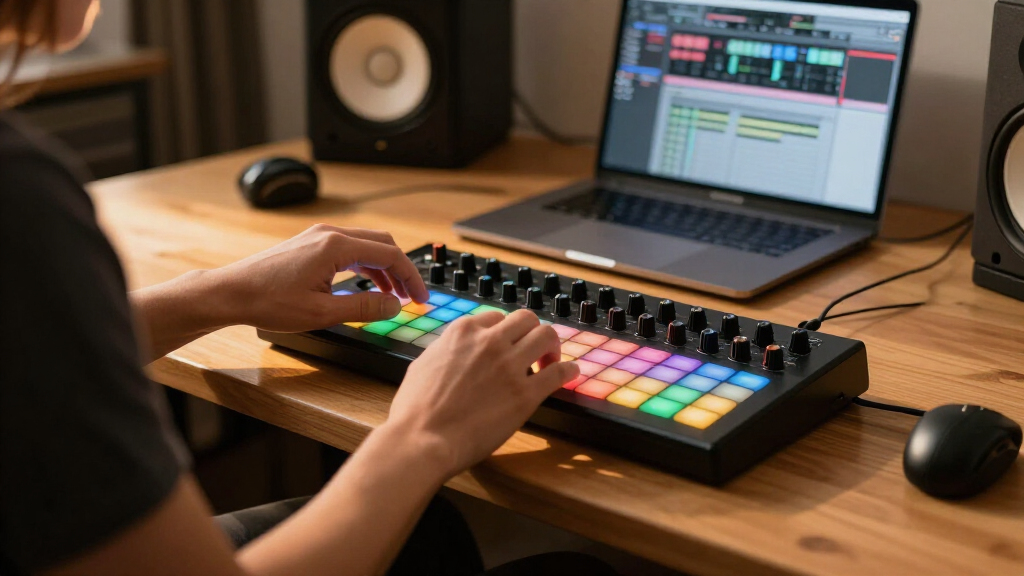
We evaluated each MIDI controller based on performance, build quality, usability, compatibility, and value. Priority was given to devices that offer a good balance of features for their price, considering both beginner and advanced needs. We also assessed user interface design, portability, and software bundle quality. The ranking reflects which controllers provide the most reliable, versatile, and user-friendly experience for music producers, from hobbyists to professionals.| music production MIDI controller | Connectivity |
|---|---|
| Korg NanoKontrol Studio Blueto | Wireless Bluetooth and USB |
| Akai Professional APC40 MKII U | — |
| Akai Professional LPD8 USB MID | USB |
| Akai Professional LPK25 25-Key | USB MIDI |
| Akai Professional APC Mini MK2 | — |
| PreSonus ATOM Production & Per | — |
| Akai Professional MPK Mini MK3 | USB |
| Akai Professional MPK Mini Pla | — |
| M-AUDIO Keystation Mini 32 MK3 | USB |
| M-AUDIO Oxygen Pro Mini 32 USB | USB, 1/8" MIDI Out |
| Akai Professional MPK Mini Plu | USB, MIDI, CV/Gate I/O |
| Samson Carbon 49 USB MIDI Cont | USB, MIDI Out, Sustain pedal |
| Arturia MiniLab 3 Universal MI | — |
Factors to Consider When Choosing Music Production MIDI Controllers
When selecting a MIDI controller for music production, several factors can influence your decision. Size and layout should match your workspace and workflow preferences; smaller controllers are more portable but often have fewer controls. Compatibility with your DAW and software integration is essential to avoid frustration during setup. Build quality determines durability, especially if you plan to transport your gear frequently. Consider whether you need keys, pads, knobs, or a combination, and how each feature will support your creative process. Budget constraints are real, but investing in a controller that grows with your skills can save money long-term.Size and Layout
The physical size of your MIDI controller impacts portability and workspace. Compact models like the Akai MPK Mini MK3 are perfect for small studios or mobile setups, but they often sacrifice some control options. Larger controllers with more keys, knobs, and faders provide extensive control at the cost of space and portability. Think about your typical setup and whether you prefer a minimal footprint or a more comprehensive control surface.Features and Controls
Identify which controls are vital for your workflow—keys for melodies, pads for triggering samples, knobs for effects, or faders for mixing. More advanced controllers combine these elements for versatility but can become overwhelming for beginners. Balance your need for features with ease of use, especially if you’re new to MIDI controllers. Remember, more controls can mean a steeper learning curve.Compatibility and Software Integration
A controller that seamlessly integrates with your preferred DAW can streamline your workflow. Check for compatibility with popular software like Ableton Live, FL Studio, or Logic Pro. Some controllers come with bundled software, which can be a bonus, but ensure they’re compatible with your current setup. Also, consider if the controller supports Bluetooth or requires a USB connection, as this affects setup flexibility.Build Quality and Durability
A well-built MIDI controller withstands frequent use and transportation. Plastic shells are common at lower price points, but controllers with metal components or reinforced casings tend to last longer. If you plan to take your controller on the go or gig with it, investing in a durable model can save money and frustration over time. Keep in mind that higher build quality often correlates with higher price.Price and Long-term Value
While budget controllers are tempting, they may lack features that become essential as you advance. Consider how much you’re willing to invest and whether a higher-priced model offers features that will support your growth. Sometimes paying more upfront results in better durability, software support, and overall usability. Avoid getting sticker shock but don’t compromise on quality where it counts for your workflow.Frequently Asked Questions
Can I use a MIDI controller with any DAW?
Most MIDI controllers are compatible with a wide range of DAWs, but some offer better integration with specific software. For example, controllers like the Akai MPK Mini MK3 work seamlessly with Ableton Live, Logic Pro, and FL Studio. Always check the manufacturer’s specifications to see if your preferred DAW is supported. Compatibility issues can be minimized with controllers that support standard MIDI protocols and have good driver support, ensuring smooth operation across different platforms.Is it better to buy a controller with keys or pads?
Choosing between keys and pads depends on your music style and workflow. Keyboard controllers are ideal if you focus on melodic content, chords, and playing live parts. Pads are better suited for triggering samples, beats, and percussion. Some users benefit from having both, but that usually means a larger, more expensive controller. Think about your typical project needs and how each control type will enhance your production process.Should I get a wireless Bluetooth MIDI controller?
Wireless MIDI controllers like the Korg NanoKontrol Studio provide added freedom of movement and a clutter-free workspace. However, they can introduce latency, which might be problematic during sensitive performances or recording. They also tend to be more expensive and may have battery life limitations. If portability and reducing cable clutter are priorities, a Bluetooth model can work well, but for critical precision tasks, wired connections remain more reliable.Are smaller controllers sufficient for professional music production?
Small controllers like the Akai MPK Mini MK3 are capable of supporting professional workflows, especially in mobile or limited-space setups. However, they typically have fewer controls, which can limit hands-on mixing and modulation during complex sessions. For full-scale studio work, larger controllers with more knobs, faders, and keys provide more tactile control and efficiency. The choice depends on your production complexity and whether portability outweighs control richness.How important is build quality versus features?
Build quality directly impacts durability and reliability, especially if you transport your gear or use it daily. While feature-rich controllers offer more control options, poor build quality can lead to failures and frustrations. Investing in a well-constructed device ensures longevity and consistent performance. Balancing features with build quality is key, as a sturdy controller with fewer controls can often outperform a fragile, feature-heavy model in a demanding environment.Conclusion
For most users, the Akai Professional MPK Mini MK3 offers the best overall experience, blending portability, features, and value. Beginners aiming for affordability and ease of use will find the Korg NanoKontrol Studio a solid choice. For those needing a premium setup with extensive controls, the Arturia MiniLab 3 stands out. If budget is a primary concern, smaller controllers like the Akai LPD8 provide decent functionality without breaking the bank. Your ideal pick depends on your production style, workspace, and long-term goals.Halloween Picks
halloween
As an affiliate, we earn on qualifying purchases.