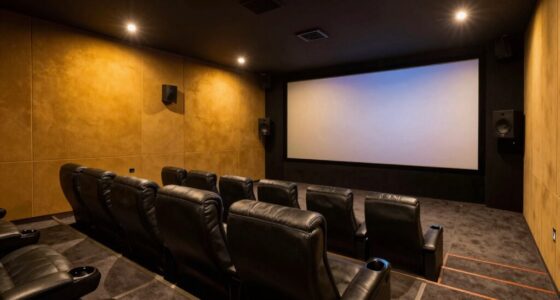

Open rooms make bass harder to control because with fewer boundaries, sound reflections become unpredictable and complex. Low frequencies spread freely, creating interference that can boost or cancel bass, leading to uneven and boomy sound. Without walls or boundaries to contain the sound, it’s more difficult to achieve tight, balanced bass. If you want to understand how to manage these challenges and improve your sound, there’s more to discover.
Key Takeaways
- Fewer boundaries cause unpredictable sound reflections, leading to complex bass interference patterns.
- Larger open spaces allow bass waves to develop longer, making them more difficult to contain.
- Lack of walls and surfaces reduces sound absorption, increasing bass boominess and muddiness.
- Multiple sound paths in open rooms create resonance issues, complicating bass clarity.
- Acoustic reflections in open rooms require targeted treatments to achieve controlled, tight bass.
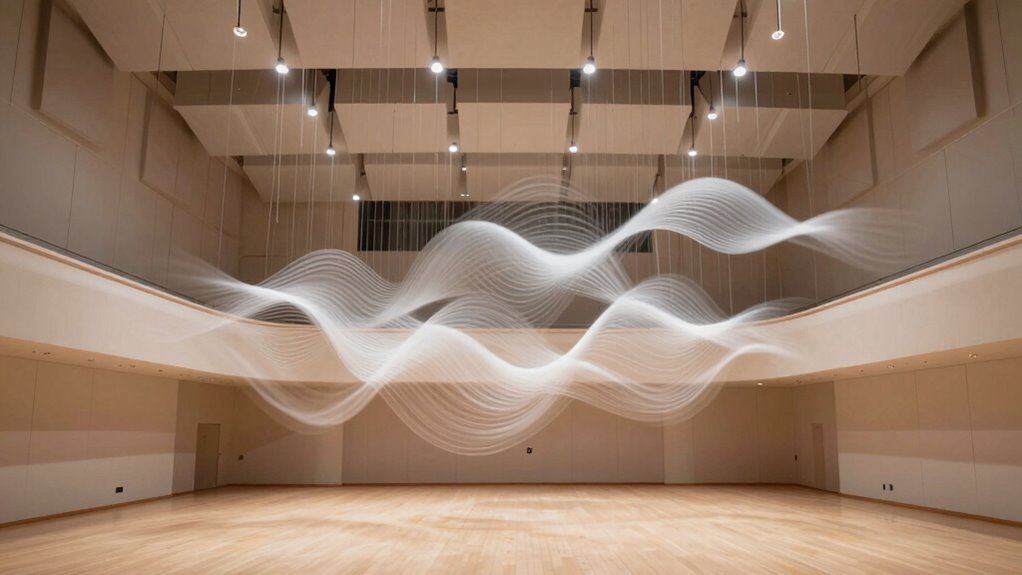
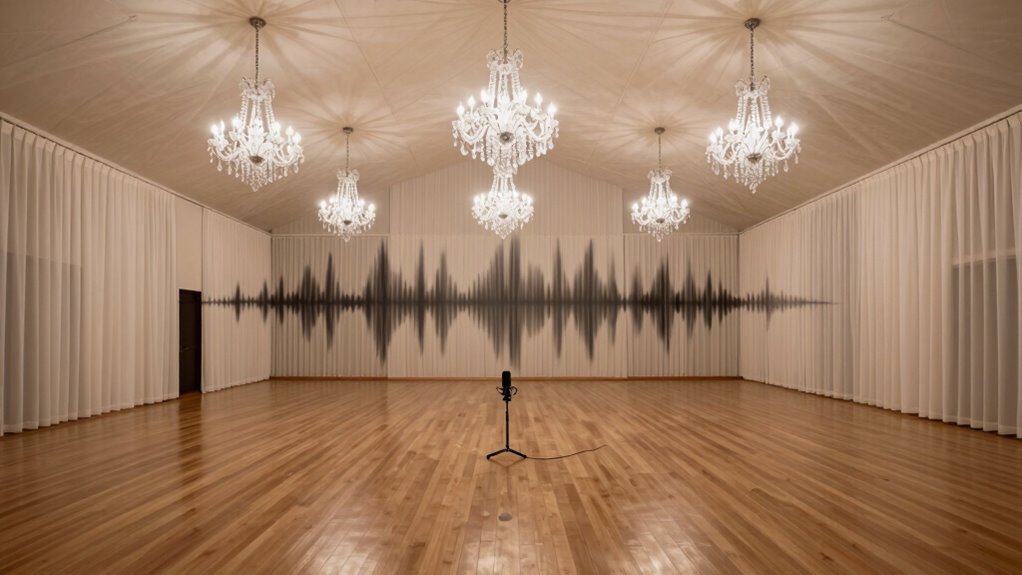
Have you ever wondered how open room designs impact bass response in your audio setup? When you set up speakers in a space with minimal walls or partitions, the way sound reflects off surfaces changes dramatically. In open rooms, sound reflection becomes less predictable because there are fewer boundaries to contain and direct low frequencies. Instead of being confined, bass waves spread out and bounce around freely, creating a complex web of reflections. This can make it more difficult to achieve balanced and tight bass, since the sound waves can interfere with each other, amplifying or canceling out at different spots. As a result, you might notice uneven bass response, with some areas booming and others sounding thin.
Room size plays a crucial role in how open spaces affect bass control. Larger rooms tend to have longer reverberation times, meaning bass notes linger longer and become more difficult to manage. When your room is spacious, low frequencies have more space to develop, which can cause them to become boomy or muddy. Without walls close enough to contain and dampen these waves, the bass can become overly resonant and difficult to tame. Conversely, in smaller open rooms, the proximity of surfaces can sometimes help contain bass to some degree, but it can also lead to strong sound reflection and comb filtering issues, where certain frequencies are reinforced or canceled out unexpectedly. The balance between room size and the open design determines how predictable and controlled your bass response can be. Additionally, the acoustic environment plays a significant role in how sound behaves in open spaces. You can also improve bass management by understanding how room acoustics influence sound reflection and resonance.
Furthermore, sound absorption techniques can be employed to reduce unwanted reflections and improve clarity in open rooms. In open rooms, sound reflection is less controlled because there are fewer surfaces to absorb or diffuse the energy of low frequencies. This lack of boundaries means that bass can develop multiple paths, creating a confusing acoustic environment. You might find that the bass response varies considerably depending on where you’re sitting or standing, making it hard to get a consistent sound. To improve control in such settings, you’ll need to consider strategies like adding acoustic treatment, placing bass traps, or using directional speakers to focus sound energy more precisely. These adjustments help manage sound reflection and mitigate some of the challenges posed by large, open spaces. Moreover, sound propagation can be affected by furniture and decor, which can help break up sound waves and reduce reflections. Ultimately, the larger and more open the room, the more effort it takes to achieve tight, controlled bass, because sound reflection and room size combine to create a complex, dynamic acoustic environment that demands careful tuning.

8 Pack – Bass Traps Acoustic Foam Corner, 8''x8''x12'' Black Bass Traps Corner Studio Foam, High Density and Fire-Proof Acoustic Panels Recording Studio Acoustical Treatments
- Sound Absorbing Structure: Specially absorbs low-frequency standing waves
- Wide Application: Suitable for studios, theaters, offices, and more
- High-Quality Material: High-density, fire-retardant acoustic foam
As an affiliate, we earn on qualifying purchases.
As an affiliate, we earn on qualifying purchases.
Frequently Asked Questions
How Do Open Rooms Affect Different Types of Bass Frequencies?
Open rooms affect different bass frequencies by causing more bass reflection, which can lead to muddiness and uneven sound. Low frequencies tend to bounce around more, making them harder to control, while higher bass frequencies might experience some degree of frequency absorption by surfaces. This combination results in less precise bass response, requiring careful acoustic treatment or sound engineering to manage the reflections and absorption effectively.
Can Specific Furniture Improve Bass Control in Open Spaces?
Yes, specific furniture can improve bass control in open spaces. Imagine furniture as barriers, breaking up sound waves like rocks in a stream, helping diffuse bass frequencies. Proper furniture placement works alongside acoustic treatments, such as soft furnishings and rugs, to absorb and scatter excess bass. Together, they create a more balanced sound environment, reducing muddiness and making bass easier to manage in open rooms.
What Are the Best Electronic Tools for Managing Bass in Open Rooms?
You should use electronic tools like bass traps and acoustic panels to manage bass in open rooms. Bass traps absorb low-frequency energy, preventing it from bouncing around excessively, while acoustic panels help control mid and high frequencies. Combining these with equalizers and room correction software allows you to fine-tune your sound system, making the bass tighter and more controlled even in large, open spaces.
How Does Room Size Influence Bass Control Challenges?
You might think a bigger room offers more space, but it actually complicates bass control due to room acoustics and sound absorption. Larger spaces often create echoes and standing waves, making bass sound unpredictable. The open nature means less sound absorption, so low frequencies bounce around wildly, demanding more precise tuning and treatment. Ironically, bigger rooms challenge your ability to keep bass tight, clear, and controlled, not easier.
Are There Specific Speaker Placements That Help in Open Environments?
You should experiment with speaker positioning by placing them slightly away from walls to reduce bass boom and reflections. Aim for symmetrical placement, avoiding corners where bass can accumulate. Incorporate acoustic treatment like bass traps and diffusers to absorb excess low frequencies and control sound reflections. This combination helps balance bass in open environments, making it easier to achieve clear, tight sound without overwhelming reverberations.

Premium Acoustic Wood Slat Wall Panels – Noise-Reducing Sound Absorption Panels for Home Theater, Studio & Office | Modern Decorative Slat Walling for Echo Control | Eco-Friendly & Easy to Install
- Effective Noise Reduction: Reduces echo and sound reflections
- Stylish Modern Design: Features 3D wood slat aesthetic
- Eco-Friendly Materials: Low-VOC, odorless, and durable
As an affiliate, we earn on qualifying purchases.
As an affiliate, we earn on qualifying purchases.
Conclusion
Exploring open rooms can feel like trying to tame a wild river—you might find it challenging to keep the bass in check. But with patience and the right tools, you can guide the sound to flow more smoothly. Embrace the journey of fine-tuning your space, knowing that each adjustment brings a subtle shift toward harmony. Sometimes, the most beautiful soundscapes emerge from gentle persistence amidst the open expanse.

RECOIL BB-T Bass Blocks Designed to Protect Car Audio Tweeters
- Protects car audio tweeters: Prevents damage from harmful frequencies
- Frequency blocking range: 4Ω: 0-5600Hz, 8Ω: 0-2800Hz
- Power handling capacity: Supports up to 50 watts
As an affiliate, we earn on qualifying purchases.
As an affiliate, we earn on qualifying purchases.

TroyStudio Bass Traps – 12 Pcs 4 X 4 X 12 Inches Dense Thick Studio Bass Foam Corner, Acoustic Treatment Panel Absorbing Echo Reverb, Low Frequency Sound Absorber for Music Room Home Recording Studio
- Dimensions: 4 x 4 x 12 inches
- Pack Size: 12 panels included
- Lightweight: 0.07 lbs per panel
As an affiliate, we earn on qualifying purchases.
As an affiliate, we earn on qualifying purchases.