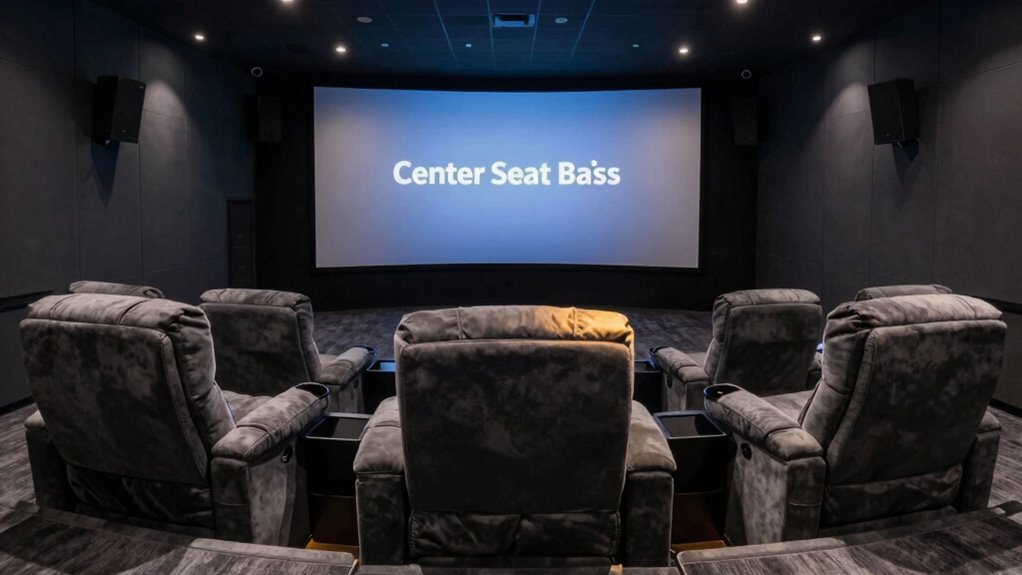

The center seat bias in your family home theater often leads to uneven sound and viewing experiences, as most prefer and prioritize the middle position. This bias can cause challenges with audio calibration and room layout, making side seats less enjoyable. To create a more balanced setup, consider arranging seating evenly and calibrating sound for multiple positions. If you want to know how to fix these issues effectively, keep exploring ways to optimize your theater space.

Get audio and creator gear delivered free with Prime
- Fast, free delivery on millions of items
- Prime Video, Amazon Music and more included
- Member-only deals all year
Key Takeaways
- Viewers naturally prefer the center seat, causing uneven audio and visual experiences for side-seat viewers.
- Focusing calibration solely on the center seat can compromise sound quality for other seating positions.
- Seating arrangements like semi-circles or tiers promote balanced viewing and sound distribution.
- Proper speaker placement and room acoustics are essential for achieving uniform sound coverage.
- Inclusive design and multi-position calibration help create a comfortable, balanced home theater for all family members.
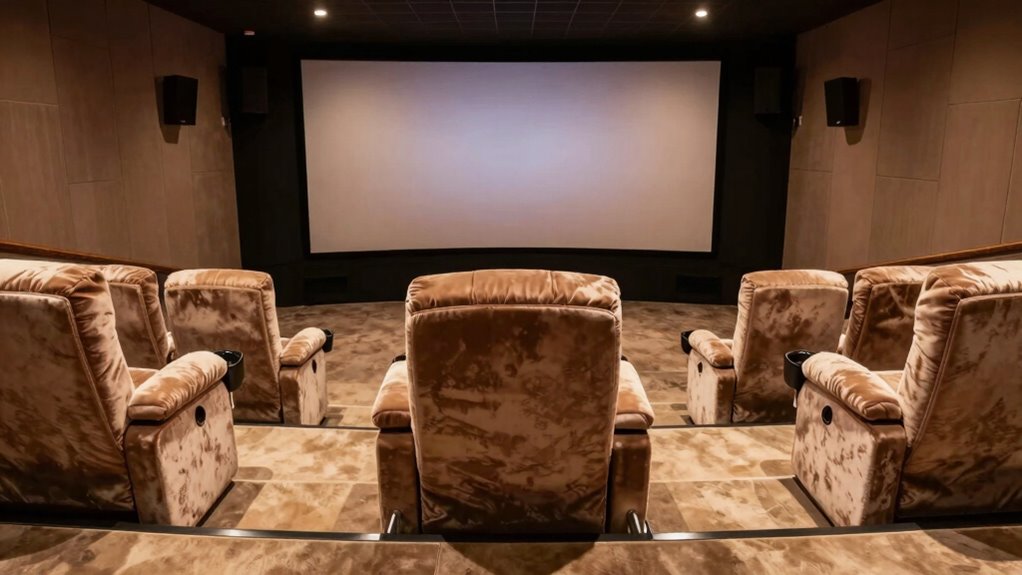
When designing your family home theater room, you might notice a natural tendency for viewers to gravitate toward the center seat. It’s a common phenomenon, often driven by a mix of tradition and perceived optimal viewing. But this bias can create issues when it comes to audio calibration and seating arrangement. If everyone naturally wants that middle spot, it can lead to uneven sound experience and uncomfortable compromises for those sitting off-center.
The key to addressing the center seat bias is to understand how your audio calibration works in relation to your seating layout. Audio calibration isn’t just about turning up the volume; it’s about fine-tuning sound so everyone perceives clear, balanced audio regardless of where they sit. When everyone heads for the middle seat, it’s easy to assume that’s the ideal listening point, but this can cause the sound to be overly optimized for that one spot. To avoid this, you should calibrate your system with multiple seating positions in mind, ensuring each seat receives balanced sound. Using an SPL meter or calibration microphone, you can measure sound levels at different locations and adjust your speakers accordingly. This helps prevent the middle seat from being overly dominant or the side seats from being drowned out.
Calibrate your system for multiple seats to ensure balanced sound and eliminate center seat bias.
Your seating arrangement plays a crucial role here. If you only focus on the center seat, the entire room’s layout might become skewed, leading to an imbalanced experience for those sitting elsewhere. Instead, consider creating a semi-circle or tiered seating setup that encourages occupants to spread out evenly. This way, no single seat becomes the default “best spot,” and everyone gets a more consistent audio and visual experience. It’s also worth thinking about how the room’s acoustics and speaker placement can be optimized to distribute sound evenly, regardless of where someone is sitting. Proper speaker placement, like using surround sound speakers and re-arranging them for even coverage, can make a big difference. Additionally, understanding the importance of audio calibration in relation to room acoustics can help ensure balanced sound distribution across all seats. Incorporating room acoustics considerations can further enhance the overall sound quality and comfort for viewers. Investing in quality audio equipment and regular calibration checks can also help maintain an even sound field over time.
Ultimately, the goal is to design your home theater so that all seats are comfortable, with equally good sound and viewing angles. By being intentional about your seating arrangement and conducting thorough audio calibration, you can minimize the center seat bias and create a room where everyone feels equally included in the experience. It’s about shifting the focus from a single “best spot” to an inclusive, balanced setup that maximizes enjoyment for everyone.
Products Worth Considering

Bose SoundLink Flex Bluetooth Speaker (2nd Gen), Portable Waterproof Speaker, Black

Sonos Era 100 Wireless Smart Speaker, Black

Sony WH-1000XM6 Wireless Noise-Canceling Over-Ear Headphones, Blue, Bundle
As an affiliate, we earn on qualifying purchases.
Frequently Asked Questions
How Can I Encourage Family Members to Sit Evenly?
To encourage your family members to sit evenly, foster audience participation by inviting everyone to share their seating preferences. Arrange seats symmetrically to create a balanced view, making it more inviting for all. You can also set up activities or discussions that involve everyone equally, helping to break the center seat bias. By emphasizing seating symmetry and involving everyone, you promote fair participation and a more enjoyable movie night for all.
Are There Specific Seating Arrangements That Reduce Bias?
Imagine you’re steering a spaceship—seating symmetry is your best tool to mitigate bias. To reduce bias, arrange seats in a semi-circular or tiered pattern, ensuring everyone has an equal view of the screen. Position the main seats at the same distance from the screen, and avoid placing one seat directly in the center. This setup encourages equal participation and minimizes the center seat bias in your family home theater room.
What Are the Psychological Effects of Seat Bias?
Seat bias can profoundly influence your emotional experience, making you feel more engaged or comfortable depending on your seat. It causes perception distortion, leading you to view the movie or content differently based on where you’re seated. This bias can heighten emotional responses or diminish them, affecting overall enjoyment. Recognizing this effect helps you choose better seating, ensuring a more balanced and immersive viewing experience without letting perception distortion skew your feelings.
How Does Seat Bias Impact Viewing Experience?
Seat bias impacts your viewing experience like a crooked mirror distorting your reflection. When you favor the center seat, your viewing comfort diminishes, causing neck strain and eye fatigue. It also disrupts seating symmetry, making the experience less immersive and more uneven. This bias can lead to missing out on balanced sound and picture quality, ultimately reducing your enjoyment and making the entire movie night less satisfying.
Can Seat Bias Be Measured Objectively?
Yes, seat bias can be measured objectively by analyzing seating dynamics and subjective perception. You can use sensors or cameras to track where viewers sit most often, quantifying preferences. Additionally, surveys or real-time feedback provide insights into subjective perception. Combining these methods helps establish concrete data on seat bias, revealing patterns that influence your viewing experience and guiding better seating arrangements to minimize bias effects.
Conclusion
So, steer clear of the center seat bias and spread the seating sanctuary equally. By balancing the best spots, you boost everybody’s bliss, banish boredom, and bring brightness to every movie moment. Your family’s fun-filled theater transforms into a fair, frolic-filled favorite, fostering full-family fun. Remember, a thoughtful, fair seating setup guarantees everyone enjoys the show, creating countless cherished memories. Make your home theater a harmonious haven where every seat feels special and satisfying!





![Nancy 10/13/26 [Nancy]](https://beamandbass.com/wp-content/uploads/2026/10/nancy-10-13-26-nancy-featured-260x140.jpg)