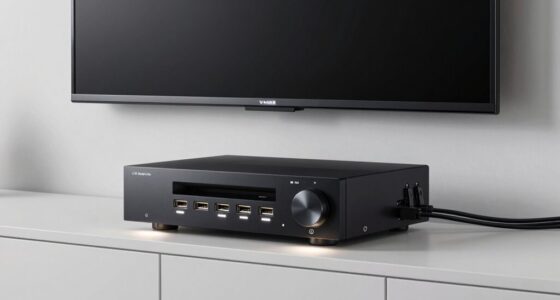

Bi-amping splits your audio signal into separate channels for high and low frequencies, which can improve clarity if your speakers and equipment support it, but it doesn’t automatically boost power or quality. Zone 2 lets you extend sound to other rooms or outdoors, giving flexibility without extra gear. However, both methods can be ineffective or complicated if your gear isn’t compatible or your setup doesn’t benefit from them. Want to learn when they’re just unnecessary? Keep going.
Key Takeaways
- Bi-amping improves sound clarity and reduces distortion only with compatible speakers and proper setup; it doesn’t automatically boost power.
- Zone 2 extends audio to additional rooms or outdoor areas, offering multi-room flexibility and independent volume control.
- Benefits of bi-amping are often exaggerated; gains depend on speaker design, system quality, and correct calibration.
- Bi-amping can cause imbalance and complexity due to extra wiring and matching requirements, sometimes degrading sound instead of improving it.
- Zone 2 is unnecessary for simple setups or small spaces where multi-room audio offers minimal advantage.
Understanding Bi-Amping: Separating the Signal for Better Sound
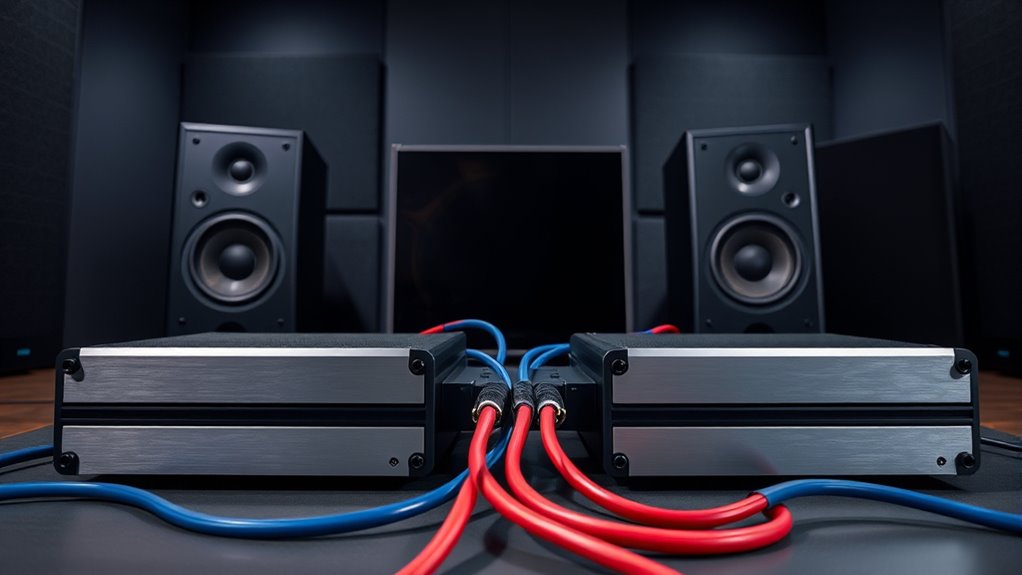
Bi-amping involves splitting the audio signal into separate channels for different speakers or speaker sections, which can considerably improve sound clarity and detail. Instead of sending one full-range signal to a single set of terminals, you use two amplifiers or two channels from a multichannel amplifier. One handles the low frequencies, while the other manages the high and midrange sounds. This separation reduces distortion and interference, resulting in cleaner, more precise audio. You’ll notice better bass response, clearer vocals, and improved overall soundstage. Bi-amping requires compatible speakers with separate input terminals for different frequency ranges. It’s a technique that can elevate your listening experience by giving each speaker section dedicated power, minimizing crossover distortion, and allowing finer control over sound reproduction. Additionally, understanding the importance of audio signal separation can help you optimize your setup for the best possible sound quality. Proper amplifier configuration is essential to achieve the full benefits of bi-amping and ensure your system functions harmoniously.
How Zone 2 Extends Your Listening Flexibility

With Zone 2, you can easily expand your listening range to different rooms or outdoor spaces without interrupting your main setup. This feature allows you to switch seamlessly between zones, giving you more control over where your music plays. By doing so, you increase your listening flexibility and enjoy a more dynamic audio experience throughout your home. Additionally, integrating Zone 2 with other audio components can enhance your overall home entertainment system, making your setup more adaptable to various environments.
Expanding Listening Range
By incorporating Zone 2 into your audio setup, you can substantially expand your listening options without overloading your main system. Zone 2 allows you to send audio to different speakers or areas, giving you flexibility to enjoy music in multiple spaces simultaneously. This setup is perfect for hosting gatherings or relaxing in separate rooms without sacrificing sound quality. For example, you could listen to your favorite playlist in the living room while background music plays in the kitchen or patio. Here’s a quick overview:
| Zone 2 Capability | Benefits | Ideal Use Case |
|---|---|---|
| Multiple outputs | More options for listening | Multi-room listening |
| Separate volume controls | Custom sound levels | Different preferences |
| Independent source | Versatile content | Simultaneous audio streams |
Additionally, understanding the bi-amping process can help optimize your speaker performance by providing dedicated power to different frequency ranges, enhancing overall sound quality. This setup broadens your audio experience without complicating your main system.
Seamless Zone Transitions
Once your Zone 2 setup is in place, the ability to switch between different listening areas becomes smooth and effortless. You can seamlessly move from your main listening room to a patio or backyard without adjusting your main system. This flexibility means you don’t have to disconnect or reconfigure your primary speakers or amplifier. Instead, you use Zone 2 to add or remove audio in specific zones instantly. This allows you to enjoy music or audio content in multiple areas simultaneously or switch focus effortlessly. The shift feels natural because the system is designed to handle these changes smoothly, maintaining consistent sound quality. Modern audio technology enhances this seamless zone transition, making multi-zone listening more intuitive. Incorporating connected equipment enables these transitions to be more reliable and user-friendly, further elevating your multi-zone audio experience. Additionally, multi-zone systems often include features that optimize sound distribution, ensuring a balanced audio experience across all zones.
The Technical Difference Between Bi-Amping and Bi-Wiring

Understanding the technical differences between bi-amping and bi-wiring starts with examining their signal paths and how they handle crossover points. You’ll notice that bi-amping involves separate amplifiers for different frequency ranges, while bi-wiring uses a single amp with separate terminals. These differences impact how the channels and crossover implementations function within each setup.
Signal Path Differences
The key difference in signal paths between bi-amping and bi-wiring lies in how the amplifier’s channels connect to the speaker. With bi-amping, each speaker’s frequency range is powered separately, with dedicated amplifiers for high and low frequencies. This means your preamp sends two distinct signals—one to the high-channel and one to the low-channel—through separate cables, creating two parallel paths. In bi-wiring, a single amplifier channel feeds both high and low frequency sections via two wires, but these wires connect to different parts of the same speaker crossover. The signal path in bi-wiring remains unified before reaching the speaker, while bi-amping splits the path early, providing independent power and potentially reducing crosstalk and interference.
Crossover Implementation Variations
In bi-amping, each amplifier channel connects directly to a specific section of the speaker’s crossover network—one for highs and one for lows—allowing independent filtering and amplification. This setup enables precise control over each frequency range, potentially improving clarity and dynamics. Variations in crossover implementation can influence sound quality and system flexibility. For example:
- *Passive crossovers* are built into the speaker, requiring no external components but limiting customization.
- *Active crossovers* operate before amplification, offering adjustable filters for each channel.
- *Linkwitz-Riley* filters provide steep slopes for minimal overlap between frequencies.
- *First-order* filters have gentle slopes, allowing more overlap but less effective separation.
Understanding these differences helps you tailor your system for ideal performance, especially when considering the crossover implementation for your specific setup.
Amplifier Channel Roles
Bi-amping and bi-wiring differ primarily in how they assign amplifier channels to a speaker’s crossover network. In bi-amping, you use separate amplifiers for the high and low frequencies, each connected directly to their respective drivers via the crossover. This setup allows you to power the treble and bass sections independently, reducing intermodulation and potentially improving clarity. Conversely, bi-wiring uses a single amplifier channel but splits the speaker’s connection into separate wires for high and low-frequency drivers. The crossover remains inside the speaker, not in the amplifier. This means bi-wiring doesn’t provide the same independent power or interference reduction as bi-amping. Understanding these roles helps you decide whether dedicated channels or just split wiring suits your system’s performance goals.
Common Myths About Bi-Amping and When It’s Overhyped
Many people believe bi-amping automatically doubles your loudspeaker’s performance, but that’s a common misconception. While it can improve clarity, it doesn’t transform your system into a powerhouse. Here are some myths to contemplate:
- Bi-amping guarantees better sound quality: Only if your current setup is fundamentally limited; otherwise, the improvement may be negligible.
- It doubles the power output: Not necessarily—power distribution isn’t always linear, and speaker design influences results.
- It’s a quick fix for poor audio: Bi-amping requires proper setup; it won’t fix fundamental issues like room acoustics or source quality.
- All speakers benefit equally: Some speakers don’t benefit substantially from bi-amping, especially if they have a passive crossover designed for single amplification.
When Using Zone 2 Is Actually Beneficial
Using Zone 2 becomes truly beneficial when you want to enjoy background music or ambient sound in multiple areas without sacrificing audio quality. It allows you to distribute audio signals to different zones, so each space gets clear, consistent sound without overloading your main system. This setup is perfect if you have a large home or multiple living spaces and want to create a seamless listening experience. Instead of using multiple speakers connected directly to your main amp, Zone 2 lets you control volume and sources independently, giving you flexibility. You won’t need separate stereo systems for each zone, saving space and cost. When you’re entertaining or relaxing, Zone 2 ensures all areas have appropriate sound levels without compromising overall audio fidelity.
Limitations and Pitfalls of Bi-Amping in Home Setups
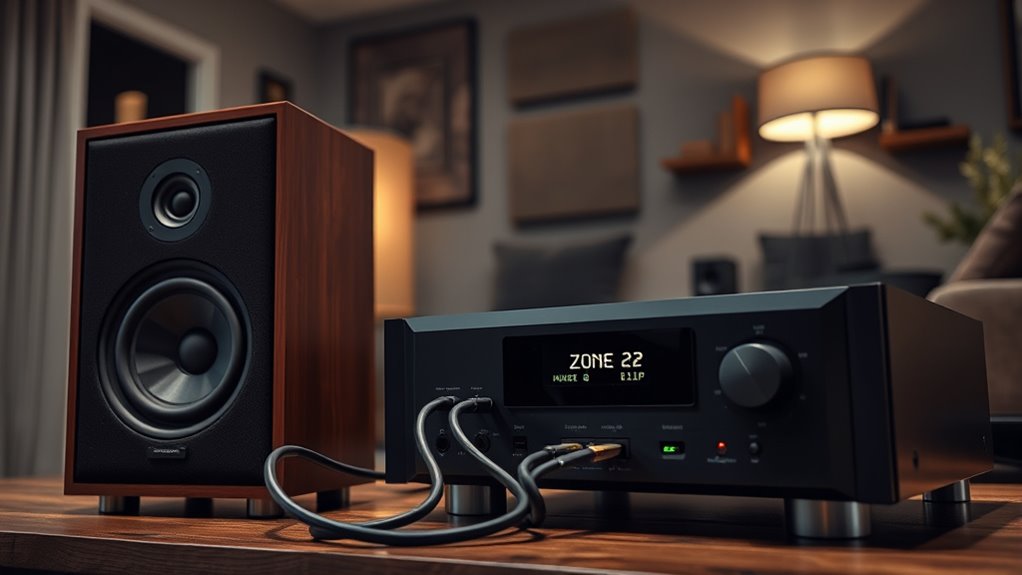
Bi-amping can introduce issues like inconsistent channel matching, which may cause sound imbalance. It also adds complexity to your system, making setup and troubleshooting more difficult. Plus, the expected acoustic benefits often diminish if your components aren’t perfectly aligned. Additionally, sound healing science suggests that improper configuration can disrupt the natural vibrations that contribute to optimal sound quality.
Inconsistent Channel Matching
Achieving perfectly matched channels is a common challenge when bi-amping your home audio system. Small differences in components, cables, or settings can create noticeable imbalances between the left and right channels. This inconsistency can lead to a less cohesive soundstage and reduced stereo imaging. To combat this, you need to consider several factors:
- Speaker sensitivity differences that affect volume levels.
- Variations in cable quality or length impacting signal strength.
- Amplifier channel output discrepancies caused by manufacturing tolerances.
- Incorrect or uneven equalization settings that skew tonal balance.
Addressing these issues requires careful calibration and often trial and error, making it difficult to achieve seamless channel matching in a typical home setup.
Increased System Complexity
While bi-amping can enhance audio performance, it also introduces significant complexity to your home system. Managing multiple connections, ensuring proper wiring, and configuring settings can become overwhelming. This complexity increases the risk of errors, such as incorrect wiring or mismatched components, which can degrade sound quality or damage equipment. Additionally, troubleshooting issues becomes more difficult, requiring technical knowledge beyond basic setup. To understand the pitfalls, consider this table:
| Aspect | Challenge | Impact |
|---|---|---|
| Wiring | Extra connections needed | Increased setup time |
| Component matching | Ensuring compatibility | Potential sound imbalance |
| Signal routing | Properly directing signals | Risk of feedback or distortion |
| Calibration | Fine-tuning levels | Time-consuming and complex |
| Maintenance | Additional checks required | Higher effort for upkeep |
This added complexity demands more effort and expertise, limiting the practicality for most home users. Understanding technical requirements is essential before attempting bi-amping to avoid costly mistakes, especially considering the potential for equipment damage if not properly managed. Moreover, the additional equipment required can significantly increase overall costs and space requirements.
Diminishing Acoustic Benefits
Despite the potential for improved sound clarity, bi-amping often offers diminishing returns in typical home environments. Your listening space, equipment, and speaker placement can limit the benefits you might expect. Often, the differences are subtle—hardly noticeable unless you use high-end gear or conduct careful comparisons. Additionally, bi-amping can introduce issues like phase mismatches or uneven power distribution, which can degrade sound quality. Here’s what to regard:
- Room acoustics can overshadow any subtle improvements from bi-amping.
- Speaker quality and design may limit how much benefit you gain.
- Amplifier matching is critical; mismatched components can cause more harm than good.
- Listening habits and source material often determine whether you’ll notice an improvement or not.
- Understanding home audio setup and how it influences sound performance can help you make more informed decisions.
The Pros and Cons of Using Zone 2 in Multi-Room Audio
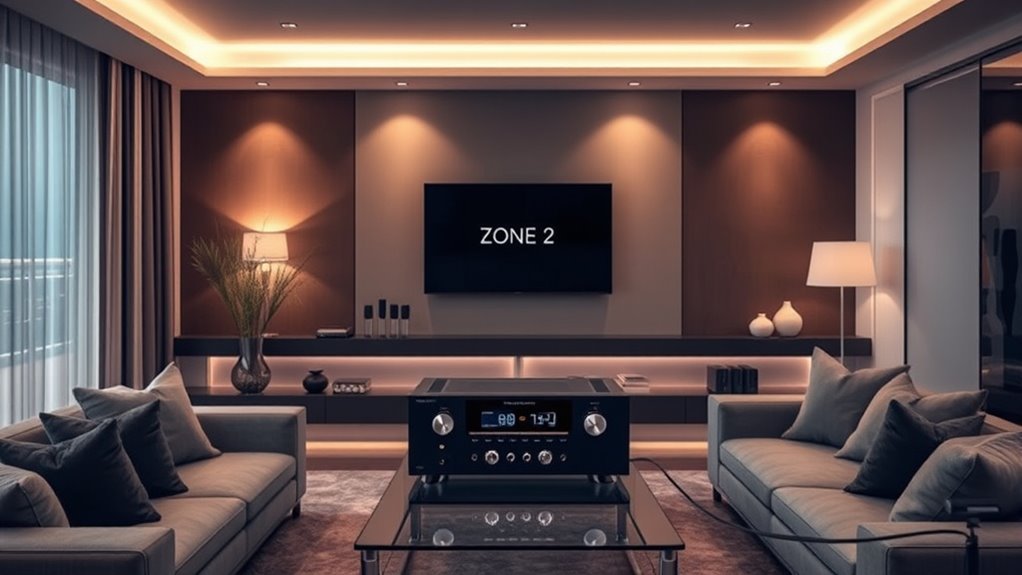
Have you ever wondered whether using Zone 2 in your multi-room audio setup is worth it? Zone 2 lets you play different audio in another room, offering flexibility. The main advantage is convenience—you can listen to separate sources without disturbing the main zone. However, there are downsides. You might experience reduced audio quality or limited control options. Additionally, some amplifiers or receivers don’t support Zone 2 effectively, making it less useful.
| Pros | Cons |
|---|---|
| Multi-room flexibility | Possible audio quality drops |
| Independent source control | Limited support in some gear |
| Easy to set up | Increased complexity |
| No need for extra amps | Potential synchronization issues |
| Enhanced entertainment options | May require extra wiring |
Situations Where Bi-Amping Offers Minimal or No Advantage
Bi-amping can considerably improve audio quality when used appropriately, but in some situations, its benefits are minimal or nonexistent. If your speakers are simple, or the amplifier isn’t powerful enough, you won’t notice much difference. Additionally, bi-amping offers little gain if your speakers aren’t designed for it or lack separate crossover points. Here are some scenarios where bi-amping doesn’t help much:
- When speakers have a single, integrated driver setup.
- If your amplifier’s power isn’t sufficient to justify separate channels.
- When your audio source already provides high-quality, full-range output.
- In rooms with high acoustical reflections, where room treatment matters more than wiring configurations.
In these cases, investing in bi-amping might not deliver the improvements you expect.
Practical Tips for Deciding If You Need Bi-Amping or Zone 2
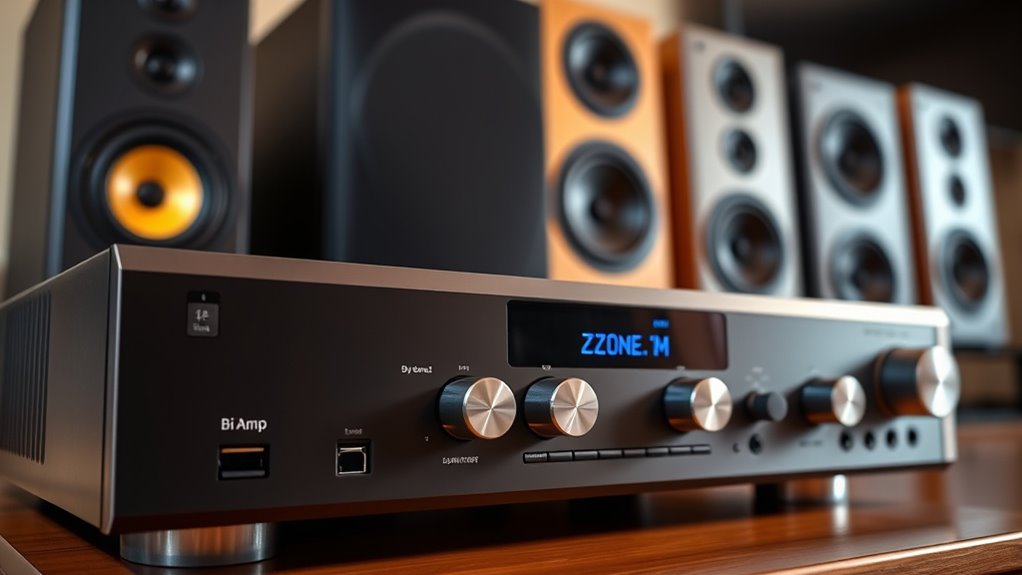
Deciding whether you need bi-amping or Zone 2 often depends on your specific audio setup and listening goals. If you want clearer, more detailed sound from high and low frequencies, bi-amping can help by reducing speaker crossover distortion. However, if your goal is to enjoy music in another room without affecting your main listening area, Zone 2 is more suitable. Evaluate your equipment: do you have enough amplifier channels, or do you want to simplify your setup? Consider your speakers’ capabilities and your room size. If you’re seeking a noticeable upgrade in sound quality for your main speakers, bi-amping might be worth the effort. For background music or multi-zone listening, Zone 2 offers convenience without complex wiring. Focus on your priorities to decide which approach aligns best with your needs.
Alternatives to Bi-Amping and Zone 2 for Improving Sound Quality
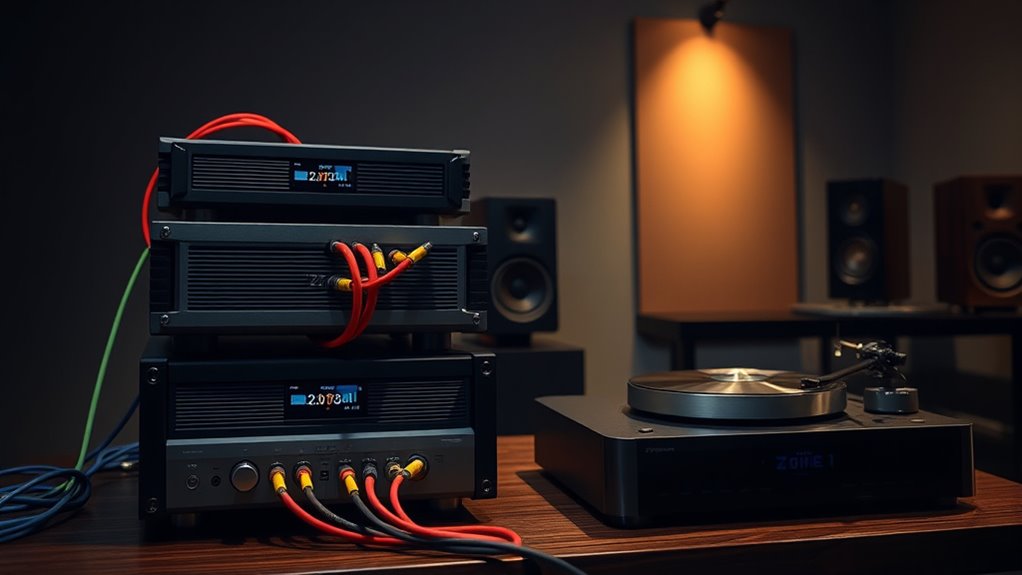
While bi-amping and Zone 2 are popular options for enhancing sound, there are other effective ways to improve your audio experience without complex wiring or additional zones. First, upgrade your speakers or add acoustic treatments to reduce unwanted reflections and improve clarity. Second, optimize your speaker placement for better soundstage and imaging. Third, invest in a high-quality DAC or audio processor to ensure cleaner signal conversion. Fourth, fine-tune your system’s calibration with room correction software, which can dramatically improve sound balance and detail. These approaches are simpler, more cost-effective, and often more impactful than complex wiring setups, giving you better sound quality without the hassle of additional zones or bi-amping. Additionally, considering vintage audio equipment can add character and warmth to your system, elevating your listening experience in a way modern gear sometimes cannot replicate.
Frequently Asked Questions
Can Bi-Amping Damage My Speakers if Not Done Correctly?
Yes, bi-amping can damage your speakers if you don’t set it up properly. If you connect the wrong amp channels or mismatch impedance levels, you risk overloading or distorting the speakers. Always guarantee your amplifiers are compatible and correctly wired. Double-check your connections and settings before powering on. When done correctly, bi-amping can improve sound quality without risking damage. Otherwise, it’s best to consult your speaker and amplifier manuals.
Is Zone 2 Suitable for Outdoor or Waterproof Speaker Setups?
Yes, Zone 2 is suitable for outdoor or waterproof speaker setups. It’s designed to handle multiple zones, making it perfect for backyard parties or garden music without disturbing indoor audio. Imagine controlling your outdoor speakers separately, enjoying music without interference. Just make certain your system supports Zone 2, and you’ll have seamless, flexible audio everywhere you want—whether it’s a poolside gathering or a quiet patio retreat.
How Does Bi-Amping Affect Overall Power Consumption?
Bi-amping can increase your overall power consumption because you’re powering two separate amplifier channels instead of one. This setup often requires more energy, especially if you’re pushing the system hard. However, it can improve sound quality and reduce distortion. You should consider whether the added power use aligns with your needs, as sometimes the benefits don’t justify the extra energy costs, especially in less demanding setups.
Are There Specific Types of Speakers That Benefit More From Bi-Amping?
Think of your speakers as a symphony orchestra—some need the right section to shine. You’ll see the biggest benefits from bi-amping with high-end speakers, especially those with multiple drivers like tower speakers or professional-grade models. These speakers handle the additional power and separation better, delivering clearer sound and deeper bass. If your speakers are simple or budget-friendly, bi-amping might be like adding a splash of color to a black-and-white photo—nice, but not essential.
What Are the Cost Implications of Upgrading to a Bi-Amped or Zone 2 Setup?
Upgrading to a bi-amped or Zone 2 setup can be costly, as you’ll need extra amplifiers, cables, and possibly a more advanced receiver. Expect to spend more on equipment and installation. However, the improved sound quality and system flexibility might justify the investment if you’re aiming for top-tier audio performance or want to customize listening zones. Budget wisely, considering both upfront costs and long-term benefits.
Conclusion
Ultimately, whether you choose bi-amping or Zone 2 depends on your setup and goals. Did you know that only about 10% of audiophiles notice a real difference with bi-amping? If you’re seeking better sound or more flexibility, explore your options carefully. Sometimes, simple upgrades like speaker placement or quality cables can make more impact than complex configurations. Make informed choices to enjoy the best listening experience tailored to your needs.