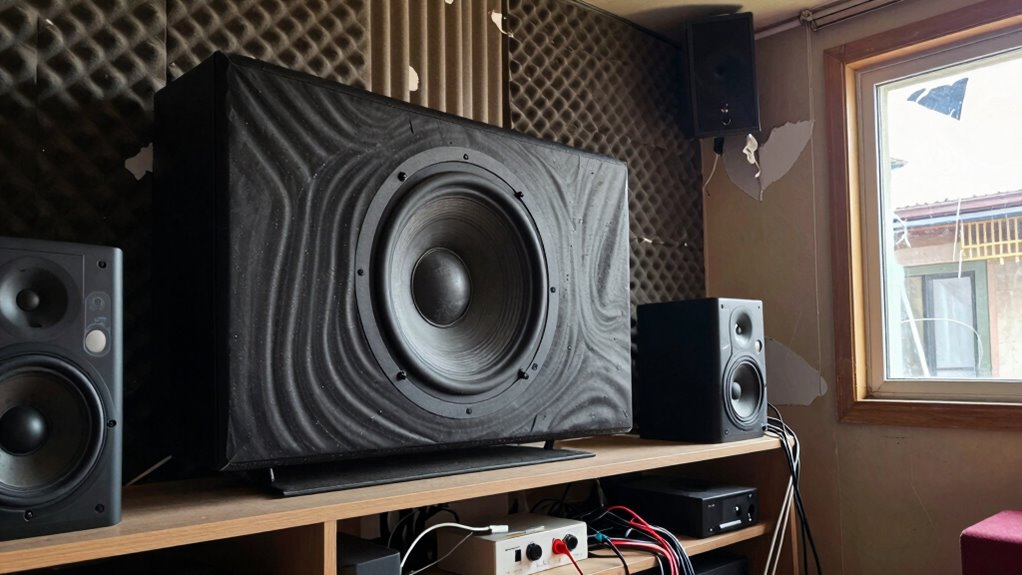

Boomy bass often results from three main room problems. First, room modes and standing waves cause certain low frequencies to reinforce or cancel, creating boomy spots. Second, inadequate absorption and reflection strategies lead to uncontrollable echoes and muddled sound. Finally, poor speaker placement and room symmetry can amplify bass issues and produce uneven sound. Fixing these issues improves your sound clarity, and understanding them is key to solving boomy bass—keep exploring to learn more about these room factors.
Key Takeaways
- Room modes and standing waves create peaks and nulls, causing boomy bass and uneven sound.
- Inadequate absorption and reflective surfaces lead to excessive low-frequency buildup and muddiness.
- Improper speaker placement near walls or corners amplifies bass resonance and causes boominess.
- Large or irregularly shaped rooms can develop low-frequency resonances, resulting in boomy sound.
- Lack of acoustic treatments like bass traps and diffusers allows sound reflections to reinforce bass issues.
Room Modes and Standing Waves
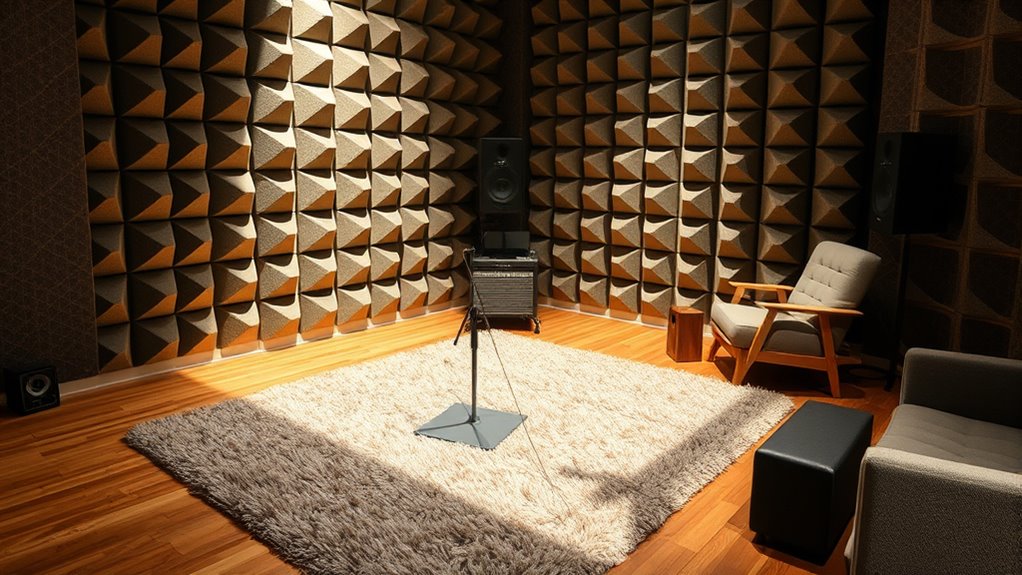
Room modes and standing waves occur when sound waves reflect between parallel surfaces, causing certain frequencies to reinforce or cancel each other. This reinforcement creates peaks, making bass sound boomy and overly prominent. Conversely, cancellations lead to nulls, where some bass notes seem weak or absent. These effects happen at specific frequencies related to the room’s dimensions, so larger rooms tend to have lower-frequency issues. When you sit in these spots, you’ll notice inconsistent bass response—boomy in some areas, thin in others. Standing waves cause uneven sound distribution, disrupting your listening experience. To identify these problems, listen for exaggerated bass or areas with muffled sound. Understanding how room modes influence sound helps you take steps to minimize their impact and improve overall audio clarity. Proper room treatment can significantly reduce these acoustic issues and create a more balanced listening environment. Additionally, acoustic panels and bass traps are common solutions to help control these problematic reflections and standing waves. Being aware of room dimensions and setup can also aid in room design to mitigate these effects from the start. Incorporating knowledge about room acoustics during the planning stage can prevent many of these issues before they develop. Recognizing the role of room dimensions in acoustic problems is essential for effective sound management.
Inadequate Room Absorption and Reflection
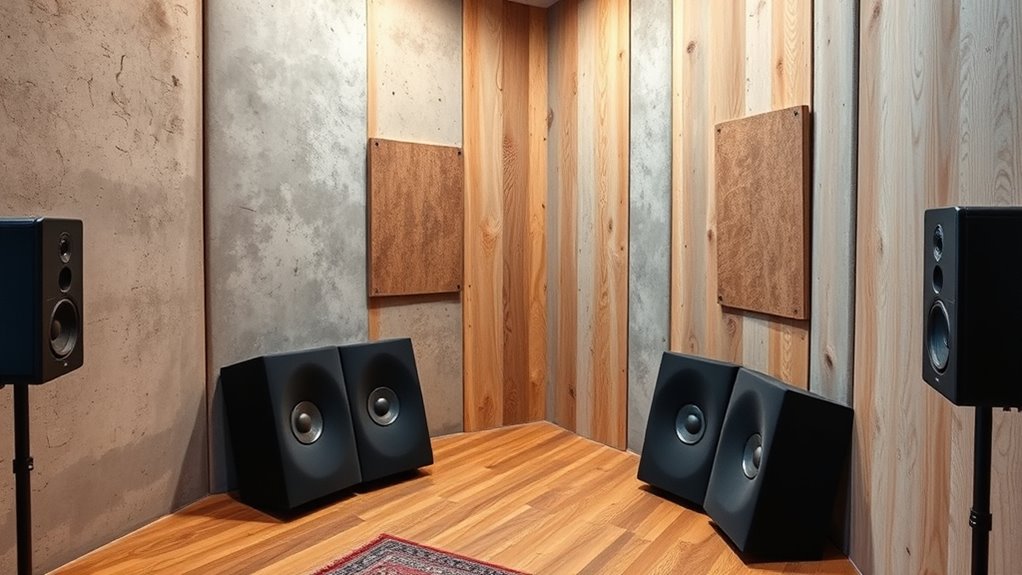
When a space lacks proper absorption, reflections bounce unpredictably off surfaces, creating a cluttered and uneven sound field. This unevenness can cause certain frequencies to amplify while others fade, resulting in boomy bass and muddled sound. You’ll notice that echoes and reverb make it difficult to hear details clearly. To improve, consider these steps:
Unbalanced reflections create muddled sound, boomy bass, and unclear details—improve your acoustics with proper absorption.
- Add soft furnishings like rugs, curtains, or acoustic panels to absorb reflected sound.
- Strategically place bass traps in corners to tame low-frequency reflections.
- Use diffusers to scatter sound waves evenly, preventing harsh echoes and uneven sound distribution.
- Ensuring proper room dimensions and surface materials can enhance acoustic quality and further reduce problematic reflections. Incorporating room acoustics optimization principles helps create a more balanced sound environment. Properly treating the room can also prevent sound energy from becoming trapped in certain areas, which contributes to the problematic reflections. Additionally, understanding and applying sound energy management techniques can further improve overall acoustic performance.
These actions help balance sound energy and reduce excess reflections, leading to a clearer, more controlled listening environment. Proper absorption makes your bass tighter and your overall sound more natural. Effective acoustic treatment can significantly enhance sound clarity in spaces with problematic reflections.
Poor Speaker Placement and Room Symmetry

Poor speaker placement and uneven room symmetry can substantially distort your sound quality. When speakers are too close to walls or corners, bass frequencies become boomy and uncontrolled. An asymmetrical room causes uneven sound distribution, making some areas sound dull or overly bright. To optimize your setup, position speakers at ear level, equidistant from walls, and avoid placing them directly against corners. Symmetry matters: a balanced room ensures even sound dispersion. Here’s a helpful comparison:
| Room Feature | Ideal Setup | Common Mistake |
|---|---|---|
| Speaker Placement | Equidistant from side walls | Closer to one wall |
| Room Symmetry | Balanced layout | Asymmetrical furniture, corners |
| Wall Arrangements | Symmetrical, minimal obstructions | Cluttered, uneven surfaces |
Adjusting these factors reduces boomy bass and improves clarity, emphasizing the importance of room acoustics in achieving optimal sound. Proper speaker positioning and room arrangement are essential for mitigating these issues and enhancing your listening experience. Paying attention to room symmetry can significantly improve sound quality by preventing uneven distribution and echo problems. Additionally, incorporating acoustic treatments such as panels or diffusers can further refine sound quality and reduce unwanted reverberations. Considering soundproofing techniques can also help contain sound within the space, improving overall acoustics.
Frequently Asked Questions
Can Digital Room Correction Tools Eliminate Boomy Bass Completely?
Digital room correction tools can considerably reduce boomy bass, but they might not eliminate it entirely. You’ll notice an improvement in clarity and balance, especially in problematic areas. However, some room issues are tough to completely fix with software alone, especially if the room has large reflective surfaces or uneven surfaces. Combining room correction with physical adjustments like bass traps and speaker placement offers the best chance for a clean, tight bass response.
How Do I Identify if My Room Has Problematic Modes?
You can tell if your room has problematic modes when your bass suddenly becomes a thunderstorm or a booming explosion in specific spots. Walk around and listen for bass that wildly fluctuates—loud in some areas, whispering in others. Use a frequency analyzer or a mobile app to spot peaks at certain frequencies. If certain spots sound drastically different, those are your room’s trouble spots, causing that exaggerated boomy bass.
Are Bass Traps Effective for All Types of Room Issues?
Yes, bass traps are effective for most room issues, especially problematic low-frequency resonances. They absorb excess bass energy, reducing boominess and improving clarity. However, they work best when properly placed in corners where bass tends to accumulate. Keep in mind that bass traps alone may not resolve all acoustic problems, so combining them with other treatments, like diffusers and absorbers, will give you the best overall sound quality.
What Are Quick Fixes for Severe Bass Boom in a Room?
Like tightening a loose screw, you can tame severe bass boom quickly by adding bass traps or placing thick furniture in corners. You might also try placing a heavy rug on the floor or hanging thick curtains to absorb excess low frequencies. Adjusting your listening position, such as moving closer to or further from walls, can also help reduce boominess. These simple steps can make your room sound clearer almost instantly.
Does the Type of Flooring Affect Bass Response and Room Acoustics?
Yes, the type of flooring affects bass response and room acoustics. Hard surfaces like tile or wood reflect sound, causing bass to bounce and amplify, which can lead to boomy or muddy sound. Carpeting and rugs absorb low frequencies, smoothing out bass and improving clarity. You should consider adding soft flooring or rugs to control reflections, and experiment with placement to achieve a balanced, natural bass response in your space.
Conclusion
Understanding these three room issues can dramatically improve your bass response. Did you know that room modes can cause certain bass frequencies to be up to 10 times louder or quieter? By addressing standing waves, adding proper absorption, and optimizing speaker placement, you’ll enjoy clearer, more balanced sound. Don’t let your room’s quirks hold back your listening experience—tackle these problems, and your bass will sound tight, deep, and true every time.