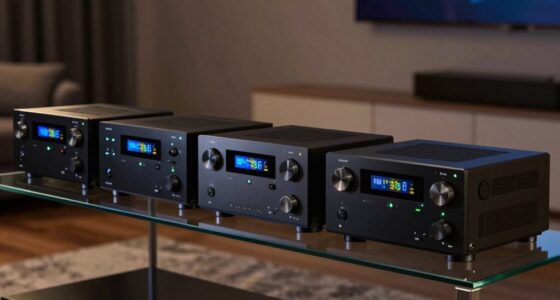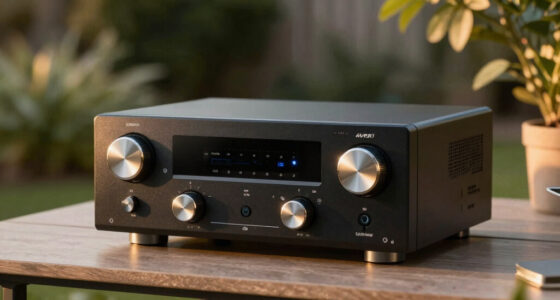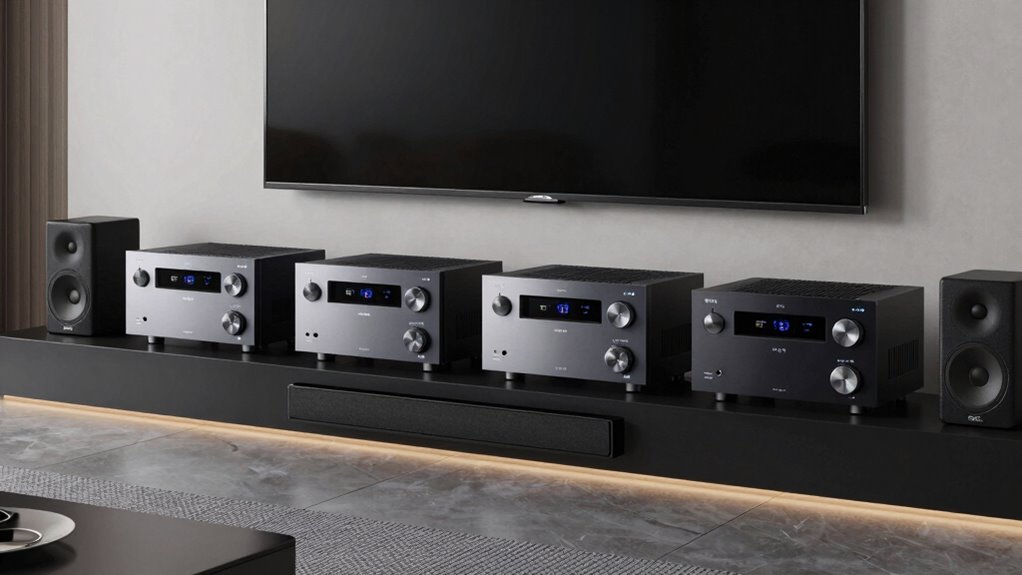

Setting up a TV with eARC for the first time can seem daunting, but choosing the right AV receiver makes it straightforward. For most users, the Onkyo TX-NR7100 offers advanced sound calibration and 8K support, making it ideal for high-end home theaters. If you’re after simplicity and all-in-one convenience, the Yamaha YHT-4970U provides a complete package with speakers and easy setup. Gamers and tech enthusiasts will appreciate the Denon AVR-X1700H for its future-proof HDMI standards and multi-room features. Each of these options balances features with complexity and price, but the right choice depends on your specific setup goals and technical comfort level.

Get audio and creator gear delivered free — and shop member deals
- Fast, free delivery on millions of items
- Access to Prime Big Deal Days deals on October 6–7
- Prime Video, Amazon Music and more included
Complete the kit



Key Takeaways
- The Onkyo TX-NR7100 excels in room calibration and 8K support but is more complex and costly.
- The Yamaha YHT-4970U offers an all-in-one, easy-to-set-up home theater with Dolby Atmos but less customizable.
- The Denon AVR-X1700H balances future-proof HDMI support with versatile connectivity, ideal for multi-room setups.
- Price and complexity vary significantly; select based on your technical comfort and budget.
- All models support eARC, but features like Wi-Fi, voice control, and multi-channel power differ widely.
| Onkyo TX-NR7100 9.2-Channel AV Receiver |  | Best Overall for Advanced Home Theater Enthusiasts | Channels: 9.2 | Power per Channel: 100 Watts | HDMI: 3 HDMI-out, HDMI 2.1 with 8K/4K support | VIEW ON AMAZON | See Our Full Breakdown |
| Yamaha YHT-4970U 5.1-Channel Home Theater System with Dolby Atmos and 4K/8K Support |  | Best Complete System for Easy Setup and Immersive Sound | Channels: 5.1 | Supports: Dolby Atmos, DTS Virtual:X | Video Resolution: 4K/120Hz, 8K/60Hz | VIEW ON AMAZON | See Our Full Breakdown |
| Yamaha RX300A 5.2-Channel Home Theater AV Receiver with Dolby Atmos, 4K120/8K HDMI, Bluetooth |  | Best for Easy Setup with Modern HDMI Support | Channels: 5.2 | Power: 70W per channel | HDMI Support: 4K120/8K60, HDMI eARC | VIEW ON AMAZON | See Our Full Breakdown |
| Denon AVR-X1700H 7.2 Channel AV Receiver – 80W/Channel, 8K HDMI, Dolby Atmos, DTS:X, Built-in HEOS, Alexa Voice Control |  | Best for Multi-Room and Future-Proofing | Power Output: 80W per channel | Channels: 7.2 | HDMI Inputs: 6 | VIEW ON AMAZON | See Our Full Breakdown |
| Sony STRDH590 5.2 Channel Surround Sound Home Theater Receiver with 4K HDR and Bluetooth |  | Best Budget-Friendly Option | Channel: 5.2 | Power: 725W total | HDMI Inputs: 4 | VIEW ON AMAZON | See Our Full Breakdown |
| av receivers for tv first earc setup | Channels |
|---|---|
| Onkyo TX-NR7100 9.2-Channel AV | 9.2 |
| Yamaha YHT-4970U 5.1-Channel H | 5.1 |
| Yamaha RX300A 5.2-Channel Home | 5.2 |
| Denon AVR-X1700H 7.2 Channel A | 7.2 |
| Sony STRDH590 5.2 Channel Surr | — |
More Details on Our Top Picks
Onkyo TX-NR7100 9.2-Channel AV Receiver
The Onkyo TX-NR7100 stands out for its sophisticated room correction with Dirac Live and robust HDMI 2.1 support, making it a top choice for those wanting a premium, future-proof system. Its 9.2 channels and 100W per channel output deliver powerful, immersive sound, especially suited for larger rooms. Compared with simpler models, the setup is more involved, requiring some technical knowledge, and its high price may deter casual users. However, for those seeking comprehensive features and best sound calibration—particularly when integrating with high-end TVs and gaming consoles—this receiver delivers.
Pros:- Advanced room correction with Dirac Live
- Supports 8K/4K HDMI transfer with multiple outputs
- Compatible with Sonos and multi-room setups
Cons:- Complex setup requiring some technical knowledge
- Higher price point
- USB mic not included for calibration
Best for: Audiophiles and home theater enthusiasts who want the best sound quality and future-ready HDMI support.
Not ideal for: Beginners or users with limited technical expertise seeking a plug-and-play solution.
- Channels:9.2
- Power per Channel:100 Watts
- HDMI:3 HDMI-out, HDMI 2.1 with 8K/4K support
- Room Correction:Dirac Live
- Supported Formats:Dolby Atmos, DTS:X
- Wireless Technology:Bluetooth (SBC, AAC, aptX, aptX HD)
Our verdict“Ideal for users wanting top-tier sound calibration and future-proof HDMI features, despite its complexity.”
Yamaha YHT-4970U 5.1-Channel Home Theater System with Dolby Atmos and 4K/8K Support
The Yamaha YHT-4970U offers a plug-and-play solution that includes a Dolby Atmos-enabled receiver, five speakers, and a subwoofer. Its all-in-one design makes it highly accessible for those who want quality sound without extensive configuration. The system supports 4K and 8K video with HDMI features like Dolby Vision and HDR10+, ensuring compatibility with modern TVs. While setup is simplified with on-screen menus and room correction, the fixed 5.1 channels limit customization for audiophiles seeking more channels or advanced configurations. This makes it ideal for newcomers or those prioritizing convenience.
Pros:- All-in-one system with included speakers
- Supports Dolby Atmos and DTS:X
- Easy setup with room correction technology
Cons:- Limited to 5.1 channels
- Bulkier components require space
- Higher price for a complete system
Best for: Users seeking a straightforward, complete home theater package with Dolby Atmos.
Not ideal for: Audiophiles or tech-savvy users wanting detailed customization or higher channel counts.
- Channels:5.1
- Supports:Dolby Atmos, DTS Virtual:X
- Video Resolution:4K/120Hz, 8K/60Hz
- HDMI Features:eARC, HDMI switching, Dolby Vision, HDR10+
- Included Components:Speakers, powered subwoofer, cables, microphone, remote
Our verdict“Best suited for those wanting a ready-to-go system with immersive sound and minimal setup effort.”
Yamaha RX300A 5.2-Channel Home Theater AV Receiver with Dolby Atmos, 4K120/8K HDMI, Bluetooth
The Yamaha RX300A provides a good balance for users wanting Dolby Atmos and DTS Virtual:X support in a simpler 5.2-channel setup. Its support for 8K video up to 60Hz and HDMI eARC makes it a solid choice for future-proofing TV connections, especially if you want to upgrade without replacing your entire system. Setup is straightforward with on-screen calibration, and Bluetooth multipoint allows easy wireless streaming. However, its 5.2 channel limitation might not satisfy users seeking more surround channels or advanced multi-room capabilities. This model fits well for those upgrading their existing systems or with smaller rooms.
Pros:- Supports Dolby Atmos and DTS Virtual:X
- High-resolution video up to 8K/60Hz
- Easy setup with room calibration
Cons:- Limited to 5.2 channels
- No mention of built-in Wi-Fi
- Technical features may be complex for some
Best for: Homeowners wanting a straightforward upgrade path with Dolby Atmos support.
Not ideal for: Users looking for higher channel counts or advanced multi-room features.
- Channels:5.2
- Power:70W per channel
- HDMI Support:4K120/8K60, HDMI eARC
- Dolby Atmos:Yes
- Room Correction:Yes
Our verdict“A solid choice for users seeking Dolby Atmos with an easy upgrade path, but not for extensive surround setups.”
Denon AVR-X1700H 7.2 Channel AV Receiver – 80W/Channel, 8K HDMI, Dolby Atmos, DTS:X, Built-in HEOS, Alexa Voice Control
The Denon AVR-X1700H stands out for its 7.2 channels and 80W per channel, making it suitable for larger rooms and multi-room configurations with built-in HEOS. Its support for 8K HDMI pass-through, Dolby Atmos, and DTS:X ensures compatibility with the latest TVs and gaming consoles. The voice control options via Alexa, Google Assistant, and Siri add convenience, especially for users who want seamless integration with smart home systems. Its multiple HDMI inputs and outputs make it versatile, though the setup can be complex for those unfamiliar with AV equipment. This model is an excellent choice for users seeking a flexible, feature-rich receiver capable of multi-room audio.
Pros:- Supports latest 8K HDMI standards
- Multi-room streaming with HEOS
- Voice control integration with Alexa, Google, Siri
Cons:- Complex setup for beginners
- Heavy and sizable
- High price for advanced features
Best for: Tech-savvy users and multi-room setup enthusiasts seeking future-proof HDMI standards.
Not ideal for: Casual users or those seeking a simple, all-in-one package without extensive configuration.
- Power Output:80W per channel
- Channels:7.2
- HDMI Inputs:6
- Supports:8K/60Hz, 4K/120Hz pass-through, HDR10+, Dolby Vision
- Voice Control:Amazon Alexa, Google Assistant, Apple Siri
Our verdict“Designed for users who want multi-room flexibility and future-proof connectivity, despite its setup complexity.”
Sony STRDH590 5.2 Channel Surround Sound Home Theater Receiver with 4K HDR and Bluetooth
The Sony STRDH590 provides a straightforward, budget-friendly way to support 4K HDR, Dolby Atmos, and DTS:X, with Bluetooth streaming for convenience. Its 5.2 channels deliver decent surround sound, and virtual surround modes help create an immersive experience with fewer speakers. However, its limited channel count and lack of built-in Wi-Fi restrict customization and streaming options. It’s best suited for casual viewers who want basic Dolby Atmos support and a simple setup without the need for extensive configurations or multi-room features. This receiver is a good entry point but falls short for those seeking a more expansive or future-proof system.
Pros:- Supports 4K HDR and Dolby Atmos
- Bluetooth for wireless streaming
- Simple setup with virtual surround modes
Cons:- Limited to 6 ohm impedance speakers
- No built-in Wi-Fi
- Basic feature set compared to higher-end models
Best for: Budget-conscious users seeking Dolby Atmos support in a simple, easy-to-use package.
Not ideal for: Audiophiles or users with complex multi-room requirements.
- Channel:5.2
- Power:725W total
- HDMI Inputs:4
- HDMI Outputs:1
- Supported Video:4K HDR, HDCP 2.2
Our verdict“A practical choice for casual users who want Dolby Atmos in an affordable, straightforward package.”

How We Picked
Our selection process focused on models that support TV first eARC setup, prioritizing compatibility with modern HDMI standards, ease of use, and sound quality. We compared features like HDMI pass-through, room calibration, multi-room support, and user interface simplicity. Price was also a key factor, ensuring options for different budgets. We aimed to include a mix of high-end, mid-range, and all-in-one systems, assessing each for clarity in setup, feature set, and potential tradeoffs for different user needs.
Factors to Consider When Choosing Av Receivers For Tv First Earc Setup
Choosing the right AV receiver for your TV first eARC setup involves understanding your audio and video needs, technical comfort, and budget. The key is to find a model that supports the latest HDMI standards with eARC for seamless audio return, offers enough channels for your space, and integrates easily with your existing devices. Whether you’re looking for a simple plug-and-play system or a high-end, multi-room setup, this guide will help you identify the most important features and tradeoffs to consider.Understanding eARC and HDMI support
eARC (Enhanced Audio Return Channel) is essential for transmitting high-quality audio from your TV to your receiver. Ensuring your AV receiver supports HDMI 2.1 with eARC guarantees compatibility with the latest TVs and sound formats. If your TV has eARC, selecting a receiver that also supports this feature simplifies the setup and maximizes audio quality without needing additional adapters or hardware.
Channel count and audio formats
Deciding between 5.1, 7.2, or higher channels depends on your room size and desired surround experience. Support for Dolby Atmos and DTS:X enhances immersion, especially with fewer speakers, so verify if the receiver can handle your preferred sound formats. Keep in mind that more channels often mean higher cost and more complex setup.
Ease of setup and integration
For first-time users, a receiver with automatic room calibration, clear on-screen menus, and straightforward HDMI switching makes setup less frustrating. Compatibility with smart assistants and streaming services can add convenience but may require additional configuration or Wi-Fi. Balance your desire for advanced features with your comfort level handling technology.
Frequently Asked Questions
What is eARC, and why is it important?
eARC, or Enhanced Audio Return Channel, is a feature that allows your TV to send high-quality audio signals to your AV receiver over a single HDMI cable. It supports formats like Dolby Atmos and DTS:X without compression, resulting in better sound clarity and immersion. If your TV and receiver both support eARC, setup becomes simpler, and audio quality improves significantly, making it a critical feature for modern home theater systems.
How many channels should my AV receiver have for a TV first setup?
The number of channels depends on your room size and desired surround sound experience. A 5.1 system is sufficient for most small to medium rooms, offering a balanced surround experience. Larger rooms or those seeking immersive multi-dimensional sound may benefit from 7.2 or higher channels, but these add complexity and cost. For most first setups focused on TV audio, 5.1 or 7.2 channels strike a good balance.
Can I use a simple AV receiver with my existing smart home devices?
Yes, but compatibility varies. Many modern AV receivers support voice control with Alexa, Google Assistant, or Siri, allowing you to control volume, input sources, or power via smart speakers. However, setting up these integrations can sometimes be challenging, especially with complex systems. If smart home integration is a priority, choose a receiver explicitly supporting these features and follow the manufacturer’s setup instructions carefully.
Is 8K support necessary for a first eARC setup?
While 8K support is not essential for everyday viewing, it provides future-proofing as TVs and content evolve. If you plan to upgrade your TV soon or want the latest HDMI standards, choosing a receiver with 8K support ensures compatibility with upcoming devices and higher video resolutions. For immediate needs, 4K and 4K/120Hz support are usually sufficient.
What are the main tradeoffs when choosing an AV receiver for eARC?
Primarily, higher-end models with advanced features like Dirac Live, multiple HDMI inputs, and multi-room support tend to be more complex and expensive. Simpler, budget-friendly options may lack features like multi-channel support, Wi-Fi, or advanced calibration but are easier to set up and use. Balancing your technical expertise, budget, and desired features is key in making the right choice.
Conclusion
If you’re new to home theater systems or want a straightforward, all-in-one setup, the Yamaha YHT-4970U offers excellent value and ease of use. Audiophiles or those wanting maximum customization and future-proofing should consider the Onkyo TX-NR7100 for its advanced calibration and HDMI features. For multi-room enthusiasts or users with more technical comfort, the Denon AVR-X1700H provides a versatile, feature-rich option. Budget-conscious buyers seeking Dolby Atmos support might find the Sony STRDH590 appealing, though it sacrifices some expandability. Ultimately, your choice depends on your space, technical skills, and audio/video needs.
Fall Picks
fall essentials
As an affiliate, we earn on qualifying purchases.