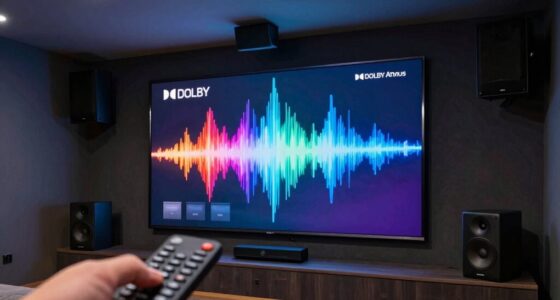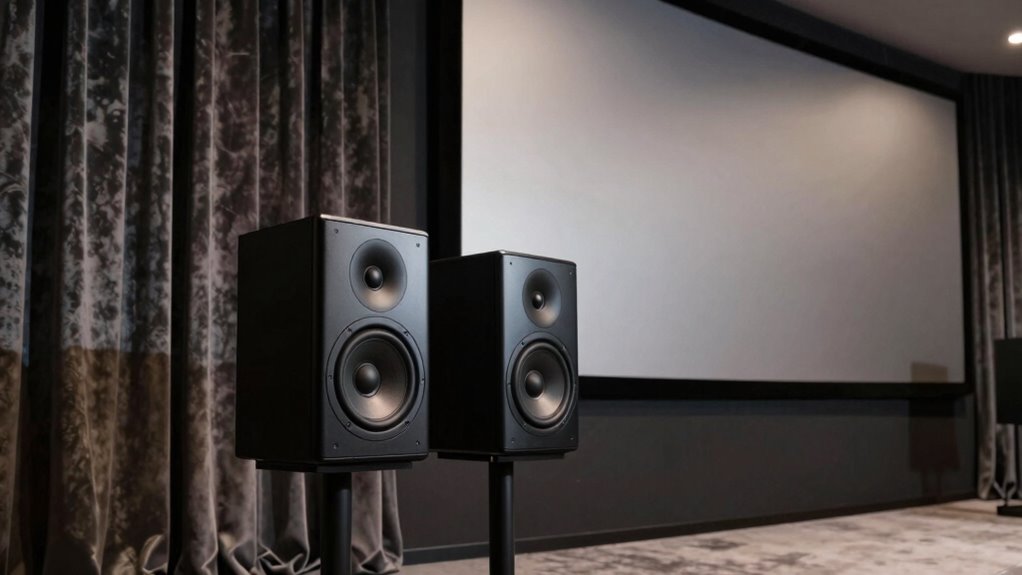
If your surround speakers feel silent, it’s often due to a mismatch between their placement and calibration settings. Poor positioning or obstructions can make speakers seem invisible, even if they work fine. Calibration helps balance sound levels and timing, but it can’t fix placement issues. Ensuring proper speaker placement first is essential for immersive sound. Keep exploring to discover how adjusting setup and calibration together can restore the full experience.
Key Takeaways
- Improper speaker placement can make surround speakers seem silent despite correct content calibration.
- Lack of proper calibration settings leads to unbalanced sound levels, causing silence or muffled audio.
- Incorrect speaker angles or distances hinder sound delivery, making speakers feel disconnected from the content.
- Poor placement prevents effective calibration, resulting in unbalanced sound even if content is properly calibrated.
- Ensuring correct placement before calibration is essential to achieve immersive, balanced surround sound experience.
When surround speakers suddenly go silent, it can disrupt your entire audio experience and leave you wondering what went wrong. Often, the culprit isn’t a malfunction but a setup issue. One common reason your speakers might seem silent is calibration issues. If your system isn’t properly calibrated, the sound levels between your speakers can become unbalanced, making some seem quiet or even completely inaudible. Calibration involves adjusting the volume levels, delay times, and speaker distances to guarantee sound reaches your ears at the right moment and at the right volume. Without this fine-tuning, your surround sound system can feel off, with certain speakers failing to produce the intended immersive effect.
Silent surround speakers often stem from calibration issues, causing unbalanced sound and loss of immersive audio.
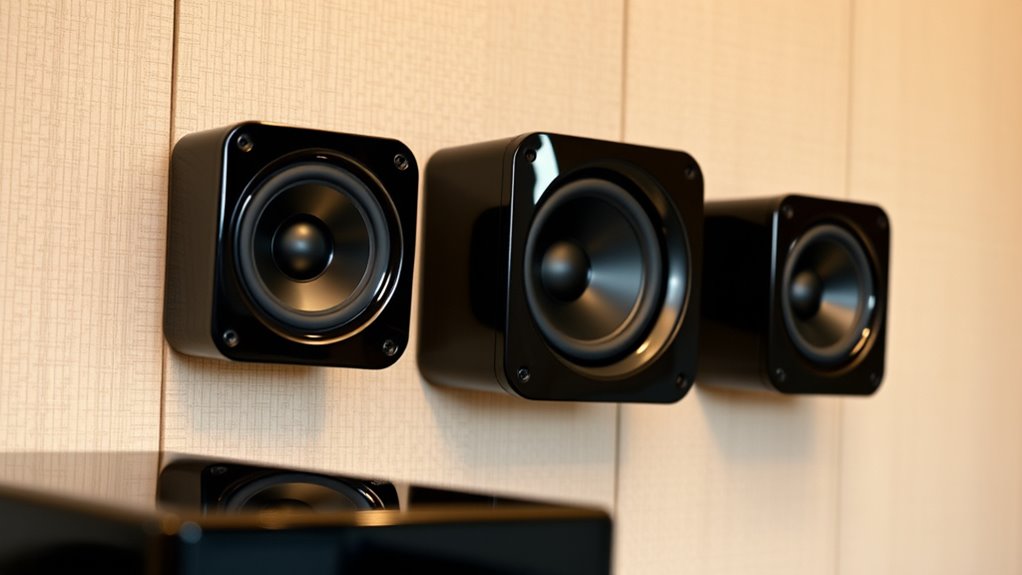
Another key factor is speaker placement. Even if your speakers are functioning perfectly, their position in the room can considerably impact sound distribution. If your surround speakers are placed too far from your listening position or are obstructed by furniture or walls, their sound output can be muffled or lost altogether. Proper placement is vital; they should be positioned at ear level, slightly behind and to the sides of your seating area, with clear line-of-sight to the listener. When speakers are misplaced, they might still be working but their sound won’t reach you effectively, creating the illusion of silence.
Sometimes, these issues intertwine—poor speaker placement can exacerbate calibration problems. For example, if your speakers are too close or unevenly spaced, calibration tools might struggle to set accurate levels, leading to unbalanced sound. Conversely, even the best calibration can’t fix a poorly placed speaker. It’s imperative to start with proper placement before fine-tuning your system with calibration tools. Check that each speaker’s position aligns with recommended guidelines for your room size and layout.
Additionally, if your speakers are placed too far apart or too close together, or if they’re pointing in the wrong direction, you may notice gaps in the sound field. This can make it seem like your surround speakers are silent, even though they’re functioning. Ensuring correct placement and running a full calibration process with a receiver’s setup microphone can help rebalance your system and restore the immersive experience. Moreover, understanding the importance of content calibration can help you optimize your system’s audio quality. Ultimately, addressing calibration issues and speaker placement is vital to solving the mystery of silent surround speakers and enjoying your home theater to its fullest.

Standard 12" Speaker Foam Surround Edge Repair Kit – 2 Speaker Kit – Fits 12" Speakers with a 3/4" Roll and The Measurements Listed
As an affiliate, we earn on qualifying purchases.
As an affiliate, we earn on qualifying purchases.
Frequently Asked Questions
Can Adjusting Speaker Placement Improve Sound Clarity?
Adjusting speaker positioning can substantially improve sound clarity. Proper speaker placement guarantees ideal sound angles and reduces interference, making your audio more precise. Incorporate acoustic treatment, like diffusers or absorbers, to enhance clarity further. When you position your speakers correctly, you’re maximizing their performance, resulting in richer, clearer sound. Don’t forget to experiment with angles and distances to find the perfect setup that complements your room acoustics for the best listening experience.
Do Different Brands Affect Surround Sound Performance?
Don’t judge a book by its cover, and the same goes for brands. Different brands do affect surround sound performance because brand compatibility and speaker design matter. Some brands optimize sound better for certain setups, ensuring your surround speakers deliver clear, immersive audio. You’ll notice a difference if you choose speakers designed to work together. So, research and pick brands with good reputations for quality and compatibility to get the best sound experience.
Is It Necessary to Calibrate the AV Receiver Regularly?
Yes, you should calibrate your AV receiver regularly. Speaker calibration guarantees your system delivers balanced sound by optimizing receiver adjustments based on room acoustics. Over time, changes like furniture movement or speaker placement can affect performance, so recalibrating helps maintain clarity and surround sound effects. Regular calibration is a simple way to keep your audio experience consistent, ensuring your speakers perform their best in every viewing or listening session.
How Do Room Acoustics Impact Surround Sound?
Room acoustics markedly impact your surround sound experience. Room reflections can cause sound waves to bounce unpredictably, muddying clarity and reducing surround effects. Acoustic treatments like bass traps, diffusers, and absorbers help control reflections, enhancing sound quality. By managing these aspects, you guarantee your surround speakers deliver immersive audio, making dialogue and effects clearer and more precise, so you truly feel enveloped in your home theater environment.
What Is the Ideal Wattage for Surround Speakers?
You should aim for surround speakers with a wattage that matches your amplifier’s power, typically between 50 to 150 watts. When speaker wattage coincides with amplifier power, you get clearer, louder sound without distortion. Too low wattage, and your speakers might struggle to handle dynamic scenes. Always check the recommended wattage for your speakers to guarantee peak performance and avoid damaging your setup.

HomeMount Speaker Wall Mount Brackets – Surround & Bookshelf Speaker Wall Mounts Kit, Holds up to 8 lbs, 2 Pack, Black
- Wide Range of Applications: Suitable for various environments
- Premium Durable Materials: Made of sturdy ABS plastic
- Strong Load Capacity: Holds up to 8 lbs
As an affiliate, we earn on qualifying purchases.
As an affiliate, we earn on qualifying purchases.
Conclusion
So, next time your surround speakers go all mute on you, remember it’s not the universe conspiring against your home theater dreams. Maybe it’s just your setup’s way of saying, “Hey, I need a little love too.” Don’t blame the speakers; blame your fancy content for being too shy to include them. In the end, the silence isn’t a bug—it’s a feature, reminding you that even in sound, a little mystery keeps life interesting.

12in Acoustic Panels for Walls, High Density Soundproof Wall Panels
- High-Quality Material: Odorless, flame retardant polyester foam
- Enhanced Sound Absorption: 25% thicker and 35% denser than traditional panels
- Customizable DIY Design: Flexible splicing and pattern creation
As an affiliate, we earn on qualifying purchases.
As an affiliate, we earn on qualifying purchases.

New Sony Calibration Mic Measurement Microphone ECM-AC2 Part Number 154277421 1-542-670-21 154271011 1-542-710-11 154267021 1-542-774-21, Auxiliary
- Genuine Sony ECM-AC2 Microphone: Calibration microphone for Sony AV systems
- Compatible with Most Sony Receivers: Supports calibration for about 150 models
- Ensures Accurate Speaker Calibration: Helps achieve correct speaker output levels
As an affiliate, we earn on qualifying purchases.
As an affiliate, we earn on qualifying purchases.