
Room modes happen when sound waves bounce between walls and create resonance at specific frequencies tied to your room’s size. This causes some spots to have booming bass while others feel thin or dead. Standing waves reinforce or cancel sound, making bass inconsistent from seat to seat. If you want to understand how your room’s shape and setup influence these zones, you can learn more about adjusting your space for better sound everywhere.

Get audio and creator gear delivered free with Prime
- Fast, free delivery on millions of items
- Prime Video, Amazon Music and more included
- Member-only deals all year
Key Takeaways
- Room modes cause specific frequencies to reinforce or cancel, leading to uneven bass levels at different seats.
- Standing waves form between room boundaries, creating peaks (booms) and nulls (disappearances) in bass response.
- The position of your listening seat relative to room resonances determines whether bass sounds strong or weak.
- Corners and walls amplify bass due to boundary reinforcement, causing boomy spots, while central areas may lack bass.
- Measuring and adjusting subwoofer placement, along with acoustic treatments, can mitigate these mode effects for balanced bass.
As an affiliate, we earn on qualifying purchases.
What Are Room Modes and How Do They Form
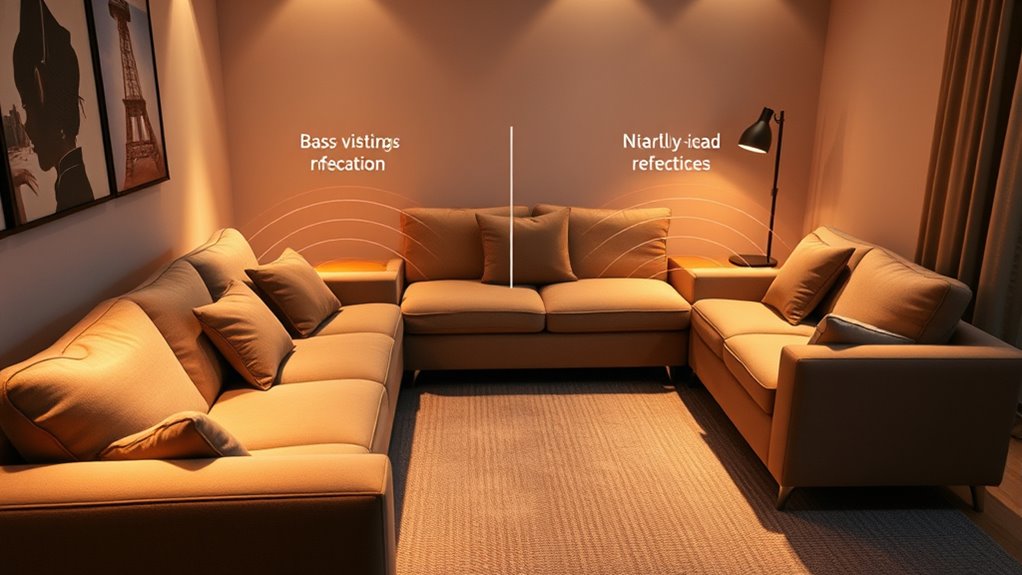
Room modes are specific frequencies at which a room naturally resonates, causing certain areas to amplify or diminish sound. When sound waves bounce between walls, they interfere with each other, creating areas of reinforcement and cancellation. These resonances happen at particular frequencies related to the room’s dimensions, such as length, width, and height. You might notice these modes as boomy bass or dead spots in your listening space. They form because sound waves reflect off surfaces, and at certain frequencies, these reflections align perfectly, strengthening or weakening the sound. Understanding how room modes develop helps you recognize why some seats sound different than others and why bass can seem uneven across a room. Recognizing these acoustic phenomena is key to addressing acoustic issues effectively. Additionally, room geometry plays a crucial role in how these modes manifest, influencing the overall sound quality.
subwoofer placement for even bass
As an affiliate, we earn on qualifying purchases.
As an affiliate, we earn on qualifying purchases.
The Science Behind Resonance in Enclosed Spaces
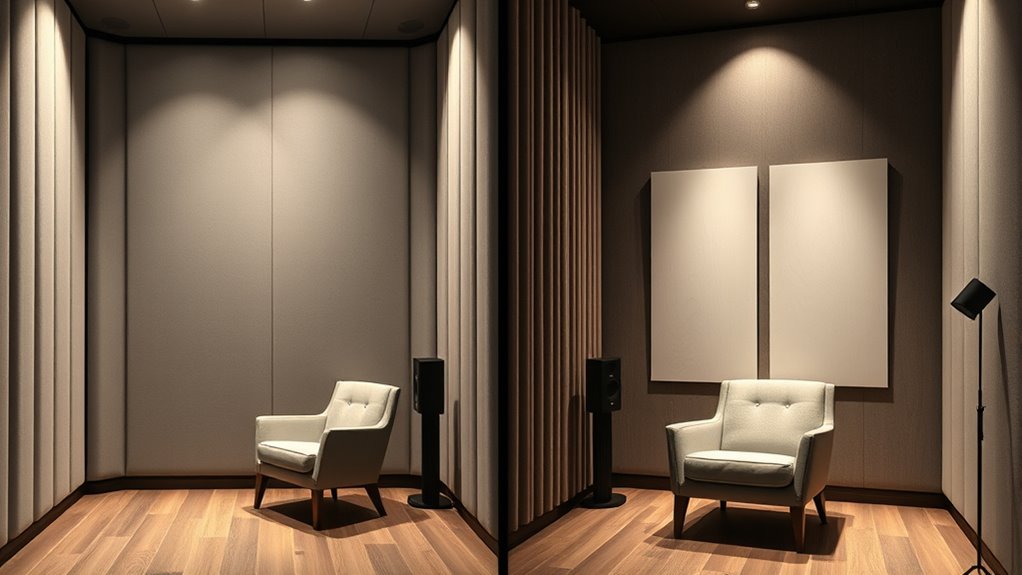
Resonance occurs when sound waves in an enclosed space match specific natural frequencies, causing them to build up and persist longer than they would otherwise. When this happens, certain sounds become amplified while others diminish, shaping your listening experience. Different areas in the room respond uniquely, depending on their position and shape. To visualize this, consider the following:
| Room Zone | Effect on Sound | Why It Matters |
|---|---|---|
| Corner | Amplifies bass | Can cause boomy spots |
| Center Seat | Least affected | Often sounds balanced |
| Walls | Reinforces certain frequencies | Leads to uneven sound |
Understanding resonance helps you identify why some seats sound perfect while others don’t, revealing how natural frequencies influence your audio environment. Additionally, the choice of body jewelry materials, such as titanium or surgical steel, can sometimes influence environmental factors like resonance in certain settings.
As an affiliate, we earn on qualifying purchases.
How Room Dimensions Influence Bass Behavior
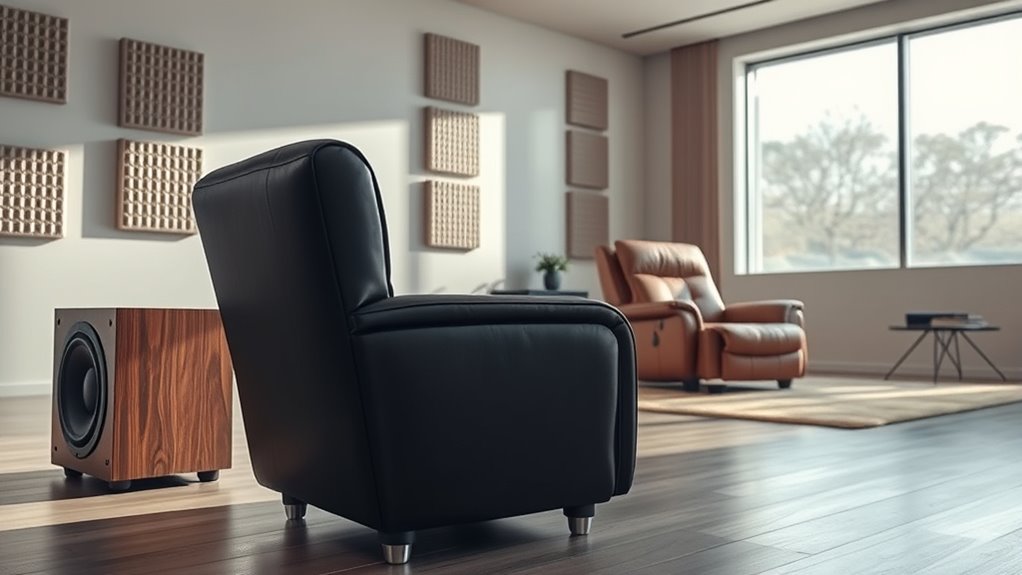
The dimensions of your space directly shape how bass frequencies behave, often determining whether they feel tight and controlled or muddy and overwhelming. Larger rooms tend to support lower, more diffuse bass, but can also create more room modes that cause peaks and nulls. Narrow or shallow rooms might emphasize certain bass frequencies, making them sound boomy or thin. The ratio between length, width, and height influences how sound waves reflect and interact, affecting where bass sounds powerful or muted. If your room’s dimensions align with specific wavelengths, you’ll notice resonances that boost or cancel frequencies. Understanding these relationships helps you anticipate how bass will behave in your space, guiding you to adjust dimensions or treatment to achieve a balanced, even bass response. Room acoustics play a critical role in shaping these effects and can be optimized through strategic placement and soundproofing techniques. Additionally, being aware of room modes allows you to predict and mitigate problematic bass resonances more effectively.
As an affiliate, we earn on qualifying purchases.
Identifying Hot Spots and Dead Zones in Your Room
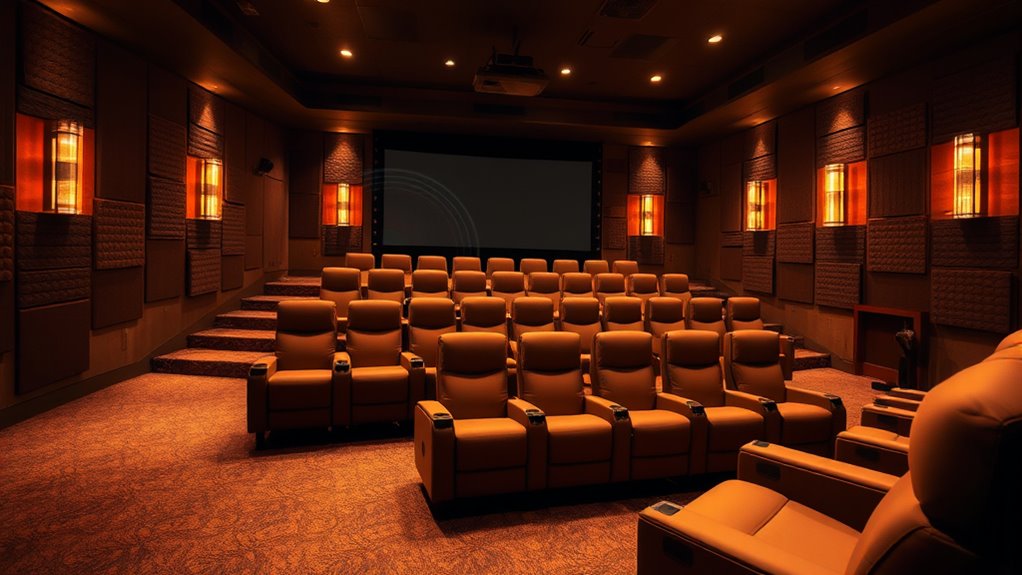
To effectively identify hot spots and dead zones in your room, you need to systematically analyze how sound behaves at different locations. Start by moving your listening position around the space and listening carefully. Use a consistent sound source to detect areas where bass sounds either amplify or fade. Pay attention to spots where you notice booming or dead sounds. To make this process easier, try these steps:
- Play a steady bass tone or music and walk around your room.
- Mark areas where bass feels overly intense or weak.
- Use a measurement app or microphone to visualize sound levels.
- Take note of patterns—are certain corners or spots consistently problematic?
- Understanding room acoustics and how they influence sound behavior is crucial for achieving balanced bass response. Recognizing how room modes affect sound distribution can help you identify specific problem areas.
The Impact of Furniture and Room Materials on Sound

Furniture and room materials play a crucial role in shaping how sound behaves in your space. Hard surfaces like glass, tile, or concrete reflect sound waves, which can amplify certain frequencies and cause unwanted echoes. Soft furnishings such as carpets, curtains, and upholstered furniture absorb sound, reducing reflections and smoothing out the acoustic environment. The density and placement of these materials influence how sound energy moves and dissipates, affecting clarity and bass response. For example, a room with minimal soft furnishings may produce harsh reflections and boomy bass, while a well-furnished room can diffuse sound evenly. By understanding how your furniture and materials interact with sound, you can better control room modes and create a more balanced listening experience.
Techniques to Minimize Undesirable Room Modes

Undesirable room modes can cause certain frequencies to resonate excessively, leading to boomy bass and uneven sound distribution. To minimize these issues, you can try several techniques.
- Rearrange your furniture: Move speakers and seating to different spots, avoiding corners and walls where modes amplify.
- Use bass traps: Place bass traps in corners to absorb low-frequency energy and reduce resonance.
- Add diffusers: Install diffusers on walls to scatter sound waves, preventing buildup in specific areas.
- Adjust speaker placement: Slightly reposition your speakers to find spots with fewer problematic modes.
- Incorporate room acoustics treatments: Using specialized materials and designs can further help manage low-frequency resonances and improve overall sound quality.
Implementing these steps helps smooth out bass response and creates a more balanced listening environment.
Using Acoustic Treatments to Improve Bass Response

Have you ever noticed your bass sounds muddy or uneven even after adjusting speaker placement? Acoustic treatments can help smooth out these issues by absorbing or diffusing problematic frequencies. Bass traps placed in corners and along walls target low-frequency energy, reducing resonances that cause boominess and dead spots. Diffusers scattered across walls break up standing waves, preventing bass from accumulating in specific areas. Using broadband absorption panels at strategic points can also help balance the overall sound. Keep in mind, treatments won’t eliminate all Room modes, but will make the bass more consistent and controlled. Understanding how standing waves develop can guide you in strategically placing treatments to maximize their effectiveness. Recognizing how room dimensions influence modal behavior can help you target specific problem areas for better sound. Additionally, knowing about resonant frequencies can assist in designing a more balanced listening environment. Properly applied acoustic treatments improve clarity, ensuring your listening experience is more accurate and enjoyable, regardless of where you’re seated in the room. Considering the acoustic properties of your space can further optimize your sound setup for the best results.
Subwoofer Placement Strategies to Reduce Mode Effects
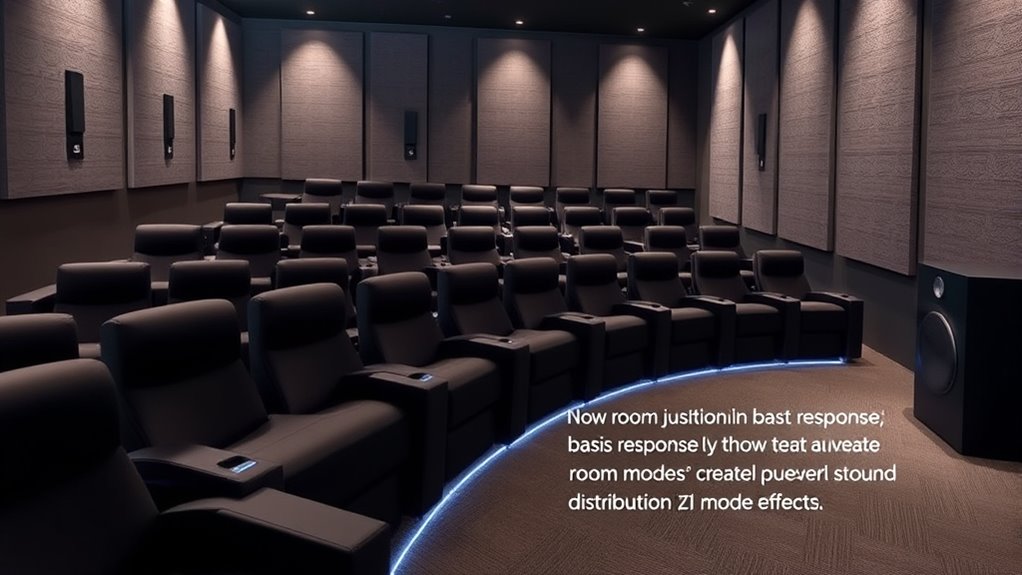
To reduce room modes, you should focus on ideal subwoofer positioning, such as placing it away from walls and corners. Room boundary tuning involves adjusting the subwoofer’s distance from walls to minimize bass peaks. Experimenting with placement helps create a smoother bass response and fewer resonant issues. Incorporating smart technology into your setup can also help monitor and optimize bass performance for consistent sound quality. Additionally, using room calibration tools can assist in fine-tuning your system for optimal sound distribution. Understanding room acoustics can further improve the overall listening experience by addressing reflections and standing waves. Being aware of resonant frequencies and how they interact with your space allows for more targeted adjustments that enhance overall sound clarity.
Optimal Subwoofer Positioning
Finding the right spot for your subwoofer can substantially reduce room mode effects and improve overall sound quality. To achieve this, try these placement tips:
- Avoid corners—placing your subwoofer too close can exaggerate bass boominess.
- Experiment with distance from walls—a few inches away helps prevent reinforcement of certain modes.
- Use the “subwoofer crawl”—place the sub at your listening position, then move around until you find where bass sounds best, and place it there.
- Maintain consistent placement—once you find a spot that minimizes mode effects, keep it steady for reliable performance.
- Consider room acoustics—adding soft furnishings or acoustic treatments can further mitigate problematic room modes and enhance sound quality.
- Incorporating subwoofer placement strategies can maximize bass response and reduce frequencies that cause mode issues.
- Utilize acoustic measurements—using tools like room analyzers or frequency response graphs can help identify and address specific wave and wind patterns affecting your space.
Room Boundary Tuning
Adjusting your subwoofer near room boundaries can considerably influence bass response by reducing problematic room modes. Placing the subwoofer against walls or corners increases boundary reinforcement, boosting bass levels and smoothing out uneven frequencies. This technique helps minimize nulls—areas where bass dips—and enhances overall bass clarity. To tune effectively, experiment with different boundary positions, moving the sub closer or farther from walls and corners. Use pink noise or bass-heavy music to listen for improvements in bass consistency across the listening area. While boundary placement can improve bass response, be cautious of overemphasizing certain frequencies, which might cause boomy or muddy sound. Combining boundary tuning with other placement strategies ensures a more balanced, accurate bass experience. Additionally, understanding the role of room boundary effects can help you optimize your subwoofer placement for the best sound quality. Recognizing how room acoustics influence sound behavior can further refine your positioning choices for optimal results, especially when considering speaker placement and its impact on sound imaging. Furthermore, employing measurement tools can provide precise feedback to fine-tune your setup for optimal bass response. Incorporating acoustic treatments like bass traps and diffusers can also help control unwanted resonances and improve overall sound quality.
Tools and Methods for Measuring Room Modes

To identify room modes accurately, you can use Room EQ devices that analyze your space’s frequency response. These tools help you visualize problem areas and measure how sound interacts within your room. By examining acoustic measurements, you gain insights to optimize your setup and reduce unwanted resonances. Incorporating Free Floating techniques can further improve sound quality by minimizing vibrations and structural interferences.
Using Room EQ Devices
Using room EQ devices is an effective way to identify and analyze room modes, ensuring your space sounds its best. These tools help you pinpoint problem areas and measure how bass frequencies behave in your room. To get the most out of them, consider these key steps:
- Connect a measurement microphone to your device, placing it at your listening position.
- Use the software to generate test tones or sweeps across your room’s frequency range.
- Record the room’s response to identify peaks and nulls caused by modes.
- Analyze the data to find areas with excessive boom or dead spots, guiding your treatment decisions.
Analyzing Acoustic Measurements
Analyzing acoustic measurements is a essential step in identifying and understanding room modes. You’ll need tools like a measurement microphone, which captures sound responses accurately, and software such as REW (Room EQ Wizard) or ARTA to visualize the data. Place the microphone at different listening positions, especially where bass issues occur, to gather frequency response measurements. Look for peaks and nulls in the data, indicating room modes. By analyzing the frequency spectrum and decay times, you can pinpoint problematic modes. This process helps you determine whether certain areas suffer from excessive bass buildup or cancellation. Accurate measurements give you a clear picture of how your room behaves acoustically, guiding you in implementing effective treatment or repositioning strategies.
Practical Tips for Achieving Consistent Bass Throughout Your Space
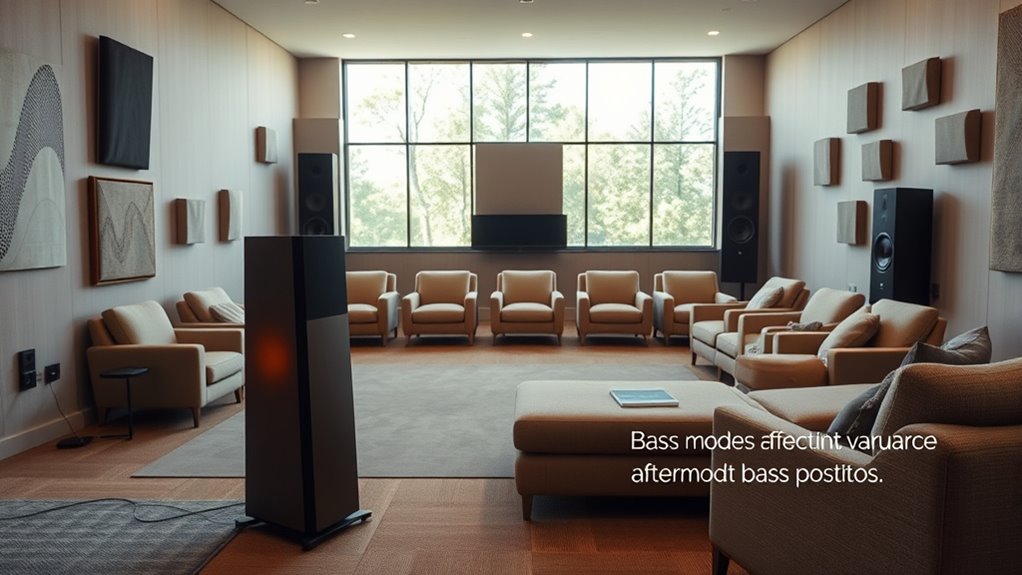
Achieving consistent bass throughout your space can be challenging, but there are practical steps you can take to improve it. First, consider placing your subwoofer centrally to distribute bass more evenly. Second, add bass traps or foam panels in corners to absorb problematic frequencies. Third, use adjustable equalizers to fine-tune bass response in different areas. Fourth, experiment with positioning by moving your subwoofer and listening spots until you find a balanced sound. These adjustments help minimize room modes that cause uneven bass. Remember, small changes can make a big difference. Regularly test your setup with a bass-rich track to identify hotspots. With patience and these tips, you’ll enjoy smooth, consistent bass throughout your entire space.
Frequently Asked Questions
How Can I Tell if a Room Mode Is Causing Sound Issues?
You can tell if a room mode causes sound issues by listening for uneven bass, where some seats feel boomy and others lack bass. Use a microphone and room measurement software to analyze frequency response across different spots. If certain areas show exaggerated or muted bass at specific frequencies, it indicates room modes. Adjusting furniture, adding diffusers, or repositioning speakers can help mitigate these problems.
Do All Rooms Have Problematic Modes, or Only Specific Dimensions?
Most rooms, especially those with specific dimensions, harbor problematic modes. Narrow, rectangular spaces often create more bass booms and dead spots, while irregularly shaped rooms tend to scatter sound, reducing issues. You’ll notice that certain dimensions—like length, width, or height—amplify troublesome modes. So, yes, many rooms have problematic modes, but their severity depends on the room’s size and shape, making some spaces more prone to acoustic anomalies.
Can Furniture Arrangement Entirely Eliminate Problematic Room Modes?
Furniture arrangement alone can’t entirely eliminate problematic room modes, but it can substantially reduce their impact. You should experiment with placement, like moving furniture away from corners and adjusting listening positions to minimize bass interactions. Combining strategic furniture placement with acoustic treatments, such as bass traps and diffusers, offers the best chance to tame problematic modes. Remember, a mix of methods works best for achieving balanced sound in your room.
Are There Digital Tools or Software to Simulate Room Mode Effects Before Setup?
Did you know over 80% of audio professionals use digital tools to simulate room acoustics? Yes, there are software options like Room EQ Wizard, EASE, and ARTA that let you model room modes before setup. These tools help you visualize how bass frequencies will behave, allowing you to optimize placement or treatment in advance. Using them saves time and improves your overall sound quality without physically altering your space first.
How Long Does It Typically Take to Acoustically Treat a Room for Better Bass Response?
It usually takes anywhere from a few days to a couple of weeks to acoustically treat a room for better bass response. You’ll want to plan for proper measurements, selecting the right bass traps, diffusers, and absorbers, then installing them carefully. The process involves testing and adjusting treatments to achieve an even bass response across your listening positions. Patience and precise placement make all the difference in getting ideal results.
Conclusion
Understanding room modes is like tuning a guitar—you need to find the right spots to get a smooth, balanced sound. By identifying hot spots and using the right treatments, you can tame bass inconsistencies and enjoy consistent, deep sound throughout your space. Don’t let uneven bass feel like a mystery—think of it as mastering an instrument, where small adjustments make all the difference for a perfect listening experience.
Fall Picks
fall essentials
As an affiliate, we earn on qualifying purchases.